8.17.2005

transport kudos


UPDATE 8.19.05: Sydney sent me a link to an article this story in philstar (link might be broken - I think Philstar doesn't archive). Looks like the Senate is also stepping into the fray (or the publicity) -let's hope it's not ningas cogon.
The soundbyte from Sen. Flavier:

"In a third world country like the Philippines with an acute transportation shortage and an ever-worsening air pollution problem, foot-powered bicycles may yet become one of the most efficient, inexpensive and practical means of public transport," Flavier said in the explanatory note of his bill. "


The confluence of higher gas prices, traffic and pollution is at last bringing authorities around to the logic of bike lanes in the city. (Thanks also to the work of the Firefly Brigade.)

Apart from bike lanes, the MMDA is also working on expanding sidewalks and pedestrian routes. About time -as the cars have been lording over planning choices in Metro Manila over the last 30 years.

Maybe this will lead them to Traffic Calming and Road Diets.

Image credit: Christian Science Monitor

8.16.2005

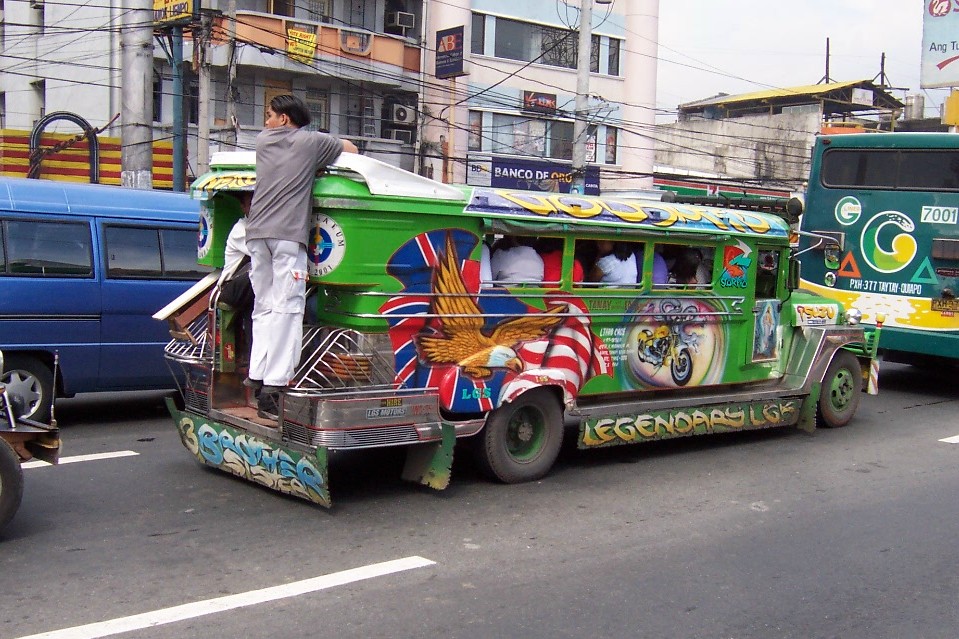
...disorganized transport (ii)


Problems with free market transportation strategies:

From a pure economic efficiency standpoint, a laissez-faire regime in transportation delivers the services directly to the needs -so it is very responsive.

But the logic of market also creates problems. Maximizing resources means stuffing as many people as you can into the vehicle ("Konting ipit lang po, pituhan yan!"), and using the vehicles for as long as they can run on the road.

So you get overstuffed vehicles; "aircon" buses that have no airconditioning to speak of; buses, jeeps and taxis on the road that are probably held together by electrical tape. ( This was made worse in the late 80's when, in response to a transport crisis, DOTC (then under Oscar Orbos) liberalized the imporation of second-hand buses.)

The market also quickly retreats when it isn't cost effective to be running services -i.e., everytime there is a massive traffic jam or downpour, the buses and jeeps disappear because being stuck in traffic eats into their earnings -leaving commuters stranded and exacerbating the situation.

There are no safeguards for the welfare of the passengers and the regulatory regime only has control over fares and emissions. So you get the nearly annual transport strike as they agitate for higher fares. (One can only dream that there would somehow be a "pasahero strike" so passengers can get a better deal.)

Programs such as the Organized Bus Route, the AUV Express (which the FX drivers can't seem to get organized enough to protest), the CNG/NGVPPT, and the Greater Manila Mass Transport System are attempts by the government to impose order after the market has organized itself.

(It's noteworthy that the government feels they are doing the FX drivers a favor by legalizing them under the "AUV Express" regime and that the FX operators are protesting the requirement that they only stop at designated points on the route and set-up terminals complete with restrooms and waiting areas -regulations after the fact.)

What the national government/MMDA and the city governments are looking for is the right incentives vs. regulations approach that will control the free market without stiffling the entrepreneurship or the profit motive.

What the national government/MMDA and the city governments haven't grasped is that public transportation systems are city shapers, and transport nodes (even ones that aren't light rail stations) can be used to the city's advantage -i.e. -by encouraging Transit Oriented Development (TOD) at the nodes.

Imagine if they built affordable high density housing around and on top of FX terminals? All the makati white-collar workers would buy/rent the units. If the cities owned/developed the terminals, they could also impose no-engine-idling rules to further reduce emissions.

More about non-rail TODs and the "boundary system" as a city-shaper in succeeding posts.

image credit: Sherry and Larry's 'Round the World website

...disorganized transport (i)


Picking up the thought from my last post: Part of Metro Manila's weakness (and effectively the National Government's failure -as it manages the National Capital Region) is that it has taken an almost pure free market approach to meeting the transportation needs of the city. We have over 15 bus operators serving the EDSA Route, thousands of FX operators, thousands more jeepney operators, thousands more of tricycles and pedicabs -all of which are privately owned. From a regulatory standpoint, it doesn't take much to be a transport operator - you just need your own vehicle (maybe two) and a few forms from the DOTC and a couple more from the LTO and you're set.

Having a free market approach has probably done wonders for the informal economy -and has moved many jeepney entrepreneurs into the middle class. (The boundary system though has created its own problems -but i'll tackle that in another post.) It also has its advantages:


  1. It saves the government money
  2. It efficiently allocates resources to routes


On saving money: Many cities are in serious debt from maintaining municipal transport companies. As with any other endeavor the government enters into - government owned transport services, if badly managed (which is likely given that it is protected from market forces) , quickly become money pits. Government ownership means pricing strategy will be and route choice will be driven by electoral expediencies leading to even more inefficiencies and higher costs.

Private led transport industries are driven by the logic of profit and competition, so overhead costs are kept to a minimum and personnel are hired or fired based on performance and are not shielded by civil service laws.

On allocating routes: Privately owned transport companies also choose the most profitable routes and can quickly adapt to changes in demand by reallocating resources. So the needs of the routes with the most demand (i.e. -lots of passengers) are met first.

The classic example would be the rise of the FX Taxi (which the government prefers to call "AUV Express") -which responded to the lack of bus lines and the long waits at the bus stations (which exacerbated the commute times). FX taxis stepped in effectively as commercialized car pools.

... to be continued in my next post: problems with free market public transport strategies.

image credit: Aidan O'Rourke

8.15.2005

organized bus routes...


Though I'm not too keen on Bayani's Fernando's design ethic (what with pink overpasses and pink fences) but his efforts to put together the organized bus route system is commendable. I know they are packaging it as a traffic solution (which gives lie to where the squeaky wheel is in urban planning decisions -pun intended) but it really is a step towards creating Bus Rapid Transit (BRT) system for Metro Manila.

BRT systems, also known as the "poor man's light rail," have been succesfully deployed in a number of Latin American cities. (Most notably: Curitiba, Brazil; in Bogota, Columbia; and lately, Mexico City, Mexico. BRT provides a cheaper way of organizing transport systems, and with political will, can do wonders for relieving urban gridlock while saving cities money.

It is generally not high on the list of systems recommended by multi-lateral funding agencies, or official aid programs as they can be implemented without expensive foreign engineering consultants or and don't require the recipient city to buy expensive technology from the sponsor country.

BRTs, if deployed correctly, offer a host of benefits apart from better public transport. Some notes from Bogota's Transmillenio:

The air is not pure in Bogota, either. The inefficiency of the public transport system in the Colombian capital is one more problem affecting the quality of life of the population, in addition to the violence associated with the illegal drug trade, the civil war and crime in general.

The mayor's office launched the "Transmilenio" plan in late 2000, aimed at improving transportation services and air quality in Bogota, the third most contaminated city in Latin America.

In two years, Transmilenio has increased the average speed of city buses from 10 kph to 25 kph, slashed the number of fatal traffic accidents and saved 10 million dollars a year in costs related to air pollution by reducing the incidence of respiratory illnesses.

Until the plan took effect, 22,000 outdated buses were used by more than 70 percent of Bogota's seven million residents, while just 19 percent traveled in 850,000 individual cars.

The Bogota bus fleet was too large (more than 3.5 buses for every 1,000 inhabitants), with a life of 14 years per unit and an average speed of 10 kph.

"Passengers spent an average of more than two hours a day in transit," said Transmilenio's chief of planning and administration, Angelica Castro.

The new system includes designated lanes for buses, four-lane roads with stops every 500 m along the meridian, leaving the exterior lanes for non-stop buses.

According to the plan, by 2016 the city will have 388 km of bus lanes, 300 km of bicycle routes and a new bus fleet equipped with catalytic converters to curb pollutants. They public buses will also be designed taking into account the needs of children, the elderly and the disabled.

The program seeks to dissuade the use of individual cars. In the works are a 100-percent hike in parking prices for downtown Bogota, and a 20 percent tax on gasoline. Half of those revenues will go toward financing infrastructure intended to fight air pollution.

-Interpress Service


BF's OBR, combined with a clear commitment fo converting to CNG buses would do wonders for Metro Manila. (Of course, they could do more with the aesthetics.)

The root of our transport problems though lies in how we have tended to view roads as investments, but public transport as a marketplace. -- more in next post.

8.10.2005

cities moving forward


Time out for some good news. Eight cities shine amidst gloom.

"There is still hope for our country. While the national government is concerned with the impeachment, the cities are moving forward. The cities have bonded to ensure that basic services are delivered," said Iloilo Mayor Jerry Treñas.

The goals of the eight cities are as follows:

  • San Fernando: The Botanical Garden City by 2010
  • Tagbilaran: A Prime Eco-Tourism Hub by 2015
  • Calbayog: One City, One People, One Culture by 2015
  • Iloilo: Premier City by 2015
  • Naga City: Model City for Participatory Government by 2015
  • Samal: Island Garden City by 2015
  • Cebu: Most Livable City in Asia by 2015
  • Marikina: A World-class City by 2015

Of these goals, my favorites are Cebu's (livability) and Naga's (participatory government). If the lack of vision at the national level is getting you down, visit these cities and be inspired by what they are trying to do.

(More about the program from CIPE-ISA.)

image credit: Jim Guiao Punzalan for INQ7

8.08.2005

the (spatial) roots of our discontent

I've often wondered about the roots of the political disconnection among the Philippine middle-class. I know the middle-class was the key swing sector in EDSA I and II, but apart from the involvement in severe convulsions of our body-politic, the middle-class seems to be content to play the role of critical bystander. It does not, raise new political leaders. (Admittedly, I have no data to support that claim.)

Why are electoral contests left to popular/populist media icons and scions of political families. Where are the children who grew up in middle-class homes with middle-class educational pedigrees?

I know the roots are many and obviously overdetermined, but may I offer up one contributing cause?

The political disconnect is mirrored in the spatial disconnect of the enviroment that the middle-class grows up in. Most live in middle-class gated villages. They go to exclusive schools that are usually an hour's drive or more away from where they live. (Paranaque kids who go to Ateneo or Poveda, QC kids who go to La Salle, etc.)

Few of them take public transport to their schools - most ride in cars. --Could it be this insularity (which finds it's roots way back in the segregation of all-spanish Intramuros from the servants' quarter of Binondo and the other arrabales) which keeps the rich and the middle class from involvement in society?

Sure, most private schools have immersion programs in urban poor communities and I do not discount the help they have extended -but as immersion programs, they teach young middle-class students that urban issues are "projects of philantrophy."

You ride a car, you do not hear the noise or smell the garbage - they are problems you pass by on your way to your destination. You study away from where you live and you have no part in community life (apart from your friends from school). You have no idea how your barangay works or where the barangay hall is. You do not even know what the communities outside your village walls look like.

Apart from traffic and pollution, which then become what the middle-class complains about (re: life in the city), you grow up without appreciating the lack of housing, the deterioration of civic monuments, the lack of public open spaces, the absence of sidewalks...

So here's the question: does the spatial organization of our cities weaken our sense of citizenship?

8.04.2005

civic pride?


Philippine Senate

Self-referrent post #2:
How the heck can that thing inspire civic pride?

tayo na sa...


My last post got me wondering (sorry for the self-referrent post) about who has actually visited our legislative buildings.

So if you have a few seconds, can you take this quick poll.

8.03.2005

and while we're at it...


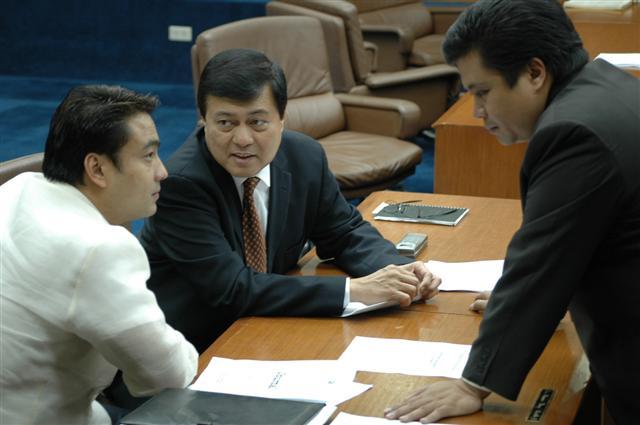
While we consider constitutional changes to the form of our legislature (and I won't argue the rightness or wrongness of cha-cha and con-ass), may I suggest some critical design and spatial changes, too?


  1. Change the chairs used by senators and congressmen
  2. Change the tables
  3. Change the location of the legislature


Those chairs are large, comfortable and they recline and swivel. Check out the Bundestag, chairs are close together and they can't swivel all the way around. The Canadian Parliament like UK's House of Commons don't even have chairs or tables. The legislators sit on benches.

Why should legislators have chairs that are NOT comfortable and don't recline or swivel? Or have large tables?

It's easier to fall asleep in a comfortable reclining chair -hence those classic shots of privilege speeches with senators sleeping in the background. A swivelling chair makes it easy to turn around and have an on the floor caucus. -- Both indulgences allow a legislator to not listen to the business at hand. It may seem trivial but that means the real "business" of the senate and congress goes on outside the legislative floor -where points are clarified and deals are made. The floor is all just for show.

Large tables makes it easy to bring papers to work on or read while at the session floor distracting from what should be a debate about the items on the agenda. Again, this means the deals are done off the floor.

The Congress and the Philippine Senate are in hard to access areas -away from the business and commercial centers and away from main roads. This reduces the chances of ordinary citizens coming in to watch the proceedings and take part in the process. Apart from during major events like the SONA, the only people who will go out of their way to go to the Senate or Congress are people with vested interests -i.e. lobbyists.

If I had my druthers, I'd ask Ayala Land to donate part of Fort Bonifacio (in a very accessible area) for a new legislative building -that can be designed via a competition -and with citizen input.

8.02.2005

deep and wide


There is no limit to what you can accomplish, as long as you are prepared to wait." Freeman Dyson

Maynila is at least 500 years old. By the time the Spanish got there in 1570, Maynila was already a thriving city with a population of 4,000.

As Stewart Brand puts it, "cities persist." Barring major natural cataclysms, Manila will still be here 450 years from now. The government's form, the shape of geopolitics, will be as similar and as different as Rajah Sulayman's court is from the current administration in Malacanang. The city's built fabric in 2450 will be shaped by the decisions we make now.

While it is easy to become frustrated by the current politics, long term vision and long term leadership means we must consider the future now. Ergo the title of this blog. In another hundred years, Arroyo, de Venecia, Cam, Estrada and the whole cast of characters will all be footnotes. Metro Manila will persist. In what form and in what condition depends on our current imagination of the horizon we have yet to see.
image credit: Maria Madonna Davidoff, cover art for "The West and the World"

Quick Links

Notable posts on the metro