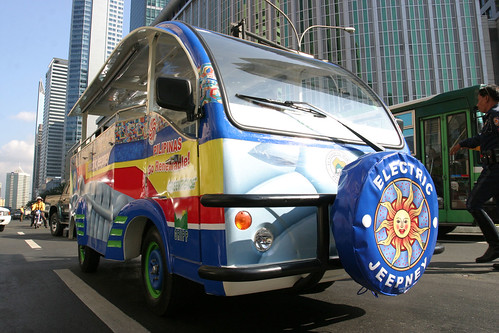
 So you've probably read about the electric jeepneys doing test runs in Makati. (See the blog posts by Ajay and and thread at Digital Pinoy.)
The project, spearheaded by Greenpeace and Solar Electric Co. (Solarco), actually previously debuted in Bacolod.
Market price for the e-jeepney is pegged at P550,000. It carries a five-horsepower engine running off 12 rechargable batteries and is capable of carrying up to 17 passengers at a max speed of 40kph.
Here's the big (and as far I can see, only benefit):
(President of Solarco Panch) Puckett said a daily electric charge of an e-jeepney battery would cost around P150, compared to the P800 to P1,000 fuel expense of a passenger jeepney running on gasoline or diesel.
So if adopted, it could redound to significant savings and better earnings for the jeepney driver (unless the operator decides to raise the
boundary correspondingly).
But I hold a healthy skepticism for promises on which they built the spin of the press releases i.e. cleaner air for our cities.
Don't get me wrong, e-jeepneys will cut GHG emissions but
we only have to do the math to see where the real problem lies: Private cars outnumber PUVs 9 to 1 in the Metro and the numbers are growing rapidly. Between 2003 and 2005, 67,186 PUVs were added to our roads while the total number of private vehicles rose by 10 times that number to 690,153.
Even if you assume that PUVs generate 3x the pollution of an ordinary car, 75% of the existing air pollution would still generated by private cars. Even if you can reduce all the GHG emissions of PUVs to zero, private cars would still be generating pollution at three-fourths of our current levels.
This is another one of my
sirang plaka (broken record) themes -that we need to make public transport more efficient and more attractive than private car use if we are to make a serious dent on our air pollution.
That we need to think of
moving people vs. moving vehicles and prioritize improving public transport over relieving traffic congestion (besides, expanding roads or making our roads faster
will not solve our traffic problems).
We don't have to reinvent the wheel, Mexico City, Curitiba, Bogota and even Jakarta are making strides in efficient public transportation.
P.S. -There are a few other things that e-jeepneys will have to overcome before they can make an impact (these aren't insurmountable, but they require more work than big splash press events):- (As I already said above) How will the boundary system affect the take-up of e-jeepneys among drivers or even operators?
- What about the support infrastructure? (-i.e. the availability of repair shops and mechanics)
- What about the replacement (and disposal) of the batteries? (Which are also serious pollutants.)
P.P.S. - Some of Ajay's commentors were complaining about how "anachronistic" the jeepney is. (Skye says the fact that they are still around "has got to be the most depressing piece of news" to ever hit her.)I beg to disagree. Jeepneys CAN'T be anachronistic because people still use them. The market for jeepneys (riders) is apparently still big enough to support drivers and operators alike. Why are there still riders? Because our public transportation is chaotic. Because we build roads instead of streets.