Showing posts with label series: disorganized transport. Show all posts

8.19.2005

konting ipit lang po*
(...disorganized transport iii)


The Boundary System as a city shaper.

Cities are self-organizing systems. With the exception of planned cities like Brasilia or Chandigarh, very few cities arise ex-nihilo.

Cities respond to the needs of the individuals that comprise it and one of the key needs is mobility -to get from one point to another.

Cities are shaped by the current mode of transportation available when they grew up. So older european cities have narrow winding streets, suitable for carts and donkeys or walking. London grew up around the tube, and New York around the subway system. L.A., like Metro Manila, grew up around the automobile -so roads (at least in the newer parts of the metropolis) are wide and traffic fast.

The mode of transportation shapes the city and the demands of the city also shapes the transportation -particularly public transportation.

In our own city, public transport, as I previously discussed has been given over to the free market. The rewards/remuneration system of this particular urban sub-system, has shaped our city in ways that may have been invisible to us all these years.

The Boundary System is basically a vehicle rent system. The driver is "hired" by the transport operator, to run and maintain his jeep, bus, or FX cab. The driver can run as many trips within the boundary period (standard is 12 hours) as he wants but he basically has to pay the "boundary fee" (usually, daily) to the owner -and his source of income is whatever he makes over and above the boundary fee. The driver covers the cost of gasoline and minor repairs.

This remuneration/rent system has shaped metro-manila in subtle and not so subtle ways.

The boundary system brings a logic to earning money that shapes the driving habits of the renting drivers. If the driver only earns above the boundary, then logic dictates that he must get as many passengers as he can in as many trips as possible . The driver also benefits by having the vehicle on the road as many days as possible - as repairs and shutdowns mean no income for the day.

So, a driver will:

  1. soak up passengers by basically waiting as long as he can in a high traffic/passenger volume area and then
  2. speed up to the next high volume pickup point to soak in more passengers.
  3. he will also see other public utility vehicles plying the route as competition so waiting in a line does not make much sense,
  4. he will try to get ahead of the line (usually by doubling up on the pickup lane) so he can be closer to the "source" of passengers and so
  5. he won't be tied down on the line and can speed up to the next destination.
  6. It also means that shorter trips are preferred to longer trips and
  7. vehicle downtime and thus vehicle maintenance is kept to a minimum (=inefficient engines, =more pollution).

This system is behind the traffic chokepoints at the major junctions and intersections. The underpass in cubao, the flyovers in ortigas, the overpasses in santolan, even the grade separations in EDSA in Makati were driven by the logic of separating the buses, who spent an inordinate amount of time at the intersections waiting for passengers, from the rest of the road traffic.

The government has also probably thrown millions of pesos in soft costs at trying to manage the behavior of the public utility vehicles by throwing hundreds of traffic enforcers and by coming up with several management programs (from Oscar Orbos' bus numbering system, to Bayani Fernando's Organized Bus Routes).

The flyovers/overpasses/underpasses have made EDSA completely un-friendly to pedestrians, and the accumulation of vehicles in the intersections have concentrated exhaust/pollution in the areas around these passenger pickup junctions so these have become some of the worst parts of the city. (Ordinarily, the high pedestrian traffic junctions would be the most suitable places for commerce and retail.)

A serious re-thinking of the boundary system (legislating a wage based system seems the easy way out -but that will create it's own problems) would go a long way not only in solving intractable traffic problems but also in re-shaping the fabric of the city.

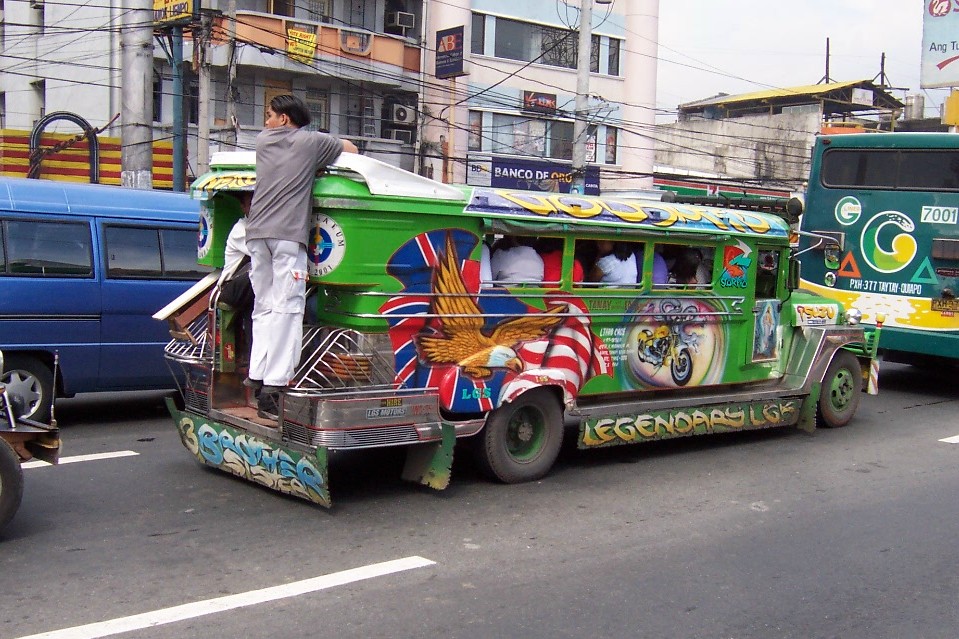
*-Part of "Konting ipit lang po, pituhan yan."

Roughly translated, "Please squeeze your thighs a bit more, this jeepney fits seven to a side."

Image credit:Manfred's Travel Pictures

8.16.2005

...disorganized transport (ii)


Problems with free market transportation strategies:

From a pure economic efficiency standpoint, a laissez-faire regime in transportation delivers the services directly to the needs -so it is very responsive.

But the logic of market also creates problems. Maximizing resources means stuffing as many people as you can into the vehicle ("Konting ipit lang po, pituhan yan!"), and using the vehicles for as long as they can run on the road.

So you get overstuffed vehicles; "aircon" buses that have no airconditioning to speak of; buses, jeeps and taxis on the road that are probably held together by electrical tape. ( This was made worse in the late 80's when, in response to a transport crisis, DOTC (then under Oscar Orbos) liberalized the imporation of second-hand buses.)

The market also quickly retreats when it isn't cost effective to be running services -i.e., everytime there is a massive traffic jam or downpour, the buses and jeeps disappear because being stuck in traffic eats into their earnings -leaving commuters stranded and exacerbating the situation.

There are no safeguards for the welfare of the passengers and the regulatory regime only has control over fares and emissions. So you get the nearly annual transport strike as they agitate for higher fares. (One can only dream that there would somehow be a "pasahero strike" so passengers can get a better deal.)

Programs such as the Organized Bus Route, the AUV Express (which the FX drivers can't seem to get organized enough to protest), the CNG/NGVPPT, and the Greater Manila Mass Transport System are attempts by the government to impose order after the market has organized itself.

(It's noteworthy that the government feels they are doing the FX drivers a favor by legalizing them under the "AUV Express" regime and that the FX operators are protesting the requirement that they only stop at designated points on the route and set-up terminals complete with restrooms and waiting areas -regulations after the fact.)

What the national government/MMDA and the city governments are looking for is the right incentives vs. regulations approach that will control the free market without stiffling the entrepreneurship or the profit motive.

What the national government/MMDA and the city governments haven't grasped is that public transportation systems are city shapers, and transport nodes (even ones that aren't light rail stations) can be used to the city's advantage -i.e. -by encouraging Transit Oriented Development (TOD) at the nodes.

Imagine if they built affordable high density housing around and on top of FX terminals? All the makati white-collar workers would buy/rent the units. If the cities owned/developed the terminals, they could also impose no-engine-idling rules to further reduce emissions.

More about non-rail TODs and the "boundary system" as a city-shaper in succeeding posts.

image credit: Sherry and Larry's 'Round the World website

...disorganized transport (i)


Picking up the thought from my last post: Part of Metro Manila's weakness (and effectively the National Government's failure -as it manages the National Capital Region) is that it has taken an almost pure free market approach to meeting the transportation needs of the city. We have over 15 bus operators serving the EDSA Route, thousands of FX operators, thousands more jeepney operators, thousands more of tricycles and pedicabs -all of which are privately owned. From a regulatory standpoint, it doesn't take much to be a transport operator - you just need your own vehicle (maybe two) and a few forms from the DOTC and a couple more from the LTO and you're set.

Having a free market approach has probably done wonders for the informal economy -and has moved many jeepney entrepreneurs into the middle class. (The boundary system though has created its own problems -but i'll tackle that in another post.) It also has its advantages:


  1. It saves the government money
  2. It efficiently allocates resources to routes


On saving money: Many cities are in serious debt from maintaining municipal transport companies. As with any other endeavor the government enters into - government owned transport services, if badly managed (which is likely given that it is protected from market forces) , quickly become money pits. Government ownership means pricing strategy will be and route choice will be driven by electoral expediencies leading to even more inefficiencies and higher costs.

Private led transport industries are driven by the logic of profit and competition, so overhead costs are kept to a minimum and personnel are hired or fired based on performance and are not shielded by civil service laws.

On allocating routes: Privately owned transport companies also choose the most profitable routes and can quickly adapt to changes in demand by reallocating resources. So the needs of the routes with the most demand (i.e. -lots of passengers) are met first.

The classic example would be the rise of the FX Taxi (which the government prefers to call "AUV Express") -which responded to the lack of bus lines and the long waits at the bus stations (which exacerbated the commute times). FX taxis stepped in effectively as commercialized car pools.

... to be continued in my next post: problems with free market public transport strategies.

image credit: Aidan O'Rourke

8.15.2005

organized bus routes...


Though I'm not too keen on Bayani's Fernando's design ethic (what with pink overpasses and pink fences) but his efforts to put together the organized bus route system is commendable. I know they are packaging it as a traffic solution (which gives lie to where the squeaky wheel is in urban planning decisions -pun intended) but it really is a step towards creating Bus Rapid Transit (BRT) system for Metro Manila.

BRT systems, also known as the "poor man's light rail," have been succesfully deployed in a number of Latin American cities. (Most notably: Curitiba, Brazil; in Bogota, Columbia; and lately, Mexico City, Mexico. BRT provides a cheaper way of organizing transport systems, and with political will, can do wonders for relieving urban gridlock while saving cities money.

It is generally not high on the list of systems recommended by multi-lateral funding agencies, or official aid programs as they can be implemented without expensive foreign engineering consultants or and don't require the recipient city to buy expensive technology from the sponsor country.

BRTs, if deployed correctly, offer a host of benefits apart from better public transport. Some notes from Bogota's Transmillenio:

The air is not pure in Bogota, either. The inefficiency of the public transport system in the Colombian capital is one more problem affecting the quality of life of the population, in addition to the violence associated with the illegal drug trade, the civil war and crime in general.

The mayor's office launched the "Transmilenio" plan in late 2000, aimed at improving transportation services and air quality in Bogota, the third most contaminated city in Latin America.

In two years, Transmilenio has increased the average speed of city buses from 10 kph to 25 kph, slashed the number of fatal traffic accidents and saved 10 million dollars a year in costs related to air pollution by reducing the incidence of respiratory illnesses.

Until the plan took effect, 22,000 outdated buses were used by more than 70 percent of Bogota's seven million residents, while just 19 percent traveled in 850,000 individual cars.

The Bogota bus fleet was too large (more than 3.5 buses for every 1,000 inhabitants), with a life of 14 years per unit and an average speed of 10 kph.

"Passengers spent an average of more than two hours a day in transit," said Transmilenio's chief of planning and administration, Angelica Castro.

The new system includes designated lanes for buses, four-lane roads with stops every 500 m along the meridian, leaving the exterior lanes for non-stop buses.

According to the plan, by 2016 the city will have 388 km of bus lanes, 300 km of bicycle routes and a new bus fleet equipped with catalytic converters to curb pollutants. They public buses will also be designed taking into account the needs of children, the elderly and the disabled.

The program seeks to dissuade the use of individual cars. In the works are a 100-percent hike in parking prices for downtown Bogota, and a 20 percent tax on gasoline. Half of those revenues will go toward financing infrastructure intended to fight air pollution.

-Interpress Service


BF's OBR, combined with a clear commitment fo converting to CNG buses would do wonders for Metro Manila. (Of course, they could do more with the aesthetics.)

The root of our transport problems though lies in how we have tended to view roads as investments, but public transport as a marketplace. -- more in next post.

Quick Links

Notable posts on the metro