9.07.2005

system of down

Fig. 1


When I started this blog, I told myself I would avoid commenting on politics. I make an exception today as my comment on politics has a long range view.

I discussed leverage points in systems in my last post. Here's a real world explanation -albeit, a simplistic example. (see Fig. 1)

  • If we think of Congress as a reserve pool or buffer (i.e.-cache of politicians).
  • Input can be new politicians or scions of political families.
  • Output is retired politicians.
  • The positive feedback gain (and I use positive in a technical, amoral sense) is power and privilege which allows retiring politicians to favor their scions with resources to run for congress.
  • The positive feedback gain encourages more scions or proteges of politicians to run for congress - having their scions run for congress actually reinforces the feedback gain.
  • Because there is no positive feedback gain for new politicians who do not want to play patronage politics, there is a slower input flow of new (non-corrupt) politicians
  • (We might consider "public acclaim" as positive feedback for new pols but this potentially only encourages them to do better work - it does not arm more incoming new pols with resources to get into the buffer.
  • Term limits (not in illustration) were intended to break the cycle of patronage politics (negative feedback), but that only speeds up the replacement cycle but does not cut the positive feedback gain.
  • We can increase the number of new (hopefully ethical) politicians coming in (increasing one input) but if the size of the buffer stock (number of corrupt politicians in congress) does not change, then the state of the system (perceived and actual corruption) will not change

So, on to the proposals on the table:

  1. Replace the leader (resign or impeach). Replacing the leader by itself does not change the system if the buffer remains stable and feedback gain remains.
  2. Change the form of the buffer stock (bicameral to unicameral). Changing the form of the buffer stock does not change the system if the inputs remain the same and the actual stock ("a congressman by any other name...") is not changed.
  3. Put in a leader with powers over the buffer, input and output (a dictatorship, benevolent or otherwise) -can potentially clear the buffer stock but has been used to just redirect the cycle of the feedback gain (to oligarchs and cronies).
  4. Replace the whole stock (resign all or revolution). This will clear the buffer stock and potentially change the input sources but if the feedback gain remains (power and privilege leading to resources), then the system will find stability again (corruption will again take root).

Again, this is a simplified example -to illustrate that, in any system, lower number leverage points have amazing power over higher number leverage points (changing parameters vs. arresting feedback gains).

The challenge is (and I do not have the answers) : "How do we decouple or de-amplify the feedback gain?" Or, "How can we create a stronger feedback gain to get new, ethical politicians into the system?"

Ideas, anyone?

p.s. -I promise to get back to Livable Cities soon.

9.06.2005

if the system is broke...


"Frameworks must be lived with and explored before they can be broken."

Thomas Kuhn


I've held back from posting over the last week given the ongoing political upheaval back home and the aftermath of Katrina in the U.S,

Both events are painful examples of failures in systems. By saying that, I am not absolving anyone of blame or complicity, simply that meaningful changes to systems rarely equate down the the replacement of a single individidual.

I am a veteran of both EDSA I and II and though each event produced the change we wanted to effect - replacing a corrupt leader - each failed to change the system for the good. Though we found the tipping point necessary to reset the political clock, the change point did not significantly affect the deeper (faulty) mechanisms of our society.

That points me to systems thinking, particularly to the late Dana Meadow who identified Twelve Leverage Points to Intervene in a System (pdf 91kb). I reproduce part of the summary from the Wikipedia page below:

Leverage points to intervene in a system
(in increasing order of effectiveness)


12. Constants, parameters, numbers (such as subsidies, taxes, standards)

Parameters are points of lowest leverage effects. Though they are the most clearly perceived among all leverages, they have little effect long term; they do not usually change behaviors. A widely changing system will not be made stable by a change of parameter, nor will a stagnant one dramatically change.

11. The size of buffers and other stabilizing stocks, relative to their flows

A buffer is a stabilizing stock. The stabilizing buffer is important when the stock amount is much higher than the potential amount of inflows or outflows. In the lake, the volume of water in the lake is the buffer: if there's a lot more of it than inflow/outflow, the system stays stable.

10. The structure of material stocks and flows (such as transport network, population age structures)

The structure of the system may have enormous effect on how the system operates. So it might also be a leverage point to act on. However, if a system structure was not built properly, the cost, delays and externalities of the rebuilding may be prohibitive. Sometimes, the structure cannot even be changed at all. So the leverage point might be to understand the system limitations and bottlenecks, and to work on fluctuations.

9. The length of delays, relative to the rate of system changes

Another leverage point is in the length of delays. Delays must be carefully considered, as information received too quickly or information received too late could cause either overreaction and underreaction. Very lengthy delays cause oscillations when trying to adjust a system. However, delays are often parameters that can be changed as easily as rate of change.

8. The strength of negative feedback loops, relative to the effect they are trying to correct against

A negative feedback loop is a control that tend to slow down a process (it refers to the direction of the change). In a system going forward, the negative loop will tend to promote stability (stagnation). The loop will keep the stock near the goal, thanks to parameters, accuracy and speed of information feedback, and size of correcting flows.

7. The gain around driving positive feedback loops

A positive feedback loop is a control that tends to speed up a process (it refers to the direction of the change). It is a self-reinforcing loop. Positive feedback loop are sources of growth, of explosion, and sometimes of collapse when the feedback is not under control (in particular of a negative feedback loop). Dana indicates that in most cases, it is preferable to slow down a positive loop, rather than speeding up a negative one.

6. The structure of information flow (who does and does not have access to what kinds of information)

Information flow is a very important leverage point in a system. It is neither a parameter, nor a re-inforcing or slowing loop, but a new loop delivering information that was not delivered before. It is considered a very powerful leverage, cheaper and easier than infrastructure change.

5. The rules of the system (such as incentives, punishment, constraints)

Rules are very high leverage points. Dana Meadows points out the importance of paying attention to rules, and mostly to who make them.

4. The power to add, change, evolve, or self-organize system structure

Self-organization refers to the capacity of a system to change itself by creating new structures; adding new negative and positive feedback loops, promoting new information flows, making new rules.

3. The goal of the system

A goal change has effect on every item listed above, parameters, feedback loops, information and self-organisation.

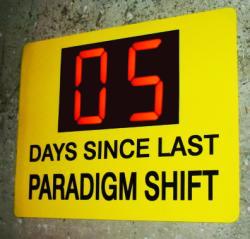
2. The mindset or paradigm that the system — its goals, structure, rules, delays, parameters — arises out of

A society paradigm is an idea, an unstated assumption (because it is unnecessary to state it) that everyone shares, thoughts, or states of thoughts that are sources of systems. Any set of assumptions becomes a paradigm, and therefore re-examining all the fundamental assumptions may lead to new paradigms. Paradigms are very hard to change, but there are no limits to paradigm change. It just requires another way of seeing things. Dana indicates paradigms might be changed by repeatedly and consistently pointing out anomalities and failures to those with open minds.

1. The power to transcend paradigms

Transcending paradigms may go beyond challenging fundamental assumptions, into the realm of changing the values and priorities that lead to the assumptions, and being able to choose among value sets at will. The power of this ability may be literally godlike.


More about this next time...

8.30.2005

DOH..duh?


“The proposal to build bike lanes may sound good to ease the impact of the rising cost of fuel products to motorists. But roads in Metro Manila are not safe for biking and the air quality in the cities is so dirty,” said (Health Secretary Francisco H.) Duque.


This Manila Times article reports DOH officials saying that encouraging biking in Metro Manila is not a good idea -because the pollution is bad for the cyclists.

So, let me get this straight: pollution from cars is bad for the cyclists so we should just all ride inside pollution causing cars so we are protected from pollution?

Is it just me or did logic take a vacation somewhere?

And why does Manila Times allow Jonathan Vicente (the reporter) to publish an article that is such an awkwardly disguised press release?

"The use of the Khaos Super Turbo Charger (KSTC) is being pushed by the government and several environmentalists to save on fuel consumption and promote clean-air quality in Metro Manila."

Seriously folks. Let's get with the program here.

8.29.2005

vancouver's vision


"It starts with having a strong vision."

"We don't want ghettoes for the rich nor for the poor."


Larry Beasley
Co-Director of Planning and
Director of Current Planning
Vancouver BC, Canada


If you have the bandwidth, and the time, download Carol Coletta's interview (in her NPR radio show, Smart City) with Larry Beasley who has led Vancouver's amazing growth and has turned it into one of the most liveable cities in the world.

The MP3 link is here, but you can also download it via iTunes Podcast Directory (do a search for "Smart City").

The interview with Larry is just the first 30 minutes but it's a revealing look at how a clear vision, that goes beyond just economic growth, can create a wonderful livable city.

The interview with Tim Jones (the lower half of the program), CEO of Artscape, a Toronto organization that develops real estate and programs for the city's artists and creative sector, is also very insightful. (I personally think we don't do enough for our artists. And creativity is a definite comparative advantage in the globalized economy.)

Image credit: Vancover, BC -Home, Sweet Home!

...oh, well...


Licuanan resigns post, palace keeps mum.

Here we go again, Subic.

Image credit: BBC News

8.26.2005

halo-halo together


1. Mix Land Uses. New, clustered development works best if it includes a mix of stores, jobs and homes. Single-use districts make life less convenient and require more driving.

from How to achieve Smart Growth


Monocultures are bad. Whether it be in forestry, farming, society, or in thinking and discourse -single-use, single-crop systems are fragile, energy inefficient systems.

Monocultures are convenient for management and efficiency experts. One crop/product makes the system predictable and easy to harvest but the choice is often very short-sighted. The cost of maintaining a monoculture increases exponentially as the single crop exhausts the land of a particular set of resources. A single crop farm will need more fertilizer, herbicide and fungicide than a in farms where the crops are mixed or rotated.

A large swath of land turned into single-crop plantation quickly exhausts the soil and makes the local economy vulnerable to collapse when the market for the crop fails.

Same goes for cities and urban districts. Monocultures -single use districts, are easy to parcel out and sell but lead to socially stratified cities and increases vehicular traffic. Separating uses means increasing travel distance between uses.

Single use districts are a product of euclidean zoning, which is itself a product of 19th and early 20th century industrial society that saw the efficiency of the assembly line and thought this would clean up the mess of cities. (cf -Congres Internationaux d'Architecture Moderne's "Functional City" in the 1933 Athens Charter).

Planners thought segregating uses, a response to the squalid conditions of the industrial cities, would create more livable cities. Commerce would stay in commercial zones, industry (and it's noxious byproducts) would be separated from residential areas and the city, in theory, would hum as cleanly as a Ford factory. As with all good ideas, this was of course taken too far such that, in the US, zoning separated even grocery stores from its customers and created auto-dependent development epitomized by monstrous suburban malls ringed by acres and acres of parking.

This is usually not a problem in traditional asian cities - walk through Hongkong, Shanghai, Seoul or Tokyo and the residential areas mix right in with the retail and services. Tokyo zoning, in fact, prescribes only what land use is NOT allowed and lets the citizens go their merry own way. The result is a more vibrant street life with residential needs closely knit to the places providing for those needs.

In our own city, this happy-mixing is captured by the corner sari-sari store in the projects of Quezon City. Manila's older parts have enough chaos that there are stores and groceries almost everywhere.

That state of affairs though is fast being lost in the suburbs north, south and east of Metro Manila, where land use plans took their cues from single-use zoning. From Better Living down to the new villages (with fancy, english sounding names) in Laguna and Cavite, finding the nearest grocery store means stepping into a car or a tricycle and driving out for a few kilometers. The subdivisions east of the metro - from Marikina to Antipolo also share the same problems arising from this same formulaic response: Master planned areas will neatly chop up areas for housing from areas for stores from areas for jobs then lay down wide roads in between to ferry people from one use to another.

Planning hindsight sees that mixing uses was not so bad after all as it allows residents to walk to get to their everyday needs -gives retail and restaurants a steady set of consumers -and more importantly puts more life on the street.

(I am glad that the Ayala Business District has lately turned to zoning rules mixing uses in the Legaspi and Salcedo districts. The ground floors are now allowed to sport restaurants, coffee bars and laundromats, it makes the street life all the more active.)

As the metropolis goes through it's cycle of new development and re-development, I hope we take more to Shanghai and Hongkong than to L.A. or Atlanta.

8.24.2005

livable cities

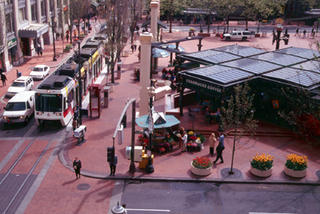
Pioneer Courthouse Square, Portland, Oregon

Cebu city's goal to be the most livable city in Asia by 2015 leads to the question: "What makes a city livable?" or more aptly, "What kind of city do we want to live in?"

Most people know what kind city they don't want to live in. (The quick answer: Metro Manila in its present state. See batjay's commentary on living the auto-driven life in the real O.C. for comparison.) Few really think about what kind of city they want -moreso how to get there.

Here's one of my favorites from the Smart Growth movement - it's a roadmap to getting to smart growth, but I think it also serves as a measure of livability. Not everything is completely applicable to Metro Manila but they serve as good take-off points for discussing the future of our city:

  1. Mix Land Uses. New, clustered development works best if it includes a mix of stores, jobs and homes. Single-use districts make life less convenient and require more driving.

  2. Take Advantage of Existing Community Assets. From local parks to neighborhood schools to transit systems, public investments should focus on getting the most out of what we’ve already built.

  3. Create a Range of Housing Opportunities and Choices. Not everyone wants the same thing. Communities should offer a range of options: houses, condominiums, affordable homes for low income families, and “granny flats” for empty nesters.

  4. Foster “Walkable,” Close-Knit Neighborhoods. These places offer not just the opportunity to walk—sidewalks are a necessity—but something to walk to, whether it’s the corner store, the transit stop or a school. A compact, walkable neighborhood contributes to peoples’ sense of community because neighbors get to know each other, not just each other’s cars.

  5. Promote Distinctive, Attractive Communities with a Strong Sense of Place, Including the Rehabilitation and Use of Historic Buildings. In every community, there are things that make each place special, from train stations to local businesses. These should be protected and celebrated.

  6. Preserve Open Space, Farmland, Natural Beauty, and Critical Environmental Areas. People want to stay connected to nature and are willing to take action to protect farms, waterways, ecosystems and wildlife.

  7. Strengthen and Encourage Growth in Existing Communities. Before we plow up more forests and farms, we should look for opportunities to grow in already built-up areas.

  8. Provide a Variety of Transportation Choices. People can’t get out of their cars unless we provide them with another way to get where they’re going.More communities need safe and reliable public transportation, sidewalks and bike paths.

  9. Make Development Decisions Predictable, Fair, and Cost-Effective. Builders wishing to implement smart growth should face no more obstacles than those contributing to sprawl. In fact, communities may choose to provide incentives for smarter development.

  10. Encourage Citizen and Stakeholder Participation in Development Decisions. Plans developed without strong citizen involvement don’t have staying power.When people feel left out of important decisions, they won’t be there to help out when tough choices have to be made.


In future posts, I'll discuss each item to see how we might apply it to Metro Manila.

Image credit: Project for Public Spaces.

8.19.2005

konting ipit lang po*
(...disorganized transport iii)


The Boundary System as a city shaper.

Cities are self-organizing systems. With the exception of planned cities like Brasilia or Chandigarh, very few cities arise ex-nihilo.

Cities respond to the needs of the individuals that comprise it and one of the key needs is mobility -to get from one point to another.

Cities are shaped by the current mode of transportation available when they grew up. So older european cities have narrow winding streets, suitable for carts and donkeys or walking. London grew up around the tube, and New York around the subway system. L.A., like Metro Manila, grew up around the automobile -so roads (at least in the newer parts of the metropolis) are wide and traffic fast.

The mode of transportation shapes the city and the demands of the city also shapes the transportation -particularly public transportation.

In our own city, public transport, as I previously discussed has been given over to the free market. The rewards/remuneration system of this particular urban sub-system, has shaped our city in ways that may have been invisible to us all these years.

The Boundary System is basically a vehicle rent system. The driver is "hired" by the transport operator, to run and maintain his jeep, bus, or FX cab. The driver can run as many trips within the boundary period (standard is 12 hours) as he wants but he basically has to pay the "boundary fee" (usually, daily) to the owner -and his source of income is whatever he makes over and above the boundary fee. The driver covers the cost of gasoline and minor repairs.

This remuneration/rent system has shaped metro-manila in subtle and not so subtle ways.

The boundary system brings a logic to earning money that shapes the driving habits of the renting drivers. If the driver only earns above the boundary, then logic dictates that he must get as many passengers as he can in as many trips as possible . The driver also benefits by having the vehicle on the road as many days as possible - as repairs and shutdowns mean no income for the day.

So, a driver will:

  1. soak up passengers by basically waiting as long as he can in a high traffic/passenger volume area and then
  2. speed up to the next high volume pickup point to soak in more passengers.
  3. he will also see other public utility vehicles plying the route as competition so waiting in a line does not make much sense,
  4. he will try to get ahead of the line (usually by doubling up on the pickup lane) so he can be closer to the "source" of passengers and so
  5. he won't be tied down on the line and can speed up to the next destination.
  6. It also means that shorter trips are preferred to longer trips and
  7. vehicle downtime and thus vehicle maintenance is kept to a minimum (=inefficient engines, =more pollution).

This system is behind the traffic chokepoints at the major junctions and intersections. The underpass in cubao, the flyovers in ortigas, the overpasses in santolan, even the grade separations in EDSA in Makati were driven by the logic of separating the buses, who spent an inordinate amount of time at the intersections waiting for passengers, from the rest of the road traffic.

The government has also probably thrown millions of pesos in soft costs at trying to manage the behavior of the public utility vehicles by throwing hundreds of traffic enforcers and by coming up with several management programs (from Oscar Orbos' bus numbering system, to Bayani Fernando's Organized Bus Routes).

The flyovers/overpasses/underpasses have made EDSA completely un-friendly to pedestrians, and the accumulation of vehicles in the intersections have concentrated exhaust/pollution in the areas around these passenger pickup junctions so these have become some of the worst parts of the city. (Ordinarily, the high pedestrian traffic junctions would be the most suitable places for commerce and retail.)

A serious re-thinking of the boundary system (legislating a wage based system seems the easy way out -but that will create it's own problems) would go a long way not only in solving intractable traffic problems but also in re-shaping the fabric of the city.

*-Part of "Konting ipit lang po, pituhan yan."

Roughly translated, "Please squeeze your thighs a bit more, this jeepney fits seven to a side."

Image credit:Manfred's Travel Pictures

and now a word from...


A reader and a friend asked why I haven't commented on Gloria-gate.

It's not out of apathy or resignation. I just think there are enough voices speaking out about the matter and my betters (MLQ, Sassy Lawyer, et. al.) are doing a good job of annotating the developments as they unfold. (Not that I agree with everything they say -I did get a total kick from Carlos Celdran's "Open Letter".)

I prefer to focus on 1) urban planning and design issues; 2) city livability; and more importantly, 3) the 50-100 year outlook. It's so easy to miss the forest for the trees -and the trees aren't looking so good right now. The forest stretches back 500 years and forward another 500. (Or in keeping with the above image -looking for the end of the tunnel, and the next tunnel...)

I figured I'd be more useful on the lookout perch than in melee on the ground.

Image credit: Thomas Hawk.

8.18.2005

a cocoon by any other name


UPDATE 8.19.05: I hadn't been checking my email box - Sydney sent me the same story on the same day. Synchronicity for you! Or rather are birds of the same feather... ?


Caught this article in yesterday's BusinessWorld Online. Apparently the apple of the pinoy developer's eye is creating "work-live-play environments." In other places this would be called mixed-use development. And you see them developing around - Rockwell, Eastwood, the new Greenbelt...

Off-hand, this is a good thing, as any departure from the sprawl-inducing, traffic-causing euclidean zoning is good. BUT (of course there has to be a but) will it lead to another form of spatial insularity? Are these "cocoons" -built on high-end retail and entertainment centers -shaping up to be the new enclaves?
"I think the theme is still for most part affordability. Condominiums that are moving right now are the ones that address affordability concerns," (Richard T. Raymundo, director for the research and consultancy division of Colliers International Philippines) said. These are those that have studio types and one-bedroom units.

Affordable for whom?

Is it too much to dream that our cities can enact inclusionary zoning regulations? After all, we do have a staggering housing backlog (to the tune of close to 250,000 units a year).

Or can we impose exactions - like requiring publicly accessible parks and open spaces or creating special tax funds to benefit public schools and barangay health centers within a 5-kilometer distance from these "cocoons"?

Just asking.

Image credit: BusinessWorld Online

Quick Links

Notable posts on the metro