Showing posts sorted by relevance for query "getting better public transit in metro manila". Sort by date Show all posts

2.05.2008

getting better public transit in metro manila (part 1)
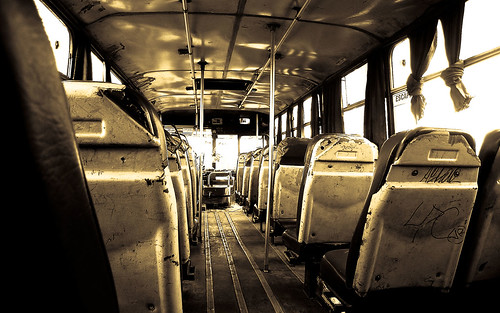
Mobilizing the political will
to improve public transit in Metro Manila
Part 1: A sense of urgency


This begins my long promised post on how to get better public transportation (in particular: bus rapid transit or BRT) in Metro Manila.

The first thing we have to do

The first thing we have to do is to create a sense of urgency.

To do that, we have to change the frame of the conversation.

Ask anyone in Metro Manila about the "effects of bad public transportation" and invariably they will say bad traffic. Granted that PUV driving behavior (caused by the economic model) does cause traffic chaos, to put that first on the list of adverse effects of bad public transportation is to be myopic.

Traffic congestion is the most visible effect -but it is largely visible to car users. What is invisible and ignored is the effect bad public transportation has on the urban poor and lower middle classes who are dependent on PUVs to get from home to school or to work.

That segment is the fat part of the pyramid, almost 80% of daily person trips in Metro Manila are taken via public transport. Despite the overwhelming size of this cohort, I have yet to see statistics that detail the consequences of the inefficient system on the riding public.

Whatever conversations about public transit that is covered by the papers centers around fare prices and the issues of the operators and drivers. Their regular threats to hold transport strikes and their near constant refrains of the fares being too low to support their livelihood and their complaints about harassment from the MMDA and the local police. (I am not discounting those complaints, only saying that they have become monotonous.)

The questions we need to ask are: what are the economic and social effects of an inefficient public transport on the riding public in general, and the urban poor in particular? What are the comparative efficiency advantages (e.g. -time) of driving a private car vs. taking the bus or jeep? Specifically we need to ask:
  1. How much of the household budget does transportation consume? (Particularly for the C,D and E classes.) -and this should cover the costs of car ownership (purchase, maintenance and operation) as well as the costs of fares for all modes of public transit.
  2. How much more time does it take to get from home to work or home to school when you take public transit (all modes) vs. a private car?
  3. What is the social cost of the inefficiency and bias towards cars? How much less time do parents in families without cars have to spend with their children? Do students have to rent at boarding houses because it is just not feasible to travel from home to school daily?
My own back of the envelope (read: totally unscientific) calculations make me think transportation eats up about 20% of the household budget of middle class families -and that share could rise up to about a third in poorer families.

I suspect that the inefficient PUV system offsets the daily schedule of transit riders by 1.5 to 2 hours a day vs. private car owners. That's about 20 hours a week of bias for car owners.

But again, these are all just estimates. We need to demand that someone study the real numbers -or bring the stats out if there have already been studies.

We need to bring these issues to the public sphere and we need to frame this as an urgent social justice issue.

Imagine the direct impact you could have on the quality of life of the middle class and the urban poor if you could at least halve that time bias. You would be giving parents 10 more hours a week with their families; giving mothers and fathers an extra hour a day to tend to their children; giving students respite from the grueling time spent on the road or giving them the option of not having to pay for room and board just to live closer to school.

We need to make efficient public transport more important than traffic congestion.


Next up: Part 2: A promise of what is possible


Image credit: "63, alone / solo" by yeraze

2.25.2008

getting better public transit in metro manila (part 3)


Mobilizing the political will
to improve public transit in Metro Manila
Part 3: Building a winning coalition

This is part three of a series on how to improve public transit in Metro Manila.

To review where we have been:

Step One is to change the frame. Improving public transit is not about decongesting traffic. It is about social justice.

Step Two is to show an alternative vision. Discussing what is wrong about the status quo will not bring change by itself. We have to show what is possible.
This brings us to:

Step Three: We need to build a winning political coalition
.


Politics often carries a negative connotation but at its root, politics is about the art and science of influencing and shaping public policy and changing policy is about shepherding the proposed changes through the political and policy formation process. It requires the shaping of public opinion, mobilizing that opinion into a political force and then bringing the appropriate political forces to bear at the right points in the process.

Effecting policy changes are often long slogs with victory going to those who can cobble, stable and effective coalitions. Miracle moments (something I'm afraid we have become addicted to) are rare and when they do occur, it usually just results in changes in leadership rather than substantive changes in policy. The change will rarely be lead by policy wonks or elected officials -rather, organized groups must bring political pressure to bear to get the policy wonks to rethink policy and the elected officials to support the change.

Mobilizing the political will to improve public transit in Metro Manila means building and mobilizing a winning coalition.

Who should be in the coalition?

The following groups should be natural core members of this coalition:

1) URBAN POOR: Ideally there should be a commuters union organized and powered by users of public transport. Since there is none, then the urban poor groups should take their place. The urban poor is the sector most dependent on public transit to function in the city and because improving public transit is a social justice issue, then this should be on top of the agenda of advocates for the poor.

2) THE CHURCH/FAITH-BASED GROUPS: Because it is a social justice issue, then the religious groups should also be in the coalition and should be working actively to address that inequity

3) LABOR UNIONS: Workers should also have a dog in the race if inefficient public transit is a bane to families of laborers.

The following groups should be strongly supportive:

4) EMPLOYERS CONFEDERATION and CHAMBERS OF COMMERCE: as inefficient public transit directly effects worker productivity. It also affects the marketability of the city as an investment destination. - More efficient public transit increases productivity and reduces the stress on workers. (These groups can also line up behind the social justice banner.)

I can think of many more groups that can have a natural affinity to this coalition, but i'll stay with this list for now. I'll take any suggestions you might have.

The operational word, of course, is "winning" and it will not be enough to cobble this coalition. The coalition must also effectively neutralize the opposition. And that will be the topic of my next post:

Part 3: Dividing and conquering the opposition


Image credit: Drivers wanted by davefitch

3.13.2008

getting better public transit in metro manila (part 4)

Mobilizing the political will
to improve public transit in Metro Manila
Part 3: Divide and Conquer

This is part four of a series on how to improve public transit in Metro Manila.

Reviewing again the previous posts:

Step One is to change the frame. Improving public transit is not about decongesting traffic. It is about social justice.

Step Two is to show an alternative vision. Discussing what is wrong about the status quo will not bring change by itself. We have to show what is possible.


Step Three is to build a winning political coalition. A political coalition that will shepherd the change through the political process, and bring political pressure to bear to convince the policy wonks and sway the elected officials.

"Winning" presumes a political contest - a battle, and so we cannot win unless we win over or defeat the opposition which brings us to:

Step Four, Dividing and Conquering the Opposition.

Sun Tzu exhorts us to "know your enemy," so the first question is, "Who would be opposed to more efficient public transportation in Metro Manila?"

The answer, of course, is no one.

More so if the premise is social justice. What politically-sane person in the Philippines would stand against something that is about efficiency, serves the public and is pro-poor?

But it would be the height of naivete to think that there would be no opposition. There will be, but their opposition will stand on issues NOT diametrically opposed to efficiency and social justice.

We need to know their interests, issues and goals and use the same to gain leverage for our agenda.

There will be two types of opposition: organized and not. And that nomenclature is split further down to groups who are influential or not.

The biggest, most visible threat would be from organized and influential opposition, which in my book will likely be the Operators and Drivers Associations of the present public transport services (BODAs, JODAs and TODAs). They have, after all, recently and successfully flexed their muscles (giving, what R.O./Y.R. calls Manila's Extreme Sport, a day long uptick in degree of difficulty -though Enrique claims he found no real effect). They also have a long history of protest action.

But as organized as the ODAs are, they are in no way monolithic. To succeed in breaking the opposition, we have to look at the internal faultlines and use their interest to win adherents over to our side.

Drivers, above all, want a predictable income. Under the boundary system, fluctuations in fuel prices, uneven fines, capricious law enforcement and traffic and traffic congestion affects their take home income. Any system that smooths out those fluctuations - that gives them steady income would be preferable.

Operators, meanwhile, want to maximize their profits. As businessmen, they will appreciate a system that provides incentives to their investments.

One other note, the current free-wheeling public transport ecosystem provides an entrepreneurial route from driver, to small operator, to large operator (or transport consortium). A better public transit system can win adherents if it answers those concerns.

The Bus Rapid Transit system, as implemented in many cities, offers viable solutions to each of these concerns.

First of, the dedicated-lane, bus priority traffic system automatically eliminates the congestion and capricious law enforcement concerns of the drivers.

Also, unlike capital intensive Light or Heavy Rail systems, BRT systems provide a pathway for participation for existing transport providers. Drivers and smaller operators can be encouraged to form cooperatives to bid for and to run the services of the BRT. Large consortiums can easily transition and also provides services. Take the example of Mexico's MetroBus, where 70% of the service is run by companies and cooperatives from the ranks of the former drivers and operators of the minibus services that the BRT system replaced.

Becoming service providers for the BRT, under a formalized enterprise, will allow drivers to shift into formal salaries , moving them away the insecurity of the boundary system. They will also have the benefits of formal employments, such as health insurance and social security.

We can also mandate employee ownership of the service firms so that the drivers earn more than their salaries, but also partake of the profits. Their livelihoods will also not be tied down to the fare rates, but their extra income (share of the profits) will be linked to the efficiency of the service.

A properly designed BRT policy and investment program will move small operators from single proprietorships into medium sized business enterprises. We can provide the capital and tax incentives -for example, by having the government buy and own the buses and leasing them back to the operators to reduce the operator's asset risks. The system can professionalize the current large consortiums, encouraging better corporate management.

A properly designed BRT policy will break the ranks of the ODAs and will likely appeal to majority of the drivers and will draw quite a few of the entrepreneurs.

Other opposition

The only possible opposition left will be the companies with vested interests in large infrastructure projects along with politicians who earn kickbacks from these major investments.

They will argue that fixed rail systems are more efficient but their influence can be neutralized by questioning their vested interests. So, too, with politicians who would stand on their side.

Imagine a politician who is not only labelled "anti-poor" for standing against the social justice issues of a more efficient public transport system, but that they could also be questioned for supporting large investments - as having vested interests.

The final other possible group would be an organized motorist group, which presently does not exist as a viable political force, but it is foreseeable that they could coalesce into a front that can wield some influence. Their main concern would be the traffic consequences of appropriating a lane for the BRT, but that easily be traded of with the removal of undisciplined PUV behavior and by arguing that more efficient public transit will actually reduce car use -thereby freeing up the road for more devoted motorists.

If we frame the BRT proposition correctly, and wield the right political levers, we can easily neutralize the opposition listed above.


Next up: Making it work, the mechanics


Image credit: Our Direction by B Tal

2.13.2008

getting better public transit in metro manila (part 2)


Mobilizing the political will
to improve public transit in Metro Manila
Part 2: A promise of what is possible


So, first we have to change the frame of the conversation: from congestion to social justice.

The consequence of a bad public transport system is not bad traffic (alone) but a fundamental inequity -where those who cannot afford cars or cannot afford to take cars everyday pay a greater share of their household income and pay a greater penalty in time.

A bad public transport system is inequitable. And it is also inefficient.

We need to get better public transport not because we want to get rid of traffic congestion* -but because we want a transport system that does not favor the rich over the poor and the middle class. We want it because we want parents to spend more time with their children and we want students to have more time to study.


The next thing

The next thing we have to do is to provide an alternative vision of what can be.

You cannot change anything by simply complaining about it or pointing out what is wrong. We do not need any more black hats to tell us why something does not work when we know it is not working. We need to see what will work.

You can only inspire and motivate people to change if you show them what can be.

This is where the success of Bogota, Curitiba, Mexico and Jakarta comes in. We don't have to reinvent the wheel. There are many, many successful examples of bus rapid transit projects.

These projects are successful not only in terms of efficiency, but also in terms of economy and democratic participation.

Unlike massive light rail projects, bus rapid transit is:
  • cheaper (at just 1/5 to 1/3 the cost per kilometer vs. fixed rail)
  • cheaper to operate (no substations, no high maintenance infrastructure)
  • is more flexible (if you design the stations right, you can have service overlaps)
  • faster to roll out (transjakarta started in 2004 and will have a total length of 159 kilometers by the end of the decade)
  • is more participative (you can ask existing bus operators and drivers to bid to operate the buses -compare that to their options when we go with expensive fixed rail infra)
We need to invite people from these cities to come and talk about their success. We need to show videos of how BRT works and do TV and magazine reports on our transportation options. We need to show the best practices and the best solutions other mega cities are already exploring,

We need to talk about BRT and other alternative transportation systems (like bicycle networks, and bike rental systems). We need to get everyone to ask:

Why not?
and
So why can we do that here?


Up next, Part 3: Building a winning coalition


*BTW, next time someone says we need to ---take your choice:
  • widen roads,
  • build flyovers,
  • discipline the driver
  • deploy more traffic cops
  • buy a new computerized traffic signal system or
  • build new roads
--to eliminate traffic congestion, challenge them to name ANY CITY in the world that has eliminated traffic congestion by doing any of those actions. I guarantee you, NOT ONE city or region or metropolis in the world has has succeeded using any of those options.

NOT ONE.


There is only ONE PROVEN method to reduce traffic congestion -and that's congestion pricing.

It's been proven in Singapore. It has been very succesful in London. New York is planning to implement it.

2.04.2008

brt up close

The public transportation system
we could have in Metro Manila


Here's an even more in depth look at bus rapid transit -how it works and how it is managed, featuring Bogota's Transmilenio.

The video is from The Oil Drum and was produced by Streetfilms, the same folks who gave you the documentary on Bogota's Ciclovia.

Just so you know that BRT systems are not only about improving traffic, but is basically about social justice through efficient transportation, read more about the Transmilenio's impact on the urban poor from the BoP folks in NextBillion. They write:
For Enrique Peñalosa, the mayor of Bogotá who drove the initial planning and implementation of Transmilenio, making high quality transportation accessible to Bogotá's low-income population was central to the project. By attacking the public transportation crisis, characterized by "penny wars," gaps in service, unequal pricing, high levels of pollution, and serious traffic congestion, the new BRT system aimed to reduce inequality. This included not only disparities in the quality of transportation services, but also long-term economic and educational inequities perpetuated by a lack of mobility and access between high and low-income areas of the city. [WRI has an interesting feature piece available that also describes the breadth and vision of Peñalosa's urban reform efforts].
Hmmm. So "public transportation crisis" that is characterized by "penny wars, gaps in service, unequal pricing, high levels of pollution, and serious traffic congestion."

Does that sound familiar?


---
And this serves as a great prelude to my next post: "Getting better public transportation in Metro Manila."

Quick Links

Notable posts on the metro