Showing posts with label vision. Show all posts

9.11.2007

new cities in new valleys


I've talked about Ayala Land's vast land holdings in Canlubang before and how that will definitely figure into the future of our megacity. Apparently they've laid out the vision of the shape of that new development. (Ah, the tribulations of unrequited and long distance love - when you live and work away from the city you call home. News gets by without you.)

Jo, the ManilaRat, keyed me in on the developments in Nuvali in her latest post.

Heard about AyalaLand's new project in Canlubang, called Nuvali (from the Latin nuvo meaning "birth of a star"). Literally a "new valley" in the Sta. Rosa-Tagaytay area, it's a 1,600-hectare megatownship development set for full bloom over the next 40 to 50 years. Eyed as the next Makati, its main thrust is 21st century technology meets back-to-basics harmony with nature. Think eco-friendly, ultra-modern sustainable living: clean lines, fluid designs, integrated zones (residential, business, services), and green green green everywhere.
So I hied off to the Ayala Land site (and noticed how it seems to be so geared towards the OFW -or Pinoy Expats, as Dave Llorito prefers -market) and jumped off to Nuvali site. (Warning: bad UI flash-based website.)

I was eager to look for broad sketch masterplans but all the site had was spiffy marketing marterial. You can download pdf copies of an ad series about Nuvali that they ran in the Philippine Star. (Another warning: they make you pass through a copyright agreement. -duh!)

The content is worth it, if you can stand the marketing speak ("evoliving" -? really???) and the weird commitment to pseudo-italian placenames ("Abrio" -?!?). The sidebar on "design and planning initiatives" (see below) were significant.


I'll definitely cheer for de-emphasizing cars and multi-use (read: mixed-use) neighborhoods. Kudos also to a "future that veers away from the severe sprawl of conventional urban development."

To that end, Joel Luna, Chief Architect of the Ayala Land Innovation and Design Group, says they are building wider sidewalks:

"...to encourage more people to walk rather than take their car. This is also safer and more pedestrian friendly. We are also building narrower pavements...so there's more room for natural landscaping. There will be double-rows of trees instead of the typical single row."

So their are paying attention to pedestrian mobility and comfort -and the micro-climate.

Then there's this sidebar:


Can Ayala accomplish all this? Despite the marketing gloss, I have no doubt that they will. They are patient enough and forward looking enough (remember it took them 50 years to fully develop the Ayala CBD, and they waited close to decade for Metro Pacific to go belly up on Fort Bonifacio -and now it's in their control) and have the deep pockets to see this through.

The one aspect I will be looking closely at: whether they can escape their elitist past and be willing to mix incomes and avoid the segrated, gated, high-walled enclaves that I suspect add to the (spatial) roots of our discontent.

It'll probably take about 5-10 years to get the full expanse of the project - another 10 to fully build out the infra, but this will definitely be another mega-project that will shape the future of our megacity.

Image credit: swiped from ALI's website
doesn't this cover fair-use?


(p.s. -er, nuvali? can we change the name? to something a little more asian? spanish even?)

9.08.2007

brand and neurwith on cities


This one's short but sweet: from the TED Talks, a 3 minute version of Stewart Brand's talk on cities.


And if you have more time (14 minutes) here's Neurwith on Squatter Cities.

7.24.2007

growing metro manila


The animation above shows the rapid growth of highly urbanized areas (areas in yellow) in the National Capital Region from 1948 to 1999, and, as estimated, by 2015.

The growth is nothing short of spectacular.

Starting with just 83 square kilometers in 1945, the metro grew thus:

  • 1948 =83 km2
  • 1966 =221 km2
  • 1975 =323 km2
  • 1996 =788 km2
  • 2015 =1,512 km2 (projected)

    (Click on the year to see a snapshot for that year.)

So, in 48 years -from 1948 to 1996 - the highly urbanized core of the metropolis grew by an astounding 705 square kilometers or 849%. That means the development grew by an average of 14.6 square kilometers every year (18%). That's like adding an area half the size of the city of Makati to the metro every year.

The rapid urban growth, coupled with an equally explosive population growth pretty much explains why we went from the idyllic urban scenes of the 60s to the current chaos of Metro Manila.

Greater Manila's population was about 1.5 million in 1948. It hit 10.8 million by 2000. Which meant we added about 180,000 people to the metropolis each year.

That's like moving the whole (current) population of Cebu City to Metro Manila every 4 years.

No planning department (indeed, no organization) in the world could have coped with that kind of explosive growth.

The pace of growth also explains the housing crunch that we currently face. To cope with that growth, we would have had to build at the pace of nearly a hundred houses everyday for the last fifty years. (No, we couldn't get time off for weekends, either.)

I'll discuss this more on my next post - which will also be my answer to Peter Angliongto's last comment.

We're not done yet! If the projections are correct, the highly urbanized core will nearly double in size by 2015.

This kind of growth though is par for the course of megacities worldwide and is a part of the global trend of rapid urbanization.

It's good to keep this frame in mind next time you get tempted to blame all of Metro Manila's woes on our our supposed lack of discipline, or the avarice of our oligarchs or the corruption of our local officials or even the (presumed) faults of our culture.

Remember, it's not the attitude, it's the (sheer) numbers.


Data for map image extracted from MMUTIS
from a presentation by Dr. Ricardo Sigua

7.17.2007

"non-conformist mayor"


I bet you won't find Mayor Sergio Fajardo, of Medellin, Colombia tearing down a pedestrian mall to make way for car and jeepney traffic. No, he's as non-conformist (read: visionary) as they come.

The NYT featured the good Mayor and the turnaround city of Medellin, showcasing Fajardo's simple but radical idea:

Our most beautiful buildings,” said Mr. Fajardo, 51, “must be in our poorest areas.”

With that simple idea, Mr. Fajardo hired renowned architects to design an assemblage of luxurious libraries and other public buildings in this city’s most desperate slums.
That's radical enough itself, but remember we're talking about Medellin, Colombia -described as the "World's Deadliest City" in the early 1990s. Then, the home of the infamous Cali Cartel and the global cocaine syndicate.

This city of about two million people had 29 homicides per 100,000 inhabitants in 2006, down from 381 per 100,000 when killings peaked in 1991.

Elected in 2003 as an independent, and riding a growing economy and this decline in violent crime, Mr. Fajardo has turned the city into a showcase for new educational and architectural projects.

He increased city spending on education, bringing it to 40 percent of Medellín’s annual budget of $900 million, while also raising spending on public transportation and microlending projects for small businesses.
He's building five new libraries right in the heart of the poorest sections of the city. He put in the Metrocable (an overhead cablecar system) in Santo Domingo Savio, one of the biggest slums in the city. The cable car system leads you to the Parque Biblioteca España, a civic complex that includes a library, auditorium, Internet rooms, day care center and an art gallery (Can you imagine a museum in the heart of Payatas?)

To be sure, the bold moves haven't been a panacea. The city still faces serious problems. The drug syndicates are still there, and, as NYT reports, the street kids in Plaza Botero (pictured above) still sniff glue and beg in the streets. BUT, the radical reinvestments are changing the way the city (and its citizens) views itself.

And yet Mr. Fajardo’s transformation of Medellín has captivated the city and, increasingly, other parts of Colombia. His approval ratings stand at more than 80 percent, making him the country’s most popular mayor and leading him to be widely mentioned as a potential presidential candidate after his term ends this year.

“He is carrying out a redistribution of wealth without a discourse of rage,” said Héctor Abad Faciolince, a prominent novelist and political commentator here. “If Medellín cannot take these risks, then what place can?”

What risks are we prepared to take?


P.S. -Read Mayor Fajardo's letter to National Geographic protesting NatGeo's photo essay on crime in the Medellin and listing the achievements of the city under his leadership.

7.08.2007

in praise of pedicabs


With all the press attention the electric jeepneys are getting and their purported environmental benefits, it's easy to overlook an even greener form of transportation that we're already using and that the World Health Organization says is "urgently needed to reduce climate-altering carbon emissions that are damaging Asia's health and could also threaten the economy."

The pedicab occupies the bottom of the rung of the forms of transportation our auto-riding elite look down upon. And the one form of transport that receives the most contempt.

Where jeeps and buses are seen an undisciplined nuisances that cars unfortunately have to share the road with, the pedicab is viewed as a mutant not even deserving of the asphalt. Even pollution spewing tricycles are preferred to the "padyaks."

Confession: Before my urban planning + green "epiphany," I used to refer to pedicabs as "ipis ng kalye' (literally: cockroaches of the road) as they tended to scamper and scatter the way roaches do when you switch on the kitchen light.

But as far as green cred goes, no other transportation option holds a candle to human powered vehicles. They generate no emissions, produce no waste (there are serious concerns about the chemicals in car batteries) and make for healthier drivers. (Have you ever wondered what the personal health toll is for jeep and bus drivers who sit behind the wheel for 12 hours or more daily?)

As far as low barriers to entry, the pedicab business is one the Bottom of the Pyramid folks at Next Billion would love. You could literally buy hundreds of pedicabs for the price of one jeep. (And how many pedicabs can you buy for the P550K pricetag of one e-jeeney?). Plus all building materials can be sourced locally, no need to import sparkplugs or oil filters or engines. (No need to buy oil that supports oppressive middle east regimes either.)

The tech is so simple that self-repair is the rule rather than the exception. (Here's another thought to chew on: What are the long term environmental costs of all those auto repair shops in our cities. 99.9% of them dispose of engine oil and other car related chemicals into the storm drains or onto the ground.)

Pedicabs are unsafe only in so far as they mix with other vehicles -affording little protection to the driver and the riders. And perhaps that is the design challenge we could invest our energies into solving.

Clearly our streets were not designed for pedicabs and clearly it is dangerous to mix the slow pedicab with fast moving buses, trucks and SUVs. BUT what if we built a metro wide green infrastructure anchored on shared bike/pedicab/pedestrian (ped-bike-ped) through ways? We can set apart secondary and tertiary roads and designate them as green ways. We can redesign the road right-of-way (ROW) to be friendlier to both pedestrians and bikes and pedicabs. We can take a cue from Europe's Woonerf streets. (See also this pdf 1.1. mb, and these photos.)

We could narrow the carriage way to provide very wide sidewalks with lots of trees. We could use a textured pavement for the carriage way to slow down the pedicabs and bikes and to designate that these roads are not meant for greenhouse gas emitting vehicles. (Of course we'll have to give special access permits to the cars owned by the people who live and work on these streets.)

We can also build green infra into street itself, like building sediment and percolation beds under the sidewalk and roadway. The green infra will absorb storm waters and reduce flooding, (not to mention re-charge our aquifers).

And, if we do it right, we can bring in the street vendors -provide well-designed carts (think of the stands in the malls) and have them self-regulate so we turn the ped-bike-ped/green streets network into linear parks and outdoor malls. We can change the zoning rules along the routes so as to allow ground floor retail. If we do it right, restaurants, fast food places and small specialty stores could flourish along the route. (Nothing makes business better than having lots of people walk past your store.) We could even increase the floor-area-ratios along the routes to encourage taller (maybe 6-10 story) buildings and add to the shade.

We could encourage the development of low-cost apartments and rent-to-own units (with tax policy, zoning and incentives) along the route to increase the pedestrian flow in the area. And we could waive parking requirements to encourage more walking and use of the ped-bike-ped infra. (How's that for Transport-Oriented Development?)

We can plot the routes so as to take advantage of light rail stations of LRT and the Megatren (and maybe sections of the MRT), stringing feeder routes from the stations. The pedestrian nature of the routes will allow those who would prefer to walk on their own legs to take advantage of the infrastructure, too.

If you think this is impossible, check out the bike avenues and parks they created in Bogota. (Pictures here.)

Of course I think we should also redesign the pedicab itself. Its present morphology (regular bike with a sidecar attached) is asymmetric and so leads to erratic navigation -with one side permitting almost hairpin (read: unpredictable) turns. There is no shortage of ideas as other cities are rediscovering human powered vehicles. (Check out the political struggle in New York, the regulations and routes in Vancouver and the tourist service in London.) But we probably can come up with our own, more efficient designs.

From a national policy standpoint, we could sell the creation of these ped-bike-ped networks as carbon sequestration and GHG reduction strategies and can probably either find good funding from environmental program loans of from the global market for carbon offsets.

It's win-win-win all around. (Unless you're an auto-elitist.)

Image credit: City Scenes Jeepneys and pedicabs along the Quinta market in Quiapo Manila.
from IRRI Images Collection by the International Rice Research Institute

7.04.2007

urban happiness

I hope you caught last week's article in the Globe and Mail covering Bogota's Urban Happiness Movement. It's been covered by other blogs (caveat: a few splogs on that list) but it hasn't hit any of the pinoy blogs, I think.

It features, of course, Enrique Peñalosa -one of my favorite ex-mayors of any city. He visited the Philippines early this year to address the League of Cities.

Some the nuggets of goodness from the article:

On a clear, cloudless afternoon, Enrique Peñalosa, former mayor of Bogota, leaves his office early in order to pick up his 10-year-old son from school. As usual, he wears his black leather shoes and pinstriped trousers. As usual, he is joined by his two pistol-packing bodyguards. And, as usual, he travels not in the armoured SUV typical of most public figures in Colombia, but on a knobby-tired mountain bike.

...On most days, this would be a radical and perhaps suicidal act. But today is special.

Ever since citizens voted to make it an annual affair in 2000, private cars have been banned entirely from this city of nearly eight million every Feb. 1. On Dia Sin Carro, Car Free Day, the roar of traffic subsides and the toxic haze thins. Buses are jam-packed and taxis hard to come by, but hundreds of thousands of people have followed Mr. Peñalosa's example and hit the streets under their own steam.

Hey! Two things I'd like to see in Metro Manila: Car Free Day and a Mayor riding a bike to and from work.
Car Free Day is just one of the ways that Mr. Peñalosa helped to transform a city once infamous for narco-terrorism, pollution and chaos into a globally lauded model of livability and urban renewal. His ideas are being adopted in cities across the developing world...

His policies may resemble environmentalism, but they are no such thing. Rather, they were driven by his conversion to hedonics, an economic philosophy whose proponents focus on fostering not economic growth but human happiness.

So Makati has again regained pole position in tax collection, but I wonder which of our cities would top a happiness index?

“There are a few things we can agree on about happiness,” (Peñalosa) says. “You need to fulfill your potential as a human being. You need to walk. You need to be with other people. Most of all, you need to not feel inferior. When you talk about these things, designing a city can be a very powerful means to generate happiness.”
Can we shape our cities so we generate happiness? By some counts, we already rank 7th in the world for happiness, how much higher can we get if our cities were designed "to generate happiness"?

And if you think our cities are too far gone, chew on this:
In the mid-1990s, Bogota was, citizens recall, un enfierno – a living hell. There were 3,363 murders in 1995 and nearly 1,400 traffic deaths. The city suffered from the cumulative effects of decades of civil war, but also from explosive population growth and a dearth of planning. Wealthy residents fenced off their local public parks. Drivers appropriated sidewalk space to park cars. The air rivalled Mexico City's for pollution. Workers from the squalid shanties on the city's south end spent as much as four hours every day commuting to and from Bogota's wealthy north.

...

Like cities across the Third World, Bogota was looking to North American suburbs as a development model, even though only 20 per cent of people owned cars.

The tide changed with Mr. Peñalosa's election in 1998.

“A city can be friendly to people or it can be friendly to cars, but it can't be both,” the new mayor announced. He shelved the highway plans and poured the billions saved into parks, schools, libraries, bike routes and the world's longest “pedestrian freeway.”

He increased gas taxes and prohibited car owners from driving during rush hour more than three times per week. He also handed over prime space on the city's main arteries to the Transmilenio, a bus rapid-transit system based on that of Curitiba, Brazil.

Bogotans almost impeached their new mayor. Business owners were outraged. Yet by the end of his three-year term, Mr. Peñalosa was immensely popular and his reforms were being lauded for making Bogota remarkably fairer, more tolerable and more efficient.

Moreover, by shifting the budget away from private cars, Mr. Peñalosa was able to boost school enrolment by 30 per cent, build 1,200 parks, revitalize the core of the city and provide running water to hundreds of thousands of poor. (emphasis mine -udc)

In under a decade, Bogota went from a "living hell to living well" all because of a "radical campaign to return streets from cars to people" that is "now a model for the world."


6.02.2007

curitiba v. bogota


Prof. Randall Crane compares Curitiba and Bogota in the latest post on his Urban Planning Research blog ("Cheap Chatter on Urban Studies"). I don't always agree with Prof. Crane but he does offer very insightful research into urban economics and urban planning. (c.f. this lecture in Toronto on "Sex, Lies and Commuting in the U.S. -1985-2005" -Quicktime. Windows media version here. )

Bogota, he says, "is substantially safer and more pleasant than I imagined, owing apparently to a series of quite visionary and effective mayors over the past decade and a half."

He cites this presentation by Arturo Ardila-Gómez that disputes some of the points made by this NYT article (subscription -but cited in full on Matt Khan's Environmental and Urban Economics blog here) on Jaime Lernier's success in Curitiba. The NYT article contends that Lernier's success was secured during the military dictatorship. According to Crane, Ardila-Gómez contends that, "Lerner was effective mainly because he was a coalition builder, even when the system was not particularly democratic."

Our own mayors should take notes on the need for "visionary and effective mayors" and "coalition builders."

Ardila-Gómez's presentation on the "Institutional Framework of the BRT processes in Curitiba and Bogota" also contains gems for Metro Manila. He compares the similar institutional settings before the BRT systems were put in place in Curitiba and Bogota:

  • Weak government agencies
  • Weak multiple bus operators
  • Result: extreme competition and low level of service
  • User pays inefficiency with inflated fare
  • Few powerful actors win e.g. bus operators
Then cites the first institutional change enacted in both cities - to strengthen bus operators by:
  • Curitiba, 1955-58:
  • ---From 150 to 9 operators by assigning each an exclusive area to operate (monopoly)

  • Bogota, 1998-2000
  • ---68 bus companies consolidated into 4 large operators for TransMilenio with exclusive rights to new routes

    ---large capital investors in some cases own majority stake

He goes on to cite the differences in approach in each city and concludes that effective BRT rollouts require strengthening both the bus operators and the government authority.

What is comforting is the how similar our own metropolis' situation is with the initial institutional frameworks of both Curitiba and Bogota.

All we need now are the visionary mayors.

P.S. -Read the NYT article to catch this emblematic story of Lernier's political smarts:

On Saturday mornings, children gather to paint and draw in the main downtown shopping street of Curitiba, in southern Brazil. More than just a charming tradition, the child's play commemorates a key victory in a hard-fought, ongoing war. Back in 1972, the new mayor of the city, an architect and urban planner named Jaime Lerner, ordered a lightning transformation of six blocks of the street into a pedestrian zone. The change was recommended in a master plan for the city that was approved six years earlier, but fierce objections from the downtown merchants blocked its implementation. Lerner instructed his secretary of public works to institute the change quickly and asked how long it would take. ''He said he needed four months,'' Lerner recalled recently. ''I said, 'Forty-eight hours.' He said, 'You're crazy.' I said, 'Yes, I'm crazy, but do it in 48 hours.' '' The municipal authorities were able to accomplish it in three days, beginning on a Friday night and installing paving, lighting, planters and furniture by the end of the day on Monday. ''Being a very weak mayor, if I start to do it and take too long, everyone could stop it through a juridical demand,'' Lerner went on to explain. ''If they stop the work, it's finished. I had to do it very fast, at least in part. Because we had discussed it a great deal. Sometimes they have to have a demonstration effect.''

The demonstration worked. Within days, impressed by the increase in their business, the once-recalcitrant shop owners were demanding an extension of the traffic-free district. Some diehard motorists, however, sulked. Lerner heard that a group of them were planning to disregard the prohibition and drive their cars into the street on a Saturday morning. So he contrived an unbreachable defense. With the cooperation of the city's teachers and a donation of rolls of newsprint and boxes of paint, on that morning he assembled several hundred children in the street, where they sat and drew pictures. ''It was to say, 'This is being done for children and their parents -- don't even think of putting cars there,' '' he told me. The sputtered-out protest was the last resistance to the pedestrianization of the shopping area, which has since expanded from the original 6 blocks to encompass about 15 today. ''Of course, this was very emblematic,'' Lerner recounted. ''We were trying to say, 'This city is not for cars.' When many mayors at the time were planning for individual cars, we were countervailing.'' He observed that it was emblematic in another way also: ''From that point, they said, 'If he could do this in 72 hours, he can do anything.' It was a good strategy.''


Image Credit: Photo from Urban Planning Research
(Randall Crane)

4.16.2007

manifesto for a global city

Found Mike Madison's Manifesto for a new Pittsburgh via the CEOs for Cities blog. He wrote it with the help of fellow Pittsburgh bloggers Jim Russel and Jim Morris.

There's a lot we can learn from their project:

The principles are general. They are animated by a single, overarching idea. The future of Pittsburgh depends on the region’s recognition of its dependence on other cities – and regions – and countries. And it depends on their corresponding recognition of their connections with Pittsburgh. In the 21st century, connectivity is key and king, and in that connected world, Pittsburgh has a unique asset, which we call the Pittsburgh diaspora: the thousands of people who live around the world yet who still identify closely with the Steel City. They grew up in Pittsburgh, worked in Pittsburgh, or have family in Pittsburgh. By identifying with Pittsburgh they energize it emotionally. We believe that it is possible to translate that emotional energy into economic energy. Pittsburgh can, should, and must recapture and benefit from the intellectual, economic, and cultural capital associated with the Pittsburgh diaspora. That capital is distributed geographically, but it can be invested locally.

We seem to have the same ingredients of diaspora, global connections, virtual communities, art and culture. And we can clearly learn from their goal of capturing the and benefiting from the "intellectual, economic, and cultural capital" of their diaspora.

In fact, read the Seven Principles of their Manifesto below and, as you read it, replace "Pittsburgh" with Metro Manila, "Pennsylvania" with the Philippines. With the exception of references to the Steelers -the rest of the ideas can very well apply to our city, our country and our diaspora.

1. Connect and reconnect with the virtual Pittsburgh.

Pittsburgh must replicate its famous bridges, by building metaphoric bridges to other countries, states, companies, and groups and above all to the diaspora of people and institutions with historic ties to Western Pennsylvania. We must build a global Pittsburgh.

2. Bring new resources to the region.

Pittsburgh’s diaspora is flush with social capital, which is on full display whenever and wherever the Pittsburgh Steelers play. Pittsburgh needs to use its metaphoric bridges to broaden the sources of that capital and to convey it back to Western Pennsylvania in the form of intellectual and economic capital. The diaspora can contribute time, money, and ideas to the rebirth of the region.

3. Energize Pittsburgh’s culture and community.

Pittsburgh’s position as a world leader in science, art, and culture should get extended across populations both young and old and across virtual and material media. Building the global Pittsburgh means extending excellence in computing, music, and sport and embracing the economic and social value of global community in domains beyond Pittsburgh's traditional strengths.

4. Listen for new voices.

For too long, Pittsburgh has heard the same voices in public political, cultural, and economic conversations. As part of reaching out to the Pittsburgh diaspora, Pittsburgh must enfranchise new and marginalized voices.

5. Change the face of Pittsburgh.

With new people come new opportunities. East Asian, South Asian, and Latino populations, among many others, are bringing much needed energy and human and financial capital to cities all over the United States. Building bridges to the Pittsburgh diaspora means reaching out to a 21st century global Pittsburgh of many colors, nationalities and ethnicities.

6. Build on the best of Pittsburgh’s past.

A connected Pittsburgh brings change, and change and novelty must respect the strengths of the old. Pittsburgh has rich heritage of industrial and human success to be blended with the capital contributed by the diaspora.

7. Recognize the geopolitics of the neighborhood.

The traditional localism of Pittsburgh politics should give way to an accommodation of that localism in the context of 21st century globalization. The global Pittsburgh should exist at many scales, from the region to the city to the neighborhood.


Image credit: Downtown Pittsburgh, by i_r_e_n_e

4.10.2007

urban planning can save the earth


So says Adrienne Tissier, writing for The Examiner:

Her article is largely bay area-centric, but there are wise words we should heed in our own metropolis:

The solutions to global warming are found in modern urban planning and zoning and three little words: Transit Oriented Development (link mine -udc). Build well-designed, affordable housing within walking distance of efficient mass transit, and the air-fouling traffic jams will unclog themselves. Better yet, build well-designed, affordable housing within walking distance of jobs, schools and retail, and car use will plummet (link mine -udc).

...

The environmental effects of rising concentrations of greenhouse gasses in our atmosphere were first discussed in the early to mid-1800s. Proliferation of the internal combustion engine and ensuing Industrial Revolution have contributed tremendous amounts of greenhouse gasses for more than a century. We must slow or even reverse this or our grandchildren will suffer for our inaction.

...

Saving the Earth, or at least treating the Earth’s “severe case of the humans,” starts in our own communities, one TOD at a time. We have little choice but to embrace this evolution of our communities if we want to leave viable, livable, sustainable places for coming generations. Doing less is simply irresponsible toward ourselves and our Earth.


Are you an Filipino environmentalist? Are you concerned about the global climate crisis? Then pay attention to the land use plan and the transportation investments in our cities.

We can certainly do better than empty gestures to save the environment.


Image credit: Till Dusk (8), by Parc Cruz
(cc license, attribution)

2.27.2007

stewart brand

The New York Times has a feature story on one of my favorite thinkers -and one of my intellectual heroes: Stewart Brand.

Two of his books have shaped my perception and thinking about cities, civilizations, leadership and personal and generational responsibility. I wholeheartedly recommend them.

I think Clock of the Long Now: Time and Responsibility should be required reading for anyone who is in any sort of leadership position. (Read more about the Clock project -and have your mind blown wide open.)

And How Buildings Learn should be required reading for all architecture students.

This gem from the NYT article:

He now looks at the rapidly growing megacities of the third world not as a crisis but as good news: as villagers move to town, they find new opportunities and leave behind farms that can revert to forests and nature preserves. Instead of worrying about population growth, he’s afraid birth rates are declining too quickly, leaving future societies with a shortage of young people.

How's that for counter-intuitive thinking? How's that for hope for our cities?

2.21.2007

peñalosa was here

Or rather, there.

And it's Enrique, not Gerry.

Apparently, my other favorite mayor, Enrique Peñalosa, was in town last month to keynote the League of Cities of the Philippines convention.

Entitled “Building a Just and Sustainable City,” Peñalosa’s presentation in the Convention emphasized the importance of creating a vision for a city—that which makes residents happier. He stressed that the most sustainable city is that which fosters human happiness as he puts premium to providing a good quality of life for urban residents.
You can read the rest of the LCP press release here.

Nary a mention of it though in any of the papers (or any of the blogs). You'd think this would be important to the metro pages. Ah, but then the only time we talk about our cities is when we complain about how bad it is.

I'm pretty sure he had a great presentation and I hope the mayors were listening. In a recent speech in L.A. for the Institute for Transportation & Development Policy, Peñalosa talked about the role of the urban fabric in our democracy. This gem:
"The affluent person goes to a large house, with a garden, has access to restaurants, to country houses, country clubs, sports clubs and vacations. The poor person and his/her children have a small room, practically only room to sleep, and no alternative for their leisure time if there is no public space. Therefore, in a democracy, the first place that money should go is quality sidewalks, parks and pedestrian streets. I cannot give luxury housing to everyone, but i can give quality sidewalks to everyone."
Judging by his presentation (pdf 8.6mb) to the LCP, Peñalosa probably covered much of the same ground.

Like Jaime Lernier, Peñalosa knows what he is talking about. Project for Public Spaces tells us that as mayor of Bogota, Peñalosa:
  • Created a successful Urban Land Reform institution.
  • Created a new bus-based transit system: TransMilenio (BBC audio feature here wma, 5 minutes).
  • Spearheaded large improvements to the city center, including the rejuvenation of plazas, creation of a large park in an area previously overrun by crime and drugs, and transformation of one of the main deteriorating downtown avenues into a dynamic pedestrian pubic space.
  • Built more than a hundred nurseries for children under 5 and assured resources for their operation.
  • Increased children enrolment in public schools by more than 200,000, a 34% increase in four years; did major improvements to more than 150 school buildings and built 50 new schools.
  • Put in place a network of 14,000 computers in all public schools connected to both the Internet and a network of 3 large new libraries and several smaller ones that were built.
  • Planted more than 100,000 trees.
  • Built or reconstructed hundreds of kilometers of sidewalks; more than 300 kilometers of bicycle paths, pedestrian streets, and greenways; and more than 1,200 parks.
  • Instituted the city's first "Car-Free Day" in 2000, for which he received the Stockholm Challenge Award. Through a referendum, people adopted a yearly car free day and decided that from the year 2015 onwards, there would be no cars during rush hours, from 6 AM to 9 AM and from 4:30 PM to 7:30 PM. (Imagine a car-free day for Metro Manila! -UDC)
Peñalosa (in one of the last slides in his presentation to the LCP) defined the good city, thus:
"We could say that a good city is not one with great highways but rather one where a child in a bicycle could go safely anywhere."
What about you, dear reader? What do you think defines the "good city"?

2.17.2007

what, not where (3):
the filipino architect as advocate

"The architects' skills as creative thinkers, problem solvers, planners, listeners, organizers, and implementers are valuable and needed skills within the public arena."

-Harris Steinberg, AIA,
"Toward an Architecture of Engagement,"
in The Sustainable City II: Urban Regeneration and Sustainability, 2002.

So here's idea number 2, in this series of posts on what Filipino architects can do. A rejoinder to Paulo Alcazaren's column entitled "Where are the Filipino Architects?"

IDEA 2: They can begin advocating for plans, policies and investments that create more livable cities.

Like I said in my rejoinder, architects, as professionals trained to understand the built environment, should "speak out and help find solutions to the urgent issues that confront their countrymen who must live in that built environment...They should be an active voice in the shaping of policies that ultimately shape our built environment."

By all accounts we are one of the most rapidly urbanizing populations in the world (59% and rising). The majority of our population already lives in urbanized areas, and the number will only continue to grow. Where are the public discourses on the health of our cities? Can we think about metropolitan issues beyond traffic congestion?

Architects and the allied professions should be speaking with very loud voices on the challenges of our urban landscapes.

More after the jump...
One of the most overlooked aspects of requirements for democracy is the need for democratic space - real, three dimensional space. Civic life cannot prosper without civic spaces. I strongly suspect that the ailments of our democracy are somehow pathologically linked to our lack of dedicated civic space. Plaza Miranda, notwithstanding, the space of our democracy is defined by borrowed spaces - EDSA and Ayala Avenue -spaces dedicated to vehicular traffic. (Does this lend to the notion that the practice of our democratic rights is the exception rather than the rule?)

Even if they do not directly mention civic spaces and urban livability (or even architecture), our existing policy frameworks actively shape our built environment. From the use and restrictions of eminent domain, to infrastructure budgets that prioritize roadway expansion vs. all other transportation options; from housing policies, to rent control; from squatter relocation to regional planning -there are many, many policy conversations that could better be informed by the voices of architects, planners and designers who can bring an understanding of the spatial implications of the policies.

Perhaps the United Architects of the Philippines can take its cue from the American Institute of Architects who highlight the leadership role of architects in the public discourse. One of their key projects is the Center for Communities by Design, "a nonpartisan forum that provides information, develops policy, creates partnerships, and assists in advocacy efforts to facilitate discussions of community design and inform choices for neighborhoods, cities, regions, and the nation."

The AIA has also released "How architects can be advocates for more livable communities" (pdf 2.3mb), a 24-page guidebook that defines the role architects can play as advocates in their communities.

Over and above leading the conversation on the livability of our cities, architects and the allied design professionals, trained as they are in design thinking, can bring new insights and innovative approaches to solving some of the most vexing problems we face.


Image Credit: Photo by Dan Burden,
from the Pedestrian and Bicycle Information Center
image library (www.pedbikeimages.org)

2.01.2007

what, not where (2):
the filipino architect as educator

Further to my rejoinder to Paulo Alcazaren, in my succeeding posts, I will showcase of what our local architects community could be doing to become more relevant to the urban discourse and have more of an impact in improving the quality of life in our megacity.

IDEA 1: They can begin educating their countrymen about the built environment and how it shapes our civic life.

The UK has the Commission of Architecture and the Built Environment (CABE), a government funded statutory body, that "is the government’s advisor on architecture, urban design and public space."

From the CABE site:

We work directly with architects, planners, designers, developers and clients, offering them guidance on projects that will shape lives. And parks and open spaces are as important to us as bricks and mortar.

As the government's advisor, CABE provides expert, practical advice.

More after the jump...

CABE encourages policy makers to create places that are safe, beautiful and efficient to run. Our activity includes:
  • advising clients, contractors, architects and planners - design review of significant proposals for buildings and public spaces
  • helping public agencies with good design - providing free enabling advice direct to public agencies which are commissioning new buildings, masterplans, urban frameworks or green space strategies
  • supporting public agencies in boosting their in-house design expertise
  • promoting better education, skills and careers for the built environment
  • conducting research and running campaigns on architecture, design and public spaces and encouraging the public to demand higher standards in buildings and spaces.


One of CABE's key projects is to prepare educational materials and curricula for UK schools. The program "invites pupils to approach the places and spaces they inhabit from different perspectives, encouraging long-term engagement and a realisation that, as young people, they have a valid contribution to make to the development of their local area."

CABE leads the outstanding How Places Work -a program of facilitated visits to buildings and spaces for secondary schools designed to inspire young people to learn about the built environment through first hand experience. (Download the Teacher's Guide here. -pdf 1mb)

I used to teach in a local private high school and I remember the students would go on immersion programs that introduced them to the issues of the urban or rural poor. What strikes me now is how the conversations about the plight of the poor were totally disconnected to the conditions of their physical environment. Economics is not the only determinant of poverty in our megacities, it is also determined by physical and locational factors. The conditions of our slums has its roots in our shared (but largely unconscious) paradigm of "the good city" and our understanding of the dynamics that shape it.

The United Architects of the Philippines (UAP) ("awardee of the Professional Regulation Commission's Most Outstanding Accredited Professional Organization of the Year 2002" -so they trumpet) could do well to put "educating the nation about the role of the built environment" in their otherwise bellygazing organization objectives.

And while we're asking about where the architects are -or what they should be doing -I also have to ask, where are the Filipino urban planners?

(Up Next: IDEA 2 -They can be advocates.)


Image credit: Extract from How Places Work, Teacher's Guide.
Published by CABE.

1.29.2007

how long...

...will it take to improve the quality of life in Metro Manila? Decades?

Try 3-4 years. That's according to Jaime Lernier, the the former (and famous) three-time mayor of the city of Curitiba, the capital of the Brazilian state of Parana. (He later became governor of Parana.)

Lernier, speaking last week at the World Watch Institute's State of the World 2007 briefing here in D.C., said “Every city can improve its quality of life in 3 to 4 years.”

How? Through "urban accupuncture" -that is, by "tackling urban problems at appropriate 'pressure points' (that) can cause positive ripple effects throughout entire communities."

Lerner noted that even the poorest cities can boost their standards of living by using techniques like bus rapid transit (BRT), designing multiuse buildings, and encouraging residents to live closer to their workplaces.
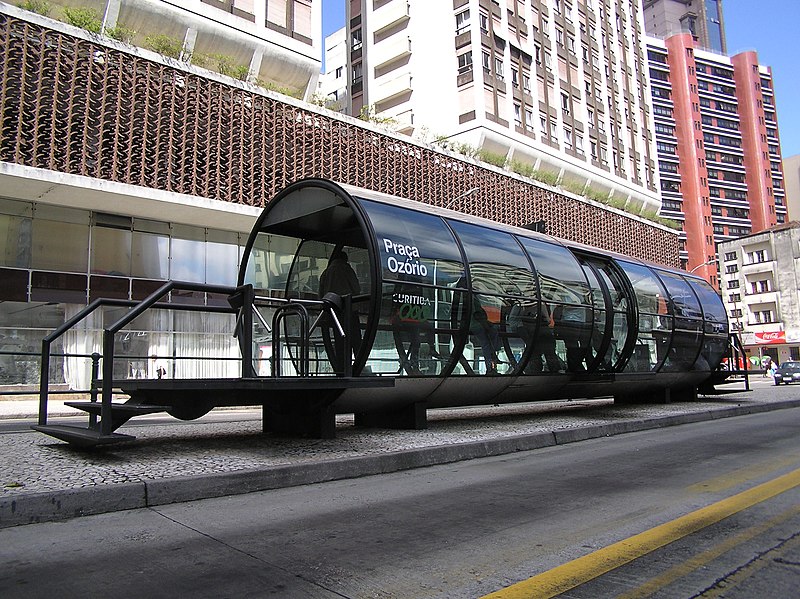
Lernier should know what he is talking about, he not only pioneered the Bus Rapid Transit system, he also pioneered innovative city maintenance systems such as:
  • using herds of sheep instead of tractors to keep the grass in the city parks -saving the city millions in mowing costs
  • paying fishermen to collect garbage (by the pound) from the neighboring bay -cleaning the bay in no time while giving the fishermen income year round and saving the city millions in clean-up and maintenance costs
  • trading bags of groceries and transit passes to people in slums in return for bags of garbage (cleaning up the streets in the slums which were too narrow for garbage trucks to get into)

More after the jump...

Lernier started planning and building Curitiba's Rede Integrada de Transporte in the 70's after doing a cost analysis that showed:
...that "heavy rail" like a subway costs ten times the amount for "light rail" (trolleys), which, in turn, costs ten times a bus system, even with dedicated bus ways. The "light rail" savings usually touted to sway municipal decision makers occur because even trolleys can have relatively fewer drivers than a 40 - 60 passenger bus. Lerner got Volvo to make 270-person accordion buses (300 Brazilians, says Lerner), so that was no longer an issue. The City built attractive transit stops with the look and feel of train stations -- and all the handicapped access equipment -- and got private firms to purchase and operate the buses. The city controls the routes and fares, while the private companies hire drivers and maintain equipment. (Emphasis mine-udc.)
The success of the BRT inspired Bogota's Transmilenio, Mexico City's MetroBus, Jakarta's TransJakarta Busway and a dozen other BRT projects around the world). The system was cheap, easy to roll out and easy to use:
Curitiba has a very simple and practical transportation system. Public transportation consists entirely of buses. There are several different types of bus, each with a different function.

Moving around in a car can be difficult in and around the city centre because of the many one-way streets and constant traffic jams. This makes the public transportation system more attractive if one wants to go there. (Emphasis mine -udc.) The trinary system allows quick access to the city centre for car drivers. Some avenues are spacious and laid out in a grid, and apart from some points around the city centre, Munhoz da Rocha Street and Batel Avenue, traffic jams aren't thus severe.
At the Worldwatch Institute event, Lerner also encouraged:
"greater efforts to turn chronic urban problems into innovative solutions. Curitiba, for example, converted an old landfill into the Open University for the Environment, a school that provides environmental education to citizens and policymakers at little-to-no cost. “In the city, there is no frog that can’t be turned into a prince,” Lerner says.
From wikipedia: "In June 1996, the chairman of the Habitat II summit of mayors and urban planners in Istanbul praised Curitiba as "the most innovative city in the world."

(Btw, Lernier is an architect and an urban planner. His work as mayor of Curitiba and his continuing commitment to improving the urban environment is the kind of action i'd like to see from Filipino architects.)


Image credit: One of the bus stops on Curitiba's pioneering BRT, via wikimedia commons.

1.26.2007

what, not where:
the filipino architect in the megacity

A month ago, landscape architect and urban historian Paulo Alcazaren asked the question "Where are the Filipino architects?" in his CITY SENSE column for The Philippine Star. The column is reprinted in this entry on Arkiboks and in this post at the Heritage Conservation Society-Youth egroup. (You have to be a member to read the egroup thread.)

So this is a belated reply to Paulo's thoughts. I offer a critique, not a reaction and I hide behind Malcolm Gladwell who thought that "the immediacy of web publishing makes some people lazy. They type faster than they think; or they believe that a reaction is the same thing as an argument."

Alcazaren bewailed the lack of visibility (and business) of local architects:

"Philippine architecture in 2006 finds itself at the edge of another construction boom. The problem today is not so much how to project Philippine architecture abroad as it is to project itself into the consciousness of contemporary Filipinos.

"Filipino architects are generally invisible. Almost no Philippine designer is a household name. This is because of the commodification of the whole process of making houses. These are known as "housing products" (the term used by developers), designed anonymously and built by model number or mass produced like burgers and fries."
I agree with him that the Filipino architect is largely invisible - the big names in the field are a generation old (Locsin, Nakpil, Santos, etc.). And yes, the local industry is not immune from the commodification of architecture into "housing products" -but that trend has been around for more than half a century. He should not be surprised that the factory paradigm (the dominant business model since Henry Ford invented the assembly line) should invade the business of real estate.

I do think, though, that he is looking in the wrong place, bewailing the wrong cause. He's not so much asking "where are the Filipino architects?" as he is asking why the architects aren't landing projects and making money.

"Where are the 30,000 or so Filipino architects and affiliated design professionals? They are invisible, save to their immediate relatives or project managers of real estate development firms who are tasked to produce the best product with the least budget (cheap but good) and if there was a budget, to pay a foreign consultant premium fees, which more often that not cut into the local consultants' fees."
Alcazaren argues that "Good Filipino architecture and its related disciplines can create the physical settings for social and economic change." Which I cannot disagree with but he ends his rant with an exhortation to the public and the profession to:
"give Philippine architecture a long hard look. Filipino clients have to give Filipino architects and related professionals the chance to do what they do best – design wonderful buildings, malls, resorts and housing to world-class standards (emphasis mine -udc). But to do this, world-class fees must also be part of the deal. If you pay peanuts, you get houses for monkeys."

This is where I part with him. I think the Filipino architect is invisible because they are worrying about the wrong problems. They look at the building boom and their own lack of commissions for the "buildings, malls, resorts and housing." They look at the money trail and worry that the big names from the western world (brands, really) have eaten their share -and this, they claim is the reason why they cannot build imaginative, inspiring Filipino architecture. Alcazaren presses their case (despite his pontifications) and unabashedly says that the Filipino architect can become visible -can be relevant -if only they get a fair cut of the big projects coming down the pike.

I contend that they are irrelevant because the problem they are bewailing is selfish and irrelevant to the current issues challenging our megacity. They worry that upper and middle class housing has become commoditized when the big problem staring Metro Manila in the face is a housing shortfall of 1M units. They worry about the big private projects when the issue at hand is the lack of civic life and civic sense in our urban life. They worry about their names on condominiums and subdivisions when we are challenged by unlivable streets and the lack of public spaces.

I do not hold it against architects to seek profit, they are running businesses not charities. But I do expect them, as individuals trained to understand the built environment, to speak out and help find solutions to the urgent issues that confront their countrymen who must live in that built environment. I hold it against them for looking at the "buildings, malls, resorts" and overlooking the dense squatter colonies and the inhospitable roads that are the fabric of our megacity.

I would be remiss if I generalized that all Filipino architects are infected with the above irrelevance, there is the work of CentroMigrante and TAO-Pilipinas. I also know that semester after semester, students from the UP and UST schools of architecture work on projects that consider design solutions to the problems of informal and low-cost housing.

I don't intend this post to just be a counter rant -but as a challenge. I leave you dear reader (perchance you might be an architect) to find inspiration in some of the work that I cite below. Innovations are coming to the field of architecture and the business of building human habitats. Our megacity presents an amazing real world laboratory for which our architects can create innovations that we can share with the other megacities that share our plight and our challenges. Instead of dreaming of achieving the monumentality of I.M. Pei, they should inspire themselves to find the sensitivity of Charles Correa. They should be an active voice in the shaping of policies that ultimately shape our built environment.

The two projects below take the idea assembly line beyond the pre-fab of products like Vazbuilt and the catalogue houses it takes its patterns from. Green technologies - new paradigms and new technologies are promising to both lower the cost and speed the roll out of housing. Our architects would do well to consider these approaches.


This article in the January 2007 issue of WIRED magazine, featured the Loblolly house.
Snapped together from a combination of modules, panels, and preformed structural frames, the Loblolly house, named for the loblolly pines here in the Maryland tidewater area, is a manifesto for a new way of building. Architect Kieran and his partner, James Timberlake, have long been known for their finely crafted and energy-efficient buildings and materials. But the Philadelphia-based pair wanted more than just high-profile commissions – they were looking for a breakthrough technology that would let them make smarter, greener structures that could go up quickly and cheaply.

In 2001, after studying how the automotive, aircraft, and shipbuilding industries had revolutionized themselves over the previous 15 years, Kieran and Timberlake realized that architecture needed the equivalent of an integrated circuit. They began to combine glass, drywall, pipe, and wood frames into finished units, each precision-engineered for cost, beauty, and sustainability. In the Loblolly house, the walls and floors are made of panels (some as tall as 21 feet) that were manufactured with wiring, insulation, plumbing, and ductwork already in place. And the main power systems of the home, including two bathrooms and the galley kitchen, were delivered to the construction site in preassembled, plug-and-play units. After the site was prepared, the 2,200-square-foot house took three weeks to assemble.

Then there is the soon to be rolled-out technology that allows construction companies to "print out" a building.

Contour Crafting (CC) is a layered fabrication technology developed by Dr. Behrokh Khoshnevis of the University of Southern California. Contour Crafting technology has great potential for automating the construction of whole structures as well as sub-components. Using this process, a single house or a colony of houses, each with possibly a different design, may be automatically constructed in a single run, embedded in each house all the conduits for electrical, plumbing and air-conditioning.

The potential applications of this technology are far reaching including but not limited to applications in emergency, low-income, and commercial housing.


Image credit: Previ Housing by Charles Correa. (Lima, Peru. 1969-1973).

good ideas


Last week, the CEO for Cities blog noted a series of columns from The Hindustan Times. The series was called "My Vision for Mumbai."

"The columns, bylined by invited residents of the city, were intended as a series of ideas on transforming the city.
One column I clipped and brought (home) was by Milind Deora, member of Parliament. In it, he argued, "We have to unite our views on what needs to be done for this city. Mumbai has 15 million different visions. A commuter's vision is different from a man who drives a fancy car. And a pedestrian has a third point of view. All of us have a role to play in uniting our vision.
"Someone living in a slum has to know that his or her vision has to tie up with the millionaire living in a high rise. Once that happens, we will be able to come out with a common blueprint and stick to it. And then place our collective demands before the various layers of government."

CEO for Cities says: "U.S. papers might take a cue from The Hindustan Times. This would be a valuable conversation for any newspaper to host."

I couldn't find the columns online (maybe they were exclusive to the print edition), but I certainly think that our local papers should also consider running such a series.

I have long bewailed that the metro sections of our newspapers deal nothing with metropolitan issues apart from featuring local crime stories with an occasional MMDA press release on traffic or garbage issues. Is there nothing else about our cities apart from crime, traffic or garbage?

It would be a welcome relief to ask our wannabe senators (be they pro, anti or third force) how they would address the long neglected urban issues that the majority (60% and growing) of our countrymen have to live with day-in and day-out. Ask the pols what their vision is for Metro Manila and our other urban centers and put that against the vision of the urban poor, of the middle class, of the artists, the technopreneurs, the businessmen, the OFW families, the architects, the students, etc.

If we can start talking about the future, maybe we can actually free ourselves from our past. As Milind Deora, puts it, "All of us have a role to play in uniting our vision."

If someone were ambitious enough, maybe we can work towards something like this.

Quick Links

Notable posts on the metro