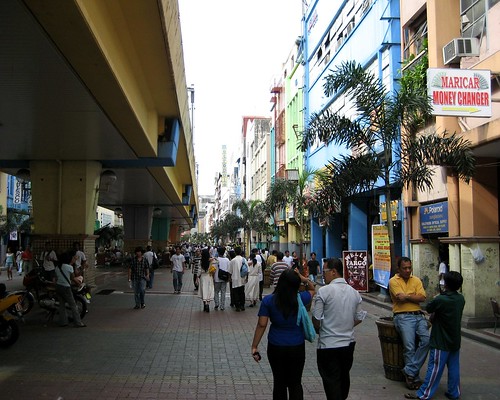
Showing posts with label governance. Show all posts

2.25.2008

getting better public transit in metro manila (part 3)


Mobilizing the political will
to improve public transit in Metro Manila
Part 3: Building a winning coalition

This is part three of a series on how to improve public transit in Metro Manila.

To review where we have been:

Step One is to change the frame. Improving public transit is not about decongesting traffic. It is about social justice.

Step Two is to show an alternative vision. Discussing what is wrong about the status quo will not bring change by itself. We have to show what is possible.
This brings us to:

Step Three: We need to build a winning political coalition
.


Politics often carries a negative connotation but at its root, politics is about the art and science of influencing and shaping public policy and changing policy is about shepherding the proposed changes through the political and policy formation process. It requires the shaping of public opinion, mobilizing that opinion into a political force and then bringing the appropriate political forces to bear at the right points in the process.

Effecting policy changes are often long slogs with victory going to those who can cobble, stable and effective coalitions. Miracle moments (something I'm afraid we have become addicted to) are rare and when they do occur, it usually just results in changes in leadership rather than substantive changes in policy. The change will rarely be lead by policy wonks or elected officials -rather, organized groups must bring political pressure to bear to get the policy wonks to rethink policy and the elected officials to support the change.

Mobilizing the political will to improve public transit in Metro Manila means building and mobilizing a winning coalition.

Who should be in the coalition?

The following groups should be natural core members of this coalition:

1) URBAN POOR: Ideally there should be a commuters union organized and powered by users of public transport. Since there is none, then the urban poor groups should take their place. The urban poor is the sector most dependent on public transit to function in the city and because improving public transit is a social justice issue, then this should be on top of the agenda of advocates for the poor.

2) THE CHURCH/FAITH-BASED GROUPS: Because it is a social justice issue, then the religious groups should also be in the coalition and should be working actively to address that inequity

3) LABOR UNIONS: Workers should also have a dog in the race if inefficient public transit is a bane to families of laborers.

The following groups should be strongly supportive:

4) EMPLOYERS CONFEDERATION and CHAMBERS OF COMMERCE: as inefficient public transit directly effects worker productivity. It also affects the marketability of the city as an investment destination. - More efficient public transit increases productivity and reduces the stress on workers. (These groups can also line up behind the social justice banner.)

I can think of many more groups that can have a natural affinity to this coalition, but i'll stay with this list for now. I'll take any suggestions you might have.

The operational word, of course, is "winning" and it will not be enough to cobble this coalition. The coalition must also effectively neutralize the opposition. And that will be the topic of my next post:

Part 3: Dividing and conquering the opposition


Image credit: Drivers wanted by davefitch

2.13.2008

getting better public transit in metro manila (part 2)


Mobilizing the political will
to improve public transit in Metro Manila
Part 2: A promise of what is possible


So, first we have to change the frame of the conversation: from congestion to social justice.

The consequence of a bad public transport system is not bad traffic (alone) but a fundamental inequity -where those who cannot afford cars or cannot afford to take cars everyday pay a greater share of their household income and pay a greater penalty in time.

A bad public transport system is inequitable. And it is also inefficient.

We need to get better public transport not because we want to get rid of traffic congestion* -but because we want a transport system that does not favor the rich over the poor and the middle class. We want it because we want parents to spend more time with their children and we want students to have more time to study.


The next thing

The next thing we have to do is to provide an alternative vision of what can be.

You cannot change anything by simply complaining about it or pointing out what is wrong. We do not need any more black hats to tell us why something does not work when we know it is not working. We need to see what will work.

You can only inspire and motivate people to change if you show them what can be.

This is where the success of Bogota, Curitiba, Mexico and Jakarta comes in. We don't have to reinvent the wheel. There are many, many successful examples of bus rapid transit projects.

These projects are successful not only in terms of efficiency, but also in terms of economy and democratic participation.

Unlike massive light rail projects, bus rapid transit is:
  • cheaper (at just 1/5 to 1/3 the cost per kilometer vs. fixed rail)
  • cheaper to operate (no substations, no high maintenance infrastructure)
  • is more flexible (if you design the stations right, you can have service overlaps)
  • faster to roll out (transjakarta started in 2004 and will have a total length of 159 kilometers by the end of the decade)
  • is more participative (you can ask existing bus operators and drivers to bid to operate the buses -compare that to their options when we go with expensive fixed rail infra)
We need to invite people from these cities to come and talk about their success. We need to show videos of how BRT works and do TV and magazine reports on our transportation options. We need to show the best practices and the best solutions other mega cities are already exploring,

We need to talk about BRT and other alternative transportation systems (like bicycle networks, and bike rental systems). We need to get everyone to ask:

Why not?
and
So why can we do that here?


Up next, Part 3: Building a winning coalition


*BTW, next time someone says we need to ---take your choice:
  • widen roads,
  • build flyovers,
  • discipline the driver
  • deploy more traffic cops
  • buy a new computerized traffic signal system or
  • build new roads
--to eliminate traffic congestion, challenge them to name ANY CITY in the world that has eliminated traffic congestion by doing any of those actions. I guarantee you, NOT ONE city or region or metropolis in the world has has succeeded using any of those options.

NOT ONE.


There is only ONE PROVEN method to reduce traffic congestion -and that's congestion pricing.

It's been proven in Singapore. It has been very succesful in London. New York is planning to implement it.

2.05.2008

getting better public transit in metro manila (part 1)

Mobilizing the political will
to improve public transit in Metro Manila
Part 1: A sense of urgency


This begins my long promised post on how to get better public transportation (in particular: bus rapid transit or BRT) in Metro Manila.

The first thing we have to do

The first thing we have to do is to create a sense of urgency.

To do that, we have to change the frame of the conversation.

Ask anyone in Metro Manila about the "effects of bad public transportation" and invariably they will say bad traffic. Granted that PUV driving behavior (caused by the economic model) does cause traffic chaos, to put that first on the list of adverse effects of bad public transportation is to be myopic.

Traffic congestion is the most visible effect -but it is largely visible to car users. What is invisible and ignored is the effect bad public transportation has on the urban poor and lower middle classes who are dependent on PUVs to get from home to school or to work.

That segment is the fat part of the pyramid, almost 80% of daily person trips in Metro Manila are taken via public transport. Despite the overwhelming size of this cohort, I have yet to see statistics that detail the consequences of the inefficient system on the riding public.

Whatever conversations about public transit that is covered by the papers centers around fare prices and the issues of the operators and drivers. Their regular threats to hold transport strikes and their near constant refrains of the fares being too low to support their livelihood and their complaints about harassment from the MMDA and the local police. (I am not discounting those complaints, only saying that they have become monotonous.)

The questions we need to ask are: what are the economic and social effects of an inefficient public transport on the riding public in general, and the urban poor in particular? What are the comparative efficiency advantages (e.g. -time) of driving a private car vs. taking the bus or jeep? Specifically we need to ask:
  1. How much of the household budget does transportation consume? (Particularly for the C,D and E classes.) -and this should cover the costs of car ownership (purchase, maintenance and operation) as well as the costs of fares for all modes of public transit.
  2. How much more time does it take to get from home to work or home to school when you take public transit (all modes) vs. a private car?
  3. What is the social cost of the inefficiency and bias towards cars? How much less time do parents in families without cars have to spend with their children? Do students have to rent at boarding houses because it is just not feasible to travel from home to school daily?
My own back of the envelope (read: totally unscientific) calculations make me think transportation eats up about 20% of the household budget of middle class families -and that share could rise up to about a third in poorer families.

I suspect that the inefficient PUV system offsets the daily schedule of transit riders by 1.5 to 2 hours a day vs. private car owners. That's about 20 hours a week of bias for car owners.

But again, these are all just estimates. We need to demand that someone study the real numbers -or bring the stats out if there have already been studies.

We need to bring these issues to the public sphere and we need to frame this as an urgent social justice issue.

Imagine the direct impact you could have on the quality of life of the middle class and the urban poor if you could at least halve that time bias. You would be giving parents 10 more hours a week with their families; giving mothers and fathers an extra hour a day to tend to their children; giving students respite from the grueling time spent on the road or giving them the option of not having to pay for room and board just to live closer to school.

We need to make efficient public transport more important than traffic congestion.


Next up: Part 2: A promise of what is possible


Image credit: "63, alone / solo" by yeraze

7.28.2007

why are there squatters?


(This entry is meant partly as an answer to Peter Anglionto's comment in a previous post and also as an expansion of the ideas from the last entry. Get a cup of coffee, this is a long one.)

The national government declared the other day that it would spend US$ 1.1 billion to resettle squatters in Metro Manila. The government plans to construct 265,955 housing units with each housing unit costing an estimated $4,200 (about PhP 185,000 per).

That news came right on the heels of the MMDA vowing to eliminate squatters from the Metro within 3 years.

All of this might be part of the posturing for the ASEAN Ministers Meeting next month but they are, nevertheless, the latest in a long, long history of attempts to remove and relocate informal dwellers (most precipitated by impending international conferences) and part of the long history of informal settlers in the metropolis.

So why are there squatters? This is, of course a multi-faceted problem, but the usual quick answers are:
  • because of poverty
  • because of lax law enforcement
The two answers are both partly true but the first only addresses the economic status of the informal dwellers (they can't afford to rent from the formal housing market), while the second only addresses the state's inability to prevent squatting in the first place (it can't protect land).

Although poverty does explain the economic choice of the poor in the city (to find housing in the black market for shelter) you still have to ask, why do the poor choose to be in the city in the first place? Why don't they opt to stay in the rural areas? Why the extreme concentrations in the metropolis? Wouldn't the poor be slightly more comfortable in the countryside where there would at least be land to till for subsistence farming?

As to lack of enforcement, many (like Peter) blame the Lina Law (the Urban Development and Housing Act -R.A. 7279) which decriminalized squatting and imposed requirements for relocation before eviction. The provisions, they say, are onerous (at least to the landlords) and abet squatting.

But we must remember that squatting and squatter colonies existed in the metro prior to the passage of RA 7279. There were squatters back when it was still illegal a crime to be a squatter. At the end of Marcos' first term (1968), as much as a third of the population of the NCR were illegal settlers. Even Marcos, with his full dictatorial powers, could not evict the existing squatter colonies and Imelda had to resort to hiding the slums behind the facade of whitewashed enclosing cement walls whenever she hosted an international event. (A cosmetic approach that apparently hasn't lost its appeal.)

You can argue that our feudal, patronage politics encourages large squatter populations, keeping them as voting bailiwicks. As true as that may be, it still doesn't answer the question of why people opt to move into the city and into squatter colonies rather than, as above, staying in the countryside (where, apparently, fewer people go hungry).

So, why are there squatters? Why do the poor choose to huddle into our urbanized areas? The answer to that question also answers why the metropolis experienced explosive growth (in urbanized area and population) in the last half century.

(I couldn't track down any relevant figures in the 2000 census, but in 1958, more than half of the residents in the NCR were migrants from the rural areas. I would venture that the current percentage would be larger given the metro's average population growth rate of 12% since 1948.)

The answer, I venture, is about the relative economic productivity of each square meter of land in the metropolis. The 639 square kilometers of Metro Manila account for a fifth of the nation's GDP. Each square kilometer in the metropolis produces US$ 158,000 per year while the rest of the country's land (and here, I am assuming all other land is flat and arable) produces $1,720 (barely one percent vs. the metro). Which means, in theory, that living on a square meter of land in the metropolis provides the potential of making an average of more than PhP 7,000 per year, while the equivalent in the countryside offers a measly PhP 77.

Of course, these are all gross numbers and averages but the numbers do point to the relative opportunities provided by Metro Manila vs. the rest of the country.

In network terms, the metropolis is a highly connected (economic) hub in a scale-free network. A condition we have to consider if we are to find effective solutions.

Why are there squatters? Because an individual has better chance of earning a living in the city than in the countryside, even if that means living in makeshift shanties on illegally occupied land.

Which then points us to the problem that has plagued our endless squatter relocation programs -taking people out of squatter colonies and moving them back to the provinces (the "balik-probinsya" programs so popular among our local governments) -will not work because the economic logic (the opportunity to make money) will always trump the logic of moving away from the city, even if you provide a shortcut to land or home ownership.

The national government gave no specifics about how it would effect the PhP 50 billion relocation program, but it did specify that the allocation was for building homes. Given our stubborn track record, it would be no stretch to imagine that this means finding building relocation sites outside of or at the periphery of the city. Which is, to say, it will probably also fail.

The squatter problem is intertwined with the challenge of managing and coping with the rapid growth of the metropolis. Which brings me to Peter's question in his latest comment, who exactly in government is in charge of or is planning for this growth?

Apparently, no one directly. I know of no subcommittee of the cabinet that integrates the key issues that characterize urban growth: land use, transportation, housing and economic development.

Ideally it should be the Housing and Urban Development Coordinating Council* -but they seem to be focused only on making housing affordable and providing affordable housing. There seems to be no coordination with the DPWH, that builds highways, or the DOT that manages transportation, and of course, land use is the purview of local governments who report to the DILG.

So, no one apparently. Which is probably why we got into this mess in the first place.

Oh, one more thing to keep in mind. We are not alone. The images above are of squatter colonies from megacities all over the globe. The UN estimates that there will be 2 billion slum dwellers in the world by the end of the decade. We share the problem, and quite possibly the solutions, with the rest of the world.

For further reading, I highly recommend Robert Neurwith's "Shadow Cities." Neurwith lived for two years in four of the biggest slums in the planet (Rocinha, in Rio, Brazil; Kibera, in Nairobi, Kenya; Sanjay Gandhi Nagar, in Mumbai, India; and Sultanbeyli, in Istanbul, Turkey). He spends the first part of his book reporting on the daily life in these neighborhoods then discusses the issue of squatting from the questions and theories of land ownership.

You can catch excerpts and reviews of Neurwith's book from the Global Business Network, from Boingboing, and from WorldChanging.


*I believe the name puts the cart before the horse. If I had my druthers, that acronym should be UDHCC.


---

P.S. -I'd like to express my appreciation to Peter, Eugene and Fred (my "regulars") who take precious time out of their day to read and react to my kilometric and often dense posts. It makes the time I spend researching and writing these entries all the more worthwhile. Thank you, gentlemen.

7.24.2007

growing metro manila


The animation above shows the rapid growth of highly urbanized areas (areas in yellow) in the National Capital Region from 1948 to 1999, and, as estimated, by 2015.

The growth is nothing short of spectacular.

Starting with just 83 square kilometers in 1945, the metro grew thus:

  • 1948 =83 km2
  • 1966 =221 km2
  • 1975 =323 km2
  • 1996 =788 km2
  • 2015 =1,512 km2 (projected)

    (Click on the year to see a snapshot for that year.)

So, in 48 years -from 1948 to 1996 - the highly urbanized core of the metropolis grew by an astounding 705 square kilometers or 849%. That means the development grew by an average of 14.6 square kilometers every year (18%). That's like adding an area half the size of the city of Makati to the metro every year.

The rapid urban growth, coupled with an equally explosive population growth pretty much explains why we went from the idyllic urban scenes of the 60s to the current chaos of Metro Manila.

Greater Manila's population was about 1.5 million in 1948. It hit 10.8 million by 2000. Which meant we added about 180,000 people to the metropolis each year.

That's like moving the whole (current) population of Cebu City to Metro Manila every 4 years.

No planning department (indeed, no organization) in the world could have coped with that kind of explosive growth.

The pace of growth also explains the housing crunch that we currently face. To cope with that growth, we would have had to build at the pace of nearly a hundred houses everyday for the last fifty years. (No, we couldn't get time off for weekends, either.)

I'll discuss this more on my next post - which will also be my answer to Peter Angliongto's last comment.

We're not done yet! If the projections are correct, the highly urbanized core will nearly double in size by 2015.

This kind of growth though is par for the course of megacities worldwide and is a part of the global trend of rapid urbanization.

It's good to keep this frame in mind next time you get tempted to blame all of Metro Manila's woes on our our supposed lack of discipline, or the avarice of our oligarchs or the corruption of our local officials or even the (presumed) faults of our culture.

Remember, it's not the attitude, it's the (sheer) numbers.


Data for map image extracted from MMUTIS
from a presentation by Dr. Ricardo Sigua

7.17.2007

"non-conformist mayor"


I bet you won't find Mayor Sergio Fajardo, of Medellin, Colombia tearing down a pedestrian mall to make way for car and jeepney traffic. No, he's as non-conformist (read: visionary) as they come.

The NYT featured the good Mayor and the turnaround city of Medellin, showcasing Fajardo's simple but radical idea:

“Our most beautiful buildings,” said Mr. Fajardo, 51, “must be in our poorest areas.”

With that simple idea, Mr. Fajardo hired renowned architects to design an assemblage of luxurious libraries and other public buildings in this city’s most desperate slums.
That's radical enough itself, but remember we're talking about Medellin, Colombia -described as the "World's Deadliest City" in the early 1990s. Then, the home of the infamous Cali Cartel and the global cocaine syndicate.

This city of about two million people had 29 homicides per 100,000 inhabitants in 2006, down from 381 per 100,000 when killings peaked in 1991.

Elected in 2003 as an independent, and riding a growing economy and this decline in violent crime, Mr. Fajardo has turned the city into a showcase for new educational and architectural projects.

He increased city spending on education, bringing it to 40 percent of Medellín’s annual budget of $900 million, while also raising spending on public transportation and microlending projects for small businesses.
He's building five new libraries right in the heart of the poorest sections of the city. He put in the Metrocable (an overhead cablecar system) in Santo Domingo Savio, one of the biggest slums in the city. The cable car system leads you to the Parque Biblioteca España, a civic complex that includes a library, auditorium, Internet rooms, day care center and an art gallery (Can you imagine a museum in the heart of Payatas?)

To be sure, the bold moves haven't been a panacea. The city still faces serious problems. The drug syndicates are still there, and, as NYT reports, the street kids in Plaza Botero (pictured above) still sniff glue and beg in the streets. BUT, the radical reinvestments are changing the way the city (and its citizens) views itself.

And yet Mr. Fajardo’s transformation of Medellín has captivated the city and, increasingly, other parts of Colombia. His approval ratings stand at more than 80 percent, making him the country’s most popular mayor and leading him to be widely mentioned as a potential presidential candidate after his term ends this year.

“He is carrying out a redistribution of wealth without a discourse of rage,” said Héctor Abad Faciolince, a prominent novelist and political commentator here. “If Medellín cannot take these risks, then what place can?”

What risks are we prepared to take?


P.S. -Read Mayor Fajardo's letter to National Geographic protesting NatGeo's photo essay on crime in the Medellin and listing the achievements of the city under his leadership.

6.30.2007

rent control redux


"High transaction costs, rent control linked to RP slums"

So goes the headline of this Inquirer article (archive copy) reporting the research findings of the Global Property Guide. Which pretty much confirms the points I made about how our intractable rent control law is to blame for the size of our squatter communities.

This from the article (emphasis mine):
The Philippines is the only country -- other than Taiwan -- in East Asia with a rent control law. Rent control and high transaction costs tend to discourage property owners from participating in the market, leading to lower supply.

If households cannot buy or rent housing due to prohibitive costs and lack of options, they may turn to self-built houses, or worse, illegally built houses on lots owned by other entities (squatting).

The GPG report itself highlights the high real estate transaction costs in the Philippines ("roundtrip" transaction costs can take up to 35% of the total property value) - and GPG reports the process of registering property in Metro Manila as "the most cumbersome in Asia."
There are eight procedures in registering property...

“In addition, payments must be made to three different offices: the Register of Deeds for the registration fee, the BIR for all the taxes and the City or Municipal Treasurer’s Office for the transfer tax. With each office and payment, there is always room for corruption and extortion.”
The report makes the following recommendations to reduce transaction costs:
  • The establishment of a one-stop-shop for property registration and payment of taxes;
  • Centralization of property valuation records held by the BIR, city and municipal treasurer’s offices, banks, Register of Deeds and other agencies;
  • Establishment of a standard property valuation system;
  • Creation of a website for all the necessary data for the real estate market; and abolition of the rent control law (the government should instead provide a standard contract for rental agreements).
Doubtless this will help people who want to buy and sell property but to expand the rental market and provide better housing options for the poor, we have to touch that third rail and find a path to gradually but definitively eliminating rent control. This is the only way to create a large scale, market-led response to creating better housing for the poor.

In my post last year, I focused on why eliminating rent control should be high on the Heritage Conservation Society's strategic goals:
Now why should this be important to the Heritage Conservation Society? Because the only real way to preserve our built environment is to make sure it is in the economic interest of the owners to invest in their properties. The Society may save a building or two by their current media strategy but they will do an even greater service to Metro Manila's heritage by making sure it is financially rewarding for landowners to reinvest in old buildings. Otherwise, the lack of actual income from rent causes disinvestment and decay. Landowners who can source new capital will more likely tear down their old buildings, while those who do not have the resources will not even be able to re-finance enough so that they can invest in the upkeep of their old buildings.
As to the effects of lifting rent control on the poor, I had this to say:
Now what about the poor? Won't lifting rent control make it more difficult for the majority of our population to find housing? We've had rent control for over 5 decades. As Dr. Phil likes to ask, "How's that working for you?"

Multiple Choice Quiz: We add over 100,000 people to the population of Metro Manila each year. And because we build so few new apartments, where do you think most of our new internal migrants wind up living?

a) In dilapidated housing
b) In crumbling apartment blocks
c) In old, over crowded boarding rooms
d) In squatter colonies
e) All of the above
(Take the time to read through the extensive and thoughtful comments to that post.)


Image credit: 960618-Payatas-22
by KarlMarx

6.26.2007

it has begun

Senor Enrique reports that Lim has started to demolish the pedestrian mall.


No consultations. No review. Just sledgehammers.

No defenders either.

At this rate, Manila Zoo is also probably doomed. And the Baywalk should also be nervous.

Sigh. Short-sightedness, lack of vision wins again.

We really, really need 1,000 Friends of Metro Manila.


Image credit: Senor Enrique
Wish you were here

6.08.2007

forward thinking in naga city

Take time to read through Willy Priles' recent posts about the University of British Columbia (SCARP) urban planning research studio presentations in Naga City. The students were led by Dr. Leonora Angeles whose areas of specialty include (very aptly) participatory planning and governance and gender and international development.

I also did travelling studio classes when I was in grad school are they are win-win propositions all around. The students get hands-on, on the ground experience as well as exposure to different cities and cultures, while the host (and subject) cities get innovative ideas unvarnished by local political expediencies.

My favorite studio was in Wuhan, China under (then Dean) Peter Rowe. We considered and came up with proposals for the Wuhan master plan, in general, and the redevelopment along the Han River waterfront, in particular.

But I digress.

Of particular interest to me were the UBC team presentations on urban design and placemaking for the Naga CBD, and the presentation on land use and urban planning (subjects near and dear to my own heart).

Was pleased to see Curitiba and Surabaya cited as examples in the land use and transpo presentations. And was even more pleased that the discussion centered around smart growth.

Of course, I have my biases. It would be fantastic if Naga, which already leads the country in participative governance, could also lead the country in smart growth, a.k.a. -sustainable urban development.

Vancouver (in B.C.) also happens to be one of the leading lights in smart growth. (For people interested to learn more about smart growth, here are the 10 Principles, or you can download this pdf (140kb) that explains what it's all about.)

The UBC team also highlighted demand-led transportation strategies (i.e. -providing alternatives to car use, vs. the supply method of building more capacity to accomodate more cars) and discussed induced demand, something our own transportation and urban planners really need to hear.

The major component of the land use presentation was a proposal to create greenways throught the Naga CBD and out to the key nodes in the city. (See image.) And Willy reports that it had considerable reactions (both pro and con).

I think Naga should seriously consider greenways -but that these should be reshaped into pedestrian and bike and pedicab routes (hmm, expressways for the pedicabs?). They should also consider modelling the CBD segment of the greenway after Barcelona's La Rambla, which is more of a linear pedestrian mall and market. That way, they don't have to try to aggregate the street vendors into the existing public markets. (Trying to get street vendors into public markets has been tried and has failed countless times in countless cities. Witness the continuing battle for street space in Baclaran.)

I hope the biggest message Naga's leaders get from the UBC presentations is that participatory governance, charting the city's future, should also include envisioning the future physical and geographic configuration of their built environment. After all, people don't live in policies -but live in the physical consequences of those policies.

6.06.2007

two steps back


Oh for heaven's sake:


Mayor-elect Alfredo Lim has promised to reopen the closed portion of Rizal Avenue when he assumes office next month.
And where do these clowns come off suing Atienza to re-open the road to vehicular traffic "in (sic) behalf of Manileños?”

Do we need a Pedestrian Rights group? Do we need advocates for Complete Streets?

Where are the lovers of the city? Is this something the Winner Foundation should step into despite their enmity with the immediate past mayor? Parks are about people -and so are pedestrian malls.

Will the merchants of Avenida, who seem to have benefited from the pedestrianization, not speak up?

Ay! Read the last part of this post and learn from Lernier's urban accupuncture.


Image credit: Avenida Rizal, by Senor Enrique.

6.02.2007

curitiba v. bogota


Prof. Randall Crane compares Curitiba and Bogota in the latest post on his Urban Planning Research blog ("Cheap Chatter on Urban Studies"). I don't always agree with Prof. Crane but he does offer very insightful research into urban economics and urban planning. (c.f. this lecture in Toronto on "Sex, Lies and Commuting in the U.S. -1985-2005" -Quicktime. Windows media version here. )

Bogota, he says, "is substantially safer and more pleasant than I imagined, owing apparently to a series of quite visionary and effective mayors over the past decade and a half."

He cites this presentation by Arturo Ardila-Gómez that disputes some of the points made by this NYT article (subscription -but cited in full on Matt Khan's Environmental and Urban Economics blog here) on Jaime Lernier's success in Curitiba. The NYT article contends that Lernier's success was secured during the military dictatorship. According to Crane, Ardila-Gómez contends that, "Lerner was effective mainly because he was a coalition builder, even when the system was not particularly democratic."

Our own mayors should take notes on the need for "visionary and effective mayors" and "coalition builders."

Ardila-Gómez's presentation on the "Institutional Framework of the BRT processes in Curitiba and Bogota" also contains gems for Metro Manila. He compares the similar institutional settings before the BRT systems were put in place in Curitiba and Bogota:

  • Weak government agencies
  • Weak multiple bus operators
  • Result: extreme competition and low level of service
  • User pays inefficiency with inflated fare
  • Few powerful actors win e.g. bus operators
Then cites the first institutional change enacted in both cities - to strengthen bus operators by:
  • Curitiba, 1955-58:
  • ---From 150 to 9 operators by assigning each an exclusive area to operate (monopoly)

  • Bogota, 1998-2000
  • ---68 bus companies consolidated into 4 large operators for TransMilenio with exclusive rights to new routes

    ---large capital investors in some cases own majority stake

He goes on to cite the differences in approach in each city and concludes that effective BRT rollouts require strengthening both the bus operators and the government authority.

What is comforting is the how similar our own metropolis' situation is with the initial institutional frameworks of both Curitiba and Bogota.

All we need now are the visionary mayors.

P.S. -Read the NYT article to catch this emblematic story of Lernier's political smarts:

On Saturday mornings, children gather to paint and draw in the main downtown shopping street of Curitiba, in southern Brazil. More than just a charming tradition, the child's play commemorates a key victory in a hard-fought, ongoing war. Back in 1972, the new mayor of the city, an architect and urban planner named Jaime Lerner, ordered a lightning transformation of six blocks of the street into a pedestrian zone. The change was recommended in a master plan for the city that was approved six years earlier, but fierce objections from the downtown merchants blocked its implementation. Lerner instructed his secretary of public works to institute the change quickly and asked how long it would take. ''He said he needed four months,'' Lerner recalled recently. ''I said, 'Forty-eight hours.' He said, 'You're crazy.' I said, 'Yes, I'm crazy, but do it in 48 hours.' '' The municipal authorities were able to accomplish it in three days, beginning on a Friday night and installing paving, lighting, planters and furniture by the end of the day on Monday. ''Being a very weak mayor, if I start to do it and take too long, everyone could stop it through a juridical demand,'' Lerner went on to explain. ''If they stop the work, it's finished. I had to do it very fast, at least in part. Because we had discussed it a great deal. Sometimes they have to have a demonstration effect.''

The demonstration worked. Within days, impressed by the increase in their business, the once-recalcitrant shop owners were demanding an extension of the traffic-free district. Some diehard motorists, however, sulked. Lerner heard that a group of them were planning to disregard the prohibition and drive their cars into the street on a Saturday morning. So he contrived an unbreachable defense. With the cooperation of the city's teachers and a donation of rolls of newsprint and boxes of paint, on that morning he assembled several hundred children in the street, where they sat and drew pictures. ''It was to say, 'This is being done for children and their parents -- don't even think of putting cars there,' '' he told me. The sputtered-out protest was the last resistance to the pedestrianization of the shopping area, which has since expanded from the original 6 blocks to encompass about 15 today. ''Of course, this was very emblematic,'' Lerner recounted. ''We were trying to say, 'This city is not for cars.' When many mayors at the time were planning for individual cars, we were countervailing.'' He observed that it was emblematic in another way also: ''From that point, they said, 'If he could do this in 72 hours, he can do anything.' It was a good strategy.''


Image Credit: Photo from Urban Planning Research
(Randall Crane)

5.16.2007

all politics is local


I've been watching the local metro races and so far, the old names have had a field day.


But the rest of the info seems to come in trickles.

----

UPDATE: Ali Atienza concedes to Lim. This info via Torn and frayed -who also gives his analysis on the why Atienza lost. Carlos Celdran, despite his misgivings about Atienza, doesn't see Lim as better alternative. I agree.


Image credit: "Three men on horseback racing"
Horse Racing Color Lithograph, 1885 (LOC)

Public Domain. Library of Congress via pingnews.

4.25.2007

mbo or gbn

That's Management By Objectives vs. Governing By Numbers.

I was reading through Willy Priles' latest post on the prospects of implementing the principles of New Public Management (NPM) in the Philippines and wondered if NPM's MBO style management would be more effective if it were paired with Citistat's model of Governing By Numbers.

Citistat, which garnered a prestigious Innovations in American Government Award from Harvard's Kennedy School of Government in 2004, was a program pioneered in Baltimore City by then Mayor Martin O'Malley. (O'Malley was recently elected governor of the state of Maryland). The Mayor implemented CitiStat (based on the ComStat program pioneered in the New York City Police Department by Jack Maple) as a government accountability tool and basically used it to run the city.

This is how the KSG Award site describes the working of Citistat:

"In bi-weekly meetings, the manager of each city agency must stand at a podium and answer questions from a panel led by the mayor or his appointed inquisitor. The questions are culled from CitiStat's statistical analyses of the agency's previous two-week performance. During the meeting, various images are projected onto two screens behind the manager: graphs of performance, recent pictures of job sites, and even the manager's face beside a performance chart. However, CitiStat was not created to assign blame; it was created to generate personal accountability for the City's challenges and focus efforts towards producing quick, effective results. In Mayor O'Malley's words, CitiStat "puts a face on the problem."

Sitting behind the manager's podium are heads of other relevant agencies. When a problem is attributed to resources or inter-agency cooperation, the other managers may be called upon to help find a solution. For instance in 2004, when an agency fell behind its goal for cleaning up after street repairs, the manager complained of inefficient four-man crews lacking sufficient equipment. The resolution, after consulting the finances manager, was to purchase more effective equipment, allowing each crew to be reduced to two. Ultimately, this permitted the department to clean twice the number of sites at approximately the same pace.

CitiStat's primary innovation is its ability to tailor performance evaluations to each agency: the animal control manager must explain an increase in strays and propose a solution; the housing manager must explain a chart of vacant houses and the plans to resolve this problem; all managers may be asked to explain each hour of their department's overtime."

How effective was Citistat? The program cost the city $400,000 to implement, and they reaped over $100 million in savings in the first 4 years. And lest you think it requires some fancy proprietary software, Baltimore built the system on largely off the shelf GIS software and often kept the data on simple excel spreadsheets. Which makes me believe Willy's home city of Naga, and our other small innovative cities can readily implement this system. (This can work very well with Naga's great GIS maps.)

So how could this help NPM? Citistat's 4 tenets:
  1. Accurate and Timely Intelligence
  2. Effective Tactics and Strategies
  3. Rapid Deployment of Resources
  4. Relentless Follow-Up and Assessment
-could be the day-to-day application of NPM's "Concepts," namely:
  • Lean State – reduced tasks performed by state
  • Separation of Decision Making Levels – Separation of the strategic from the operative level: politics decides the what, administration the how
  • Lean Management – Combination of management by objectives, flat hierarchy, project management, performance related payments, modern methods of leadership
  • New Service Attitude – Customer orientation: satisfaction in the center of all considerations, behavioral changes
  • New Model of Control – Steering by clear targets, measurement of results, transparency of resource allocation
  • Decentralization – Task, responsibility, competence and budget in the hand of the project manager/ department manager
  • Quality Management – Ensure high service quality through qualification, competition, transparency
  • Product Approach – Describing all administrative service as “products” highlighting factors such as: features, cost, needed resources, and time to deliver
Where NPM provides the goals of how government should be run, Citistat provides a day-to-day measurement of delivering on the goals of that model.

Where NPM is internalized and qualified -defining the management model for public administration; Citistat is externalized and quantified -measuring the performance of government in very concrete terms. ("Since CitiStat's statistics are published on the city website, the public also benefits from the increased governmental transparency.")

NPM is about the philosophy, outlook and motivation of government (e.g. -"emphasizing the centrality of the customer"), while Citistat is about nuts and bolts and the response times of the nervous system of government (e.g. "measuring how long it takes to get a pothole repaired from the moment it is first reported.").

Both are innovations that can be implemented at the local level (as Wily recounts in the Naga experience) and entrepreneurial local mayors and governors can move forward with either system without having to wait for the national government's initiative.

(In a sense, Naga is already doing a similar program to Citistat with their Netserve initiative that gives citizens expected delivery response times for various city services.)

You can find out more about Citistat and Governing by Numbers by reading Daniel Esty and Reece Rushings recently released report for the Center for American Progress.

3.13.2007

Is Democracy the Best Setting
For Strong Economic Growth?

Found this WSJ Econoblog (via M. Khan's Environmental and Urban Economics)

It's a conversation with K. Daron Acemoglu and Ed Glaeser on the relationship between democracy and economic growth.

But what exactly do we know about the relationship between democracy and economic growth? Economies of less-than-democratic nations such as China have surged in recent years. Does a country's brightening economic picture boost the chance democracy may eventually blossom? Or is it the other way around? Are democratic institutions a key component of long-term economic growth? And what's the role of education?

I think it is a must read.

Some gems:
(warning, most links are to pdfs)

Glaeser: Rich countries are stable democracies. Poor countries tend to be political basket cases, careening between brutal dictatorships and unstable semi-republics. The relationship between democracy and wealth might suggest democracy naturally leads to prosperity. This view is comforting and also gives us another reason to enthusiastically try to export democracy globally.

While I yield to no one in my passion for liberty, the view that democracy is a critical ingredient for economic growth is untenable. There is no robust statistical relationship to back it up, and Robert Barro actually found democracy reduces growth, once he statistically controls for the rule of law.


Acemoglu: So, why haven't democracies been more successful? I believe the answer lies in recognizing two things. First, there are different kinds of democracies. And second, it's important to consider that economic growth and democracy have a very different relationship over the long term -- that is for periods as long as 100 years -- than over the short or medium term.

Many societies counted as "democratic" using standard measures are really "dysfunctional democracies" where traditional elites dominate politics through control of the party system, political influence, vote buying, intimidation and even assassination. Colombia, which has had regular democratic elections for the past 50 years, is a typical example. In others, democratic institutions survive, but there is significant in-fighting between ethnic groups, religious groups or social classes. The situation in Iraq would be the most extreme -- but not a unique -- example. Finally, many democracies suffer economically from populist and irresponsible macroeconomic policies, which are often adopted after transitions from repressive dictatorships and during periods when politics are turbulent and conflicts over wealth distribution are strong.

On the second point, it's true that autocratic regimes can generate growth for certain periods of time by providing secure property rights and good business conditions to firms aligned with political powers. But modern capitalist growth requires not only secure property rights, but also creative destruction, that is, the entry of new firms with new ideas and technologies that replace the successful firms of the past. Creative destruction requires a level playing field, which democracies are better at providing because they have more equal distributions of political power than autocracies or monarchies.

So, if we look beyond the past 60 years, we see that it was the U.S., with its democratic institutions, that created the environment for new businesses to enter, flourish and spur the industrial growth of the 19th century. There were many rich autocracies and repressive regimes in the 18th century, including places like Cuba, Haiti and Jamaica. But it was the U.S. that grew rapidly over the next two centuries while these autocratic regimes stagnated.The relationship between human capital and democracy that Ed raises is fascinating. But I will return to that in a little in the context of the causes of democracy.

Further:

Glaeser: Since democracy is always vulnerable, I think the key question is why it survived for centuries in some countries like the U.S., the United Kingdom and the Netherlands -- and died quickly in other places, such as post-colonial Africa. One answer is that human capital -- education -- is the bedrock for lasting democracy. Empirically, initial education strongly predicts the survival of democracy education and the survival of democracy in our research.

We found 95% of the democracies that ranked as "well-educated" in 1960 stayed democracies for the next 40 years. By contrast, 50% of 1960's "less well-educated" became dictatorships within a decade. The survival of democracy hinges upon capable people who have the incentives and ability to protect their rights against would-be dictators. Education produces social capital that makes it possible for people to organize and makes them think that democracy is worth fighting to protect.


Acemoglu: Looking at the data, there is no strong evidence that either education or economic growth is a major factors in creating or strengthening democracy. In fact, countries that have grown fast over the past 50 years -- or over the past 150 -- . Consider the recent experience of Russia and Saudi Arabia. If suddenly the price of oil increases and they become much richer, do we expect them to become more democratic? The same applies to education. Countries that have boosted education levels haven't been more likely to consolidate democracy or transition from autocracy to democracy. After all, former Socialist republics had very high levels of education during the Cold War, but did not show a strong tendency to become democratic.

So what does strengthen democracy? Recent research by Benjamin Jones and Benjamin Olken finds that enlightened leadership matters, but it only in autocracies. In societies with strong institutions and established democracies, leader quality seems to have little effect on economic performance. This again makes me think that established democracies, by introducing checks and balances, create a good environment for collective decisions and resolution of conflicts. This type of environment for collective decision-making is the best guarantor of long-run economic development.

Lot's of good food for thought, so dig in.

11.29.2006

design of democracy (6)
signal, noise and oligopsonies


At last. This took a while. I struggled with parsing the design ideas but realized that I needed to talk about the system in more theoretical terms (i.e. -signal processing and economics). I struggled with making the concept as succinct and reachable as possible but decided I didn't want to sound condescending nor do I want to patronize my readers (assuming I still have readers). I hope you take this (more esoteric) post in the context of the rest of the series (1, 2, 3, 4 and 5).

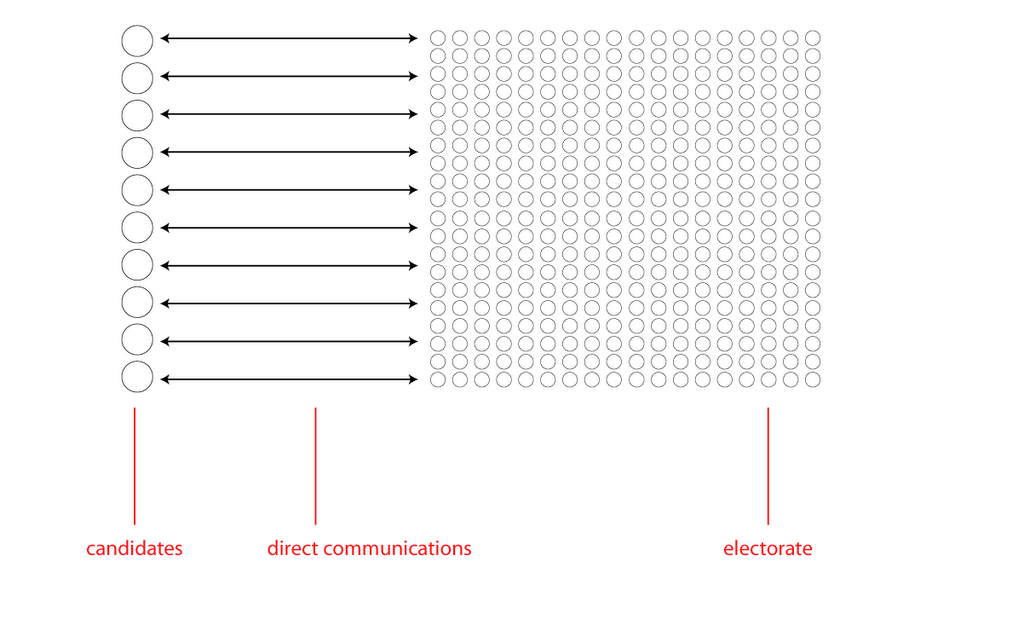
In my last post on this topic, I discussed how large electorates basically cause a market failure in the eoconomic-transaction model of democratic elections. The information asymmetry inherent in reaching a large electorate causes a market failure by reversing the transactional role of the candidate and the voter. The candidate becomes the buyer in the equation, the voter is the supplier. The kink in the system is that the buyer buys only in bulk -and the power shifts to the aggregators (middlemen) who can deliver or assemble the required number of votes. (The role of the aggregator can take the relatively "benign" form of the spinmeisters and message shapers or the media. It can also take the more malignant incarnation of the dagdag-bawas comelec mafias.)

The small number of bulk buyers (candidates) relative to the large number of suppliers (voters) characterizes an oligopsony.

The information asymmetry in the system is basically a signal vs. noise problem. The large electorate prevents direct one-to-one communication (symmetrical communication) between candidate and voter. To reach as large an audience as possible (to sway as many voters), the candidate's message must be amplified through various channels. Inherent in any amplification is distortion, noise and filtering. The fidelity of the signal is further compromised by the adversarial nature of elections. Attack ads, dis- and mis- information campaigns increase the noise in the system apart from the cacophony of multiple messages from multiple sources. Again, both the candidate and the voter (moreso the voter) cede power and control of the communication (and subsequent transaction) to the media channels.

(Some may argue that new media (the internet) may correct some of that information asymmetry. The Net does undercut the role of traditional media but current technology only really adds to the noise, requiring even more work for the voter to extract signal from noise.)

How we solve the problem? Well, how does one solve a) oligopsonies and how does one b) reduce noise in the system?

oligopsonies
  1. You can try to regulate an oligopsony so as to cut the power of the buyers and aggregators.
  2. Or you can act break up the market. In an oligopsony, the suppliers (voters) have less power because very large majorities (or pluralities) are required to win elections. (Each vote is further diluted by the number of posts a voter must fill up on the ballot.) Breaking the market almost always means atomizing the market. Breaking it up into smaller pieces so there are smaller markets with less candidates vying for the vote of a smaller electorates. (And no, this is not an argument for federalism. I am talking about the size of the markets, not the form of the governance.)
We've tried the first option -regulation -as evinced by the myriad rules governing our electoral campaigns. Regulation requires enforcement and apart from our weak enforcement, it is also true (I think I've said before) that any system that requires external enforcement to work is essentially an ineffectively designed system.

signal-to-noise
  1. You can reduce the noise in the system by increasing the signal and reducing the noise in the signal-to-noise ratio. You can try to do that by brute (technical) force by designing a system that checks for fidelity and corrects for deviations from the signal at multiple points. Systems that do this require more energy and more complexity. (The more complex a system, the higher the potential for failure.) Also, the stronger the amplification (i.e. -media to reach 50M voters) the more energy you need to ensure the fidelity of the signal.
  2. You can also spend energy to make a more sophisticated receptor that can internally filter noise from the signal.
  3. Or, you can cut the distance between the signal emitter and the receptor, reducing the need for amplification and lowering the incidence of noise.
Again, in this case, we've tried the first two options - hoping independent media can insure the fidelity of the signal - or educating voters hoping to turn them into more sophisticated receptors.

What we haven't tried to do is option 2 in both cases: breaking up the market and cutting the distance between the emitter and receptor.

And this is where I make the case for smaller electorates - and ultimately the design proposal. That's up next in what is hopefully the last installment of this series.

9.12.2006

design of democracy (5)
notes on the size of v

The standard market paradigm we have for elections is that candidates are the sellers (supply) and the voters are the buyers (demand). Our ideal is that candidates-as-sellers try to get the voters-as-buyers to choose them based on "sellable qualities" -that is: their ideas (electoral platforms and promises), reputation and track record as leaders. What the voters are buying is a promise of good government or good leadership. In essence, the candidates signal the quality of their product -through their campaign communications. (In this post, again, I will use "buy" or "sell" votes in a value neutral sense. It can refer to the selling of and buy-in to ideas or it may actual financial transactions between the parties.)

This is well and good but it assumes that voters-as-buyers have direct information about the sellers. The market paradigm encounters problems in elections that involve a large electorate (v). The size of v creates problems of information asymmetry, particularly in modern societies. Where the candidates and campaigns are armed to the teeth with polling data and sample tested communication strategies, the voter must rely on second hand information (often not even from third party reports) about the candidate. When the voting population reaches into the hundred thousands and into the millions - all information is second hand - filtered -by media, by image managers. (With an electorate size of 50M -the candidate will have to appear to 2 crowds of more than 250K each for everyday of the 90 day campaign period just to make sure every voter sees them in the flesh. Clearly that is unrealistic.)

My contention is that the inherent information asymmetry is so one sided so that we essentially have a market failure. More so, the information asymmetry actually reverses the relationship to: candidates-as-buyers and voters-as-suppliers. (caveat: I am not an economist.)

In contests involving large electorates, the game belongs to the candidate who can assemble the majority (or plurality). The candidate is, in effect, buying votes in bulk volumes, while the voter produces a single widget - their vote. The campaigns basically say "sell your widget to me - I will give you the best value for your widget." From the voter's perspective - the widget maker -the promised payment is better government (or actual financial payoff) if you "sell" to the right bulk buyer

Because the market is so large -there is a need for middle-men -whose job is to aggregate the produce - to assemble the needed volumes of widgets for the buyers who will only buy in bulk. Hence the power of the media, and the campaign professionals and the message shapers and the spinmeisters. They, in essence, aggregate the singular widgets into a majority (or plurality) vote. The vast majority of the widget makers will never meet the bulk buyer in person (they may see them in real life a large rally) but their selection will be based on the pitch given by the various layers of aggregators (the middle men). The malignant side of this condition (the need for aggregators) is vote cheating by volume (i.e. -dagdag bawas).

(The one act given to the widget maker - making a choice between buyers -is further clouded by our synchronized electoral system that makes them choose a president, a vp, 12 senators, a congressman, a provincial governor, several councillors, a mayor, several city or town councillors, etc. )

A large v marginalizes the effect of each individual vote, inverts the economic relationship and gives power to the middle men. It also necessitates a more complex electoral machine: The large v requires multiple layers of counting - multiple layers of safeguards - scaling in complexity the larger the size of the electorate gets.

Next: Effects of a small v

Image credit: "Middle Men" by Clifford Bailey.

9.04.2006

design of democracy (4)
numerator and denominator

LTNE. No comments since last time so either 1) i'm making sense or 2) no one gets it or 3) no one's reading. I'll err on the latter and push on to see where this design exercise leads me.

I left the last post with this key equation:

v/r=c

The numerator (v) is the number of voters. The denominator (r) is the amount of resources a candidate has invested into getting (re)elected. The quotient (c) is the acquisition cost per voter. (OK, for the math purists, we can call them dividend and divisor.)

Jay W. Forrester, used to say that people know intuitively where the leverage points are in a system -and that a lot of attention is put on pushing that leverage point, but often in the wrong direction.

Our electoral system is no exception. We know that overaccumulations of r is detrimental to our system. Our ideal is that candidates stand and are judged on the basis of their ideas or proposal. The reality is, they get elected based on name recall and on meticulously crafted media images.

We have thrown regulation after rule after law to try to corral r -trying to limit it by imposing ceilings on campaign expenses, or trying to balance it by providing government subsidies. We try to wrestle the positive feedback gain so that it doesn't become an advantage. In design terms, we have spent the better part of our energy trying to collar this factor using external controls.

Acting on r -the denominator - is pushing in the wrong direction. What we have not considered is the numerator. We have not considered the size of v nor have we considered managing v to moderate r.

Think about it: our democracy (as all democracies) were designed for much smaller populations. (Athenian democracy ran at the city level.) It did not foresee elections with millions of voters -nor did it comprehend the power of mass media.

If anything, we have let v get away without any controls whatsover. We delineate v not based on population size -but on geography. It doesn't matter whether one district has triple the number of voters of another district -they still both get one representative. The geographic boundaries are totally arbitrary. The district outlines are artificial -and have no grounding on population flows.

We ignore the effects of the size of v in our system to our detriment.

Compare the relative effect of spending P1M vs. P13M* on a campaign with a universe of 50M votes. The cost of acquisition per voter (c) for the candidate spending P1M is 50 -while it is only 4 for the candidate spending P13M. A cost difference of 46M.

But what if v=2,500? The difference in c between a candidate who spent P62,500 vs. a candidate who spent P8M is 0.0397 (corrected thanks to Willy Priles) - that is to say, almost negligible!

Our work should be on the numerator -and the size of the denominator will almost be insignificant. That is to say, work on the size of the voting population and the amount of resources one candidate will have (how much name recall they have or how big their political/social network is) will probably not matter.

NEXT: The advantages of a system built on a low v.

Image credit: Aqui-ali's flickr stream.

*i'm using peso values as stand-ins

8.20.2006

design of democracy (3)
barriers to entry

We have tried to regulate away the positive feedback gain and have failed simply because it is impossible to decouple elected office from the accumulation of power. If the accumulation of power cannot be decoupled from elective office (and I discussed why this was impossible to do in my last post), then this accumulated power becomes a high barrier to entry for would be challengers.

Our democratic ideals say our candidates should be competing for votes based on the ideas they propose (their electoral platform) and their leadership track record (or the level of trust the public places on them). The reality though is that today's media soaked culture rewards high media exposure with high name recall -giving the advantage to candidates who get in the news often (be it political or entertainment news).

Incumbents have the advantage of a high profile job that gives them natural exposure in the news media. This is wholly part of the positive feedback gain. This media exposure along with access to social and political networks presents a high barrier to entry that would be challengers must overcome if they are to be on competitive footing against incumbents.

How do we compute the relative cost of this barrier? What toll does it put on our electoral system?

Investments and pre-investments

Running for an elective position requires resources. The higher the post, the more the resources are needed to get elected to the position. If you are running for president, you are competing for 30M-35M votes, and depending on the size of the field (number of candidates) will need to garner somewhere in the region of 12M to 17M votes. To get elected to the Senate, you will need to garner at least 12M votes. To get elected to the House of Representatives requires anywhere from 25,000 to 200,000 votes (depending on the district) .

You can monetize these voter numbers to see the cost of a campaign (i.e. P1=voter, then you will need P12M minimum to campaign for the senate). This is, at least in theory, relatively easy to do during the actual campaign period. We know of course that campaigning to get elected begins way before the official campaign period and so incumbent politicians who want to get re-elected will devote resources in advance of elections. This is where the comparative advantage - given by the positive feedback gain -comes in.

When the incumbent gets a CDF outlay for her district (and plasters her name all over the project), when she appears in public to give speeches or cut an inaugural ribbon, when she donates to community events, when she appears in the news, or when she glad hands local leaders -she is "pre-investing" resources in getting re-elected. She is also building name recall.

Likewise, a new candidate "invests" in brand creation and name recall when they elevate their public profile (via TV shows, or movies, or appearances in local fiestas, or being cited in the news) so as to get name recall.

Unlike funds spent on a campaign, the pre-campaign "investment" in name recall is nearly impossible to monetize. We need to find a way to measure the relative effect of these investments to see their effect on electoral contests.

Cost of voter acquisition: c as a function of v and r

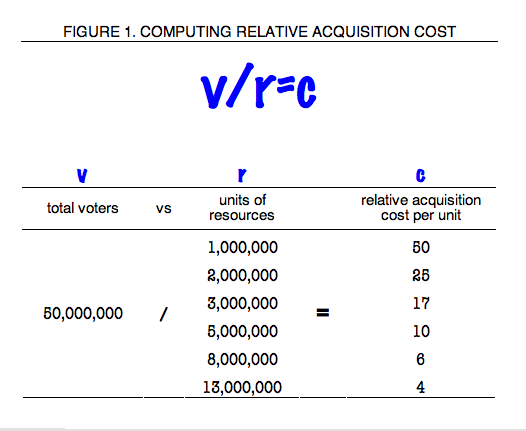
We can attribute a per unit cost (c) to acquiring a voter (i.e. -getting a vote) by expressing it as the ratio of total votes needed (v) vs. total resources expended (r), such that:

v/r=c

The cost of acquisition "c", expressed as a per unit cost, allows us to compute the relative advantage of investing more vs. less resources in an electoral campaign. You can view it as the relative marginal cost of acquiring another vote or the relative "friction" of the system against a candidate. (The lower the number, the lower the marginal cost or the lesser the friction.)

We can use this relative unit "c" to grasp how high the barrier to entry is. It also allows us to illustrate the system dynamic.

Figure 1 (click image for larger view) shows that in a electoral contest over 50 million votes, investing 12M more units gives a candidate a relative advantage of -46c vs. a candidate expending 1M units. In other words, the marginal acquisition cost of another voter is 4c units for a candidate spending 13M, while it is 50c units for a candidate spending only 1M units.

The system dynamic means that (at least in large populations) more "r" gives you a lower "c."

An incumbent, with 4 to 6 years of media exposure along with access to resources and social and political resources, has easily invested huge amounts of "r" giving him a lower "c". The longer an incumbent stays in office, the more "r" is naturally invested in making "c" lower.

The system dynamic drives new candidates to expend a similar magnitude of resources to achieve a competitive "c". It also means that only persons who already have a high "r" have any chance of being considered as candidates. (We know this instinctively and we recognize "dark horse bets" and celebrate the unlikely success of "cinderella" candidates.)

The logic of getting celebrities to run for public office makes total sense given this system dynamic. Because celebrities come with built-in media exposure (read: pre-investment" -not to mention a strong "brand" based on their media typecast), a popular celebrity would have already expended high volumes of "r" which gives the celebrity a lower "c."

Next: Attempts to level the playing field by regulating "r"

Quick Links

Notable posts on the metro