1.29.2007

how long...

...will it take to improve the quality of life in Metro Manila? Decades?

Try 3-4 years. That's according to Jaime Lernier, the the former (and famous) three-time mayor of the city of Curitiba, the capital of the Brazilian state of Parana. (He later became governor of Parana.)

Lernier, speaking last week at the World Watch Institute's State of the World 2007 briefing here in D.C., said “Every city can improve its quality of life in 3 to 4 years.”

How? Through "urban accupuncture" -that is, by "tackling urban problems at appropriate 'pressure points' (that) can cause positive ripple effects throughout entire communities."

Lerner noted that even the poorest cities can boost their standards of living by using techniques like bus rapid transit (BRT), designing multiuse buildings, and encouraging residents to live closer to their workplaces.
Lernier should know what he is talking about, he not only pioneered the Bus Rapid Transit system, he also pioneered innovative city maintenance systems such as:
  • using herds of sheep instead of tractors to keep the grass in the city parks -saving the city millions in mowing costs
  • paying fishermen to collect garbage (by the pound) from the neighboring bay -cleaning the bay in no time while giving the fishermen income year round and saving the city millions in clean-up and maintenance costs
  • trading bags of groceries and transit passes to people in slums in return for bags of garbage (cleaning up the streets in the slums which were too narrow for garbage trucks to get into)

More after the jump...

Lernier started planning and building Curitiba's Rede Integrada de Transporte in the 70's after doing a cost analysis that showed:
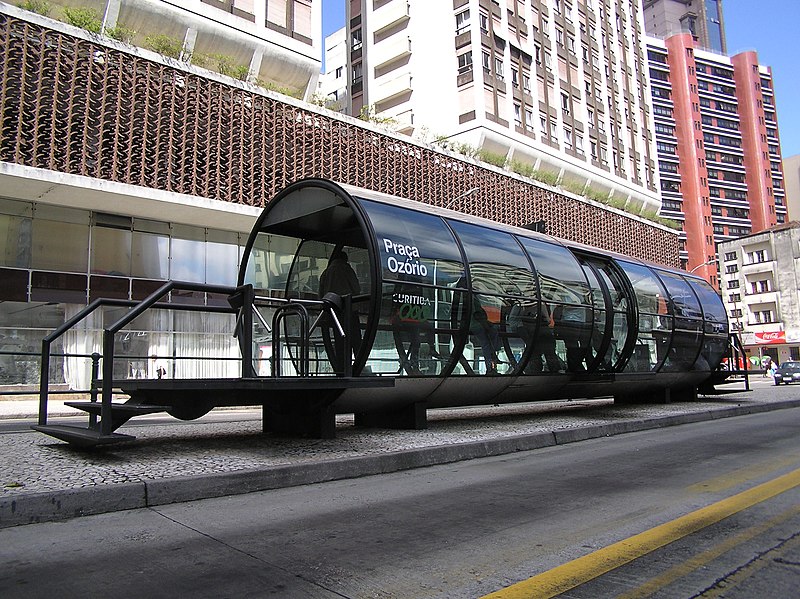
...that "heavy rail" like a subway costs ten times the amount for "light rail" (trolleys), which, in turn, costs ten times a bus system, even with dedicated bus ways. The "light rail" savings usually touted to sway municipal decision makers occur because even trolleys can have relatively fewer drivers than a 40 - 60 passenger bus. Lerner got Volvo to make 270-person accordion buses (300 Brazilians, says Lerner), so that was no longer an issue. The City built attractive transit stops with the look and feel of train stations -- and all the handicapped access equipment -- and got private firms to purchase and operate the buses. The city controls the routes and fares, while the private companies hire drivers and maintain equipment. (Emphasis mine-udc.)
The success of the BRT inspired Bogota's Transmilenio, Mexico City's MetroBus, Jakarta's TransJakarta Busway and a dozen other BRT projects around the world). The system was cheap, easy to roll out and easy to use:
Curitiba has a very simple and practical transportation system. Public transportation consists entirely of buses. There are several different types of bus, each with a different function.

Moving around in a car can be difficult in and around the city centre because of the many one-way streets and constant traffic jams. This makes the public transportation system more attractive if one wants to go there. (Emphasis mine -udc.) The trinary system allows quick access to the city centre for car drivers. Some avenues are spacious and laid out in a grid, and apart from some points around the city centre, Munhoz da Rocha Street and Batel Avenue, traffic jams aren't thus severe.
At the Worldwatch Institute event, Lerner also encouraged:
"greater efforts to turn chronic urban problems into innovative solutions. Curitiba, for example, converted an old landfill into the Open University for the Environment, a school that provides environmental education to citizens and policymakers at little-to-no cost. “In the city, there is no frog that can’t be turned into a prince,” Lerner says.
From wikipedia: "In June 1996, the chairman of the Habitat II summit of mayors and urban planners in Istanbul praised Curitiba as "the most innovative city in the world."

(Btw, Lernier is an architect and an urban planner. His work as mayor of Curitiba and his continuing commitment to improving the urban environment is the kind of action i'd like to see from Filipino architects.)


Image credit: One of the bus stops on Curitiba's pioneering BRT, via wikimedia commons.

1.28.2007

local economic activity


A visualization of comparative economic activity across the globe. You'll need the flash-plugin to see the graphic.

Keep a lookout for Metro Manila.

From the Geographically based economic data (G-econ) project at Yale:

The G-Econ research project is devoted to developing a geophysically based data set on economic activity for the world. The current data set (GEcon 1.3) is now publicly available and covers "gross cell product" for all regions for 1990, which includes 27,500 terrestrial observations. The basic metric is the regional equivalent of gross domestic product. Gross cell product (GCP) is measured at a 1-degree longitude by 1-degree latitude resolution at a global scale. Updates will be posted as they become available. The project director is Professor William Nordhaus, Yale University.

1.26.2007

what, not where:
the filipino architect in the megacity

A month ago, landscape architect and urban historian Paulo Alcazaren asked the question "Where are the Filipino architects?" in his CITY SENSE column for The Philippine Star. The column is reprinted in this entry on Arkiboks and in this post at the Heritage Conservation Society-Youth egroup. (You have to be a member to read the egroup thread.)

So this is a belated reply to Paulo's thoughts. I offer a critique, not a reaction and I hide behind Malcolm Gladwell who thought that "the immediacy of web publishing makes some people lazy. They type faster than they think; or they believe that a reaction is the same thing as an argument."

Alcazaren bewailed the lack of visibility (and business) of local architects:

"Philippine architecture in 2006 finds itself at the edge of another construction boom. The problem today is not so much how to project Philippine architecture abroad as it is to project itself into the consciousness of contemporary Filipinos.

"Filipino architects are generally invisible. Almost no Philippine designer is a household name. This is because of the commodification of the whole process of making houses. These are known as "housing products" (the term used by developers), designed anonymously and built by model number or mass produced like burgers and fries."
I agree with him that the Filipino architect is largely invisible - the big names in the field are a generation old (Locsin, Nakpil, Santos, etc.). And yes, the local industry is not immune from the commodification of architecture into "housing products" -but that trend has been around for more than half a century. He should not be surprised that the factory paradigm (the dominant business model since Henry Ford invented the assembly line) should invade the business of real estate.

I do think, though, that he is looking in the wrong place, bewailing the wrong cause. He's not so much asking "where are the Filipino architects?" as he is asking why the architects aren't landing projects and making money.

"Where are the 30,000 or so Filipino architects and affiliated design professionals? They are invisible, save to their immediate relatives or project managers of real estate development firms who are tasked to produce the best product with the least budget (cheap but good) and if there was a budget, to pay a foreign consultant premium fees, which more often that not cut into the local consultants' fees."
Alcazaren argues that "Good Filipino architecture and its related disciplines can create the physical settings for social and economic change." Which I cannot disagree with but he ends his rant with an exhortation to the public and the profession to:
"give Philippine architecture a long hard look. Filipino clients have to give Filipino architects and related professionals the chance to do what they do best – design wonderful buildings, malls, resorts and housing to world-class standards (emphasis mine -udc). But to do this, world-class fees must also be part of the deal. If you pay peanuts, you get houses for monkeys."

This is where I part with him. I think the Filipino architect is invisible because they are worrying about the wrong problems. They look at the building boom and their own lack of commissions for the "buildings, malls, resorts and housing." They look at the money trail and worry that the big names from the western world (brands, really) have eaten their share -and this, they claim is the reason why they cannot build imaginative, inspiring Filipino architecture. Alcazaren presses their case (despite his pontifications) and unabashedly says that the Filipino architect can become visible -can be relevant -if only they get a fair cut of the big projects coming down the pike.

I contend that they are irrelevant because the problem they are bewailing is selfish and irrelevant to the current issues challenging our megacity. They worry that upper and middle class housing has become commoditized when the big problem staring Metro Manila in the face is a housing shortfall of 1M units. They worry about the big private projects when the issue at hand is the lack of civic life and civic sense in our urban life. They worry about their names on condominiums and subdivisions when we are challenged by unlivable streets and the lack of public spaces.

I do not hold it against architects to seek profit, they are running businesses not charities. But I do expect them, as individuals trained to understand the built environment, to speak out and help find solutions to the urgent issues that confront their countrymen who must live in that built environment. I hold it against them for looking at the "buildings, malls, resorts" and overlooking the dense squatter colonies and the inhospitable roads that are the fabric of our megacity.

I would be remiss if I generalized that all Filipino architects are infected with the above irrelevance, there is the work of CentroMigrante and TAO-Pilipinas. I also know that semester after semester, students from the UP and UST schools of architecture work on projects that consider design solutions to the problems of informal and low-cost housing.

I don't intend this post to just be a counter rant -but as a challenge. I leave you dear reader (perchance you might be an architect) to find inspiration in some of the work that I cite below. Innovations are coming to the field of architecture and the business of building human habitats. Our megacity presents an amazing real world laboratory for which our architects can create innovations that we can share with the other megacities that share our plight and our challenges. Instead of dreaming of achieving the monumentality of I.M. Pei, they should inspire themselves to find the sensitivity of Charles Correa. They should be an active voice in the shaping of policies that ultimately shape our built environment.

The two projects below take the idea assembly line beyond the pre-fab of products like Vazbuilt and the catalogue houses it takes its patterns from. Green technologies - new paradigms and new technologies are promising to both lower the cost and speed the roll out of housing. Our architects would do well to consider these approaches.


This article in the January 2007 issue of WIRED magazine, featured the Loblolly house.
Snapped together from a combination of modules, panels, and preformed structural frames, the Loblolly house, named for the loblolly pines here in the Maryland tidewater area, is a manifesto for a new way of building. Architect Kieran and his partner, James Timberlake, have long been known for their finely crafted and energy-efficient buildings and materials. But the Philadelphia-based pair wanted more than just high-profile commissions – they were looking for a breakthrough technology that would let them make smarter, greener structures that could go up quickly and cheaply.

In 2001, after studying how the automotive, aircraft, and shipbuilding industries had revolutionized themselves over the previous 15 years, Kieran and Timberlake realized that architecture needed the equivalent of an integrated circuit. They began to combine glass, drywall, pipe, and wood frames into finished units, each precision-engineered for cost, beauty, and sustainability. In the Loblolly house, the walls and floors are made of panels (some as tall as 21 feet) that were manufactured with wiring, insulation, plumbing, and ductwork already in place. And the main power systems of the home, including two bathrooms and the galley kitchen, were delivered to the construction site in preassembled, plug-and-play units. After the site was prepared, the 2,200-square-foot house took three weeks to assemble.

Then there is the soon to be rolled-out technology that allows construction companies to "print out" a building.

Contour Crafting (CC) is a layered fabrication technology developed by Dr. Behrokh Khoshnevis of the University of Southern California. Contour Crafting technology has great potential for automating the construction of whole structures as well as sub-components. Using this process, a single house or a colony of houses, each with possibly a different design, may be automatically constructed in a single run, embedded in each house all the conduits for electrical, plumbing and air-conditioning.

The potential applications of this technology are far reaching including but not limited to applications in emergency, low-income, and commercial housing.


Image credit: Previ Housing by Charles Correa. (Lima, Peru. 1969-1973).

good ideas


Last week, the CEO for Cities blog noted a series of columns from The Hindustan Times. The series was called "My Vision for Mumbai."

"The columns, bylined by invited residents of the city, were intended as a series of ideas on transforming the city.
One column I clipped and brought (home) was by Milind Deora, member of Parliament. In it, he argued, "We have to unite our views on what needs to be done for this city. Mumbai has 15 million different visions. A commuter's vision is different from a man who drives a fancy car. And a pedestrian has a third point of view. All of us have a role to play in uniting our vision.
"Someone living in a slum has to know that his or her vision has to tie up with the millionaire living in a high rise. Once that happens, we will be able to come out with a common blueprint and stick to it. And then place our collective demands before the various layers of government."

CEO for Cities says: "U.S. papers might take a cue from The Hindustan Times. This would be a valuable conversation for any newspaper to host."

I couldn't find the columns online (maybe they were exclusive to the print edition), but I certainly think that our local papers should also consider running such a series.

I have long bewailed that the metro sections of our newspapers deal nothing with metropolitan issues apart from featuring local crime stories with an occasional MMDA press release on traffic or garbage issues. Is there nothing else about our cities apart from crime, traffic or garbage?

It would be a welcome relief to ask our wannabe senators (be they pro, anti or third force) how they would address the long neglected urban issues that the majority (60% and growing) of our countrymen have to live with day-in and day-out. Ask the pols what their vision is for Metro Manila and our other urban centers and put that against the vision of the urban poor, of the middle class, of the artists, the technopreneurs, the businessmen, the OFW families, the architects, the students, etc.

If we can start talking about the future, maybe we can actually free ourselves from our past. As Milind Deora, puts it, "All of us have a role to play in uniting our vision."

If someone were ambitious enough, maybe we can work towards something like this.

1.07.2007

tagged

Ok. Juned tagged me with the me-meme (note to self: that was three weeks ago!) so loathe as I am to cave into what Philip Dawdy calls "the pornography of the self," I do have to play by the rules of the game. In turn, I tag nth-time-new-father Wily Priles, and the Chesca-the-ex-skindiver, J0-the-Manila-Rat, Gauden-the-world-public-health-advocate, and Steph-the-full-time-artist-part-time-grinch. (That is, unless they've already been tagged. I was always kulelat in the playground anyway. Oh, and I'm also tagging Mayang-a.k.a.-chimchim-a.k.a-ninang-to-babycakes but will not link to her blog.)

1. Names

There's nom de blog Urbano dela Cruz (and no, I am not and have no relation to screenplay writer and director Uro de la Cruz) which breaks down as:

  • Juan de la Cruz - the filipino everyman
  • Jun de la Cruz -maybe a dimunitive for Juan?
  • Jun Urbano - just free association (with paeans to another great director)
  • Urban -> Urbano - what this blog is all about
  • Urbano dela Cruz - the filipino urban everyman
Then there's my real identity.

Like Juned, I am a junior to my late father's senior. Being the youngest son of an old-time protestant pastor in catholic Philippines carried its own peculiar responsibilities and benefits.

My family name literally means "of the rock" - so I probably had some miners in my ancestry. To be "of the Rock" is also apropos for a minister, and pretty much describes my own spiritual aspirations.

In high school, my generous cheeks earned me the nickname "Siopao" or "Siops."

Some insolent former students (who shall remain anonymous) from St. Scho Manila took to calling Mr. dela Pong, I think also because of the cheeks. There were nastier nicknames but let's not go there.

2. Date of Birth

The ides of October. So i'm Libran. Year of the Fire Sheep. Not that either of those zodiac signs really say anything about me.

It does mean though that I will enter my fourth decade this year. Mid-life crisis should be lurking somewhere around the corner but it'll have to wait its turn since I'm still struggling with the cognitive disonance of being 8,000+ miles away from the city I'd really like to be working in/on. (So if you know of anyone who needs an urban planner...)

3. Education

I'm a product of the public elementary school system. Spent half of my grade school life in Pura V. Kalaw Elementary School in Project 4, then the other half in GSIS Village Elementary School in Project 8 -both in Quezon City. (I moved around a lot as a child, mostly in QC. I lived -in consecutive order - in Cubao, Project 6, Project 4, Project 8 and then Fairview. As an adult, I got to live in Valle Verde, Anonas and Zobel-Roxas in Makati before I moved to this part of the world. I am very peripatetic.)

I met Juned and the rest of my geeky high school friends in UPIS - where, as Juned points out, we went to grades 7-10 instead of 1st to 4th year high school. I had a blast -even if i was in the out-crowd for most of my stay there. It did feel good to have come from the same halls that produced some of the most prominent pinoys of our day (though I'm not so hot with some of their politics) and, like them, I did learn a lot more than what was in the curriculum. (To this day, I remember the plotlines of Alfonso Mendoza's "Tipaklong, Tipaklong, Bakit Bulkang Sumabog ang Dibdib ni Delfin Balajadia” and Alberto Florentino's "The World is an Apple" and "Oli Impan.")

Like high school, I also didn't let my academics get in the way of my education in college. So I spent more years than I should have to earn my B.A. in Journalism from the UP College of Mass Communication (which was still an Institute when I entered as a freshman). Those extra years where spent attending classes for credits that I didn't need, taking Econ 11 several times over (don't ask), and rubbing elbows with the who's-who in Philippine media today. The better part of my education came from the long talks in the tambayans and the favorite watering holes of the UP Journalism Club, the UP Christian Youth Movement, TUGON and Quom-SAGM. I also tutored under the demands of the CMC Student Council but found time to help put up the CMC Volunteer Corps (Motto: "Qua Modo Nunc, Spadix Bos") and the UP CHRISTMass.

I also got to sit at the feet of Raul Ingles, Tessa Jazmines, Solita Monsod, Cheche Lazaro, etc. etc.

More than a decade after college, I had the crazy idea of studying again -this time after becoming enamoured with urban planning. The dalliance lasted eight years before I consumated, but the long wait was driven by an increasing obsession to understand and find solutions for the city I love.

I threw my coins in the fountain and one of them landed in Cambridge, Massachussetts. So now I have my ivy league credentials but an incomplete education. I still have so much to learn about cities in general and our city in particular. This, though, is one long-distance love affair I hope to succeed in.

4. Work Experience

I am a jack of all trades -and was a master of none for the longest time. Here it goes in one breath: I was -a chidren's camp director, a freelance photog, a freelance A/V producer, a freelance lay-out artist, a freelance graphic artist, a disc jockey (for a jazz bar), a writer, an editor, a public relations intern, a freelance speechwriter and a freelance lyricist -all before I finished college.

Then I taught HS for three years then worked for the Ayalas for the next 12 next 8. (My wife reminds me. I am getting old.) Under the Ayalas, I got to (again, in one breath): edit HR policies, run some training programs, write-edit-design-and-publish internal communications, manage some external communications (I helped build the company's first website), manage an internet service provider, run comms for the takeover of MWSS, help internal comms for the change management in Manila Water, create and run the Community Relations program in Manila Water, manage the Y2K certification for MW, run the Ayala Young Leaders Congress and help a bit in some of iAyala's programs.

Crazy, eh? I don't think HR was too happy about my hop-abouts.

5. Hobbies and Pastimes

Hmmm. Staying too long in school and moving jobs and addresses. Haha.

I read (currently on my night table: "Runes of the Earth" by Stephen Donaldson; "Consilience" by E.O. Wilson; and, "Spiritual Direction" by Henri Nouwen.)

I am a map geek and I am totally into GIS and all things Geospatial and Geodatabase driven.

I am also a techie-geek and have 3 different boxes at home running windows (xp and 2k), linux (ubuntu) and mac.

Oh, and yeah, I am crazy about this kid though not as crazy as I am about his mom.

So there. I think it took me so long to blog this because of the I in my INTP and all this public retrospection is bothering me so I'll end it here.


12.31.2006

your future is (still) ayala

(Full disclosure, I used to work for Ayala Corporation.)

The Makati CBD is the Philippine's undisputed premiere financial and business district and, despite the emergence of new CBDs, is still home to both the largest businesses and the tallest buildings in the country. That it became the epicenter of Philippine commerce is a testament to good planning, good corporate governance, and the long-term vision of the country's oldest business house.

The Ayalas invested in and developed the business district back in the 1930s, when Makati was just largely empty marshland and when the growing Manila metropolis was expanding to the north (Quezon City). Under the leadership of Joseph McMicking, the Ayalas masterplanned the 1,000+ hectares, intending it to become "Asia's showcase of urban development." (This was back when Singapore was still a trading post.) It was the first large scale, fully-integrated real estate project in South East Asia, the first to feature a business and commercial core surrounded by residential development.

Today, the CBD still hosts the most expensive office spaces and the priciest land values (save for Divisoria -which, per square meter, is still the most expensive land in the country) and has propelled its host city to the top of the LGU income rankings. (Makati has been dethroned from the top rank in the last few years by an ascendant and very well-managed Quezon City.)

Some half a million pinoys work in the CBD, their incomes directly supporting another 2.5 million of the population, and indirectly supporting probably 5 times that number as consumers and as producers in the economy. The CBD has shaped not only our country's economic history, but also the political and cultural history of the last five decades.

Ayala Land, Inc. (Ayala's real estate development arm) has more up its sleeve -with a land bank that will probably shape the next 50 if not 100 years of our history. There's the 254 hectares of Fort Bonifacio -with its new masterplan, then there's the 38 hectare UP North Science Park in Diliman.

The new crown jewel will be ALI's new developments in Canlubang*which, at nearly 17 square kilometers, is 1.5 times the size of Ayala's original developments in the Makati CBD. To put that in another perspective, you can fit 6.5 Fort Bonifacio-sized developments inside the Canlubang properties -with room to spare.

Canlubang, meanwhile represents just 41% of ALI's total land bank! That means, ladies and gentlemen, that your future urban lifestyle and experience will still be shaped, in no small part, by the 170 year-old company. Your children and your grandchildren will probably be working, living or shopping in some Ayala development another hundred years hence.

* -An aside: that last link is to bworldonline article which requires subscription, but Businessworld's online edition. But Businessworld, supposedly the leading business broadsheet in the country, STILL DOES NOT TAKE online payments via credit card -and asks would be international subcribers to instead FAX their credit card details to their offices in Manila. They even ask for the security number! How backward is that in this age of identity theft?? Is their sales division led by a luddite? Could someone please, please lead them to 21st century and to the internet economy?

12.28.2006

makati rezones


The city of Makati is revising its zoning code. Zoning, for the cities that use it, is the one legal instrument that pretty much defines the fabric of built environment -and so, defines the spaces and places we live and work in.

Makati's new zoning code -well, not new, really as it is a revised zoning code -changes some of the allowed uses and ups the floor area ratio* (thereby the building intensity, e.g. how tall or how massive buildings are) in various areas of the city. I think Makati uses a traditional Euclidean or Functional zoning, defining the allowed uses (commercial, residential, office, etc.) and using FAR (floor area ratio) to prescribe building heights and bulks.

I'm saying "I think" because I couldn't find a copy of either the new or old zoning ordinance online. (Note to all city goverments: PUT YOUR ZONING CODE ONLINE!!) I did find a pdf of a powerpoint presentation (pdf 1.9mb) given to the Makati City Council sometime August of 2006 that outlined the changes.

You can navigate/check out the zoning changes on the map on this page though it might be be use the larger map as for some reason, not all my placemarkers are showing on the map on this page. The map has no street names, so you can cross reference the streets (at least for the CBD) using this flash map. If you have GoogleEarth, you can download the overlay image here (kmz 855kb file).

Over the next 5-10 years, expect to see the following changes:

  1. Convenience retail (small stores, ala 7-11) on the ground floor of the buildings along Ayala Ave. before Makati ave. and along Makati Ave. towards Paseo de Roxas.
  2. In Legaspi and Salcedo Villages, new residential towers will rise along Dela Rosa, on the backside of the office buildings along Ayala Ave. and along Valero St. (The lots there are mostly occupied by structured and surface parking. Also expect a 25% increase in building heights as they raised the FAR from 6 to 8.)
  3. We'll see more intense development (taller buildings) on the north side of Sen. Gil Puyat (Buendia) from EDSA to Ayala Ave. (the Bel-Air/Jupiter St. side).
  4. More intense commercial development is allowed between Yakal and Malugay Sts. (north of Buendia)
  5. Expect buildings to double their size/height along Pasong Tamo (on both sides of EDSA)
  6. And also more intense commercial development on Pasong Tamo before Dela Rosa
  7. Ditto for (more intense) commercial development along the western side SLEX between Zobel Roxas and Cash & Carry.
  8. More intensive neighborhood scale commercial along Zobel Roxas before SLEX
  9. Expect 30% taller buildings along both sides of the stretch of EDSA between Guadalupe and Estrella.
The new code also anticipates the changes in the Fort Bonifacio masterplan and greenlights the redevelopment of the old Colgate-Palmolive and SC Johnson compounds and the Metro Club into high-rise residential, office and commercial spaces. The two properties across Estrella st. from Rockwell is part of the development's expansion plan. (Looks like they will be building more residential towers and maybe some BPO office space.)

There were a few bulletpoints about "innovations" in the pdf that got me piqued, namely (my notes in italics):
  • Granting of density bonuses (bonus in exchange for what?)
  • TOD (Transit oriented development!! Where?)
  • Green spaces (public spaces, I hope! and maybe in exchange for density bonuses.)
  • Land readjustment scheme (as a way to reshape the small irregular lots in the older, low-rise, dense areas of the city)
  • Heritage zone (I guess for the old poblacion)
  • TDR (Transfer of Development Rights!!)
I'd love to see more details about this list.

Makati's new code also calls for the creation of the Office of the Zoning Administrator -which could mean more transparency and better enforcement or more bureaucracy.

I know Makati isn't alone in revising its zoning ordinance. Manila is doing it too (and I'm waiting for a friend to send me a copy of Manila's new code. Word is, they are removing heavy industrial zones and bringing in Planned Unit Development. - My comments on that new code, once I review it.)

The new zoning codes are testament to the continuing growth and change in our megacity and, hopefully, opportunities to improve our cities.

Interactive map via MapLib.Net
Here's a graphic that better explains how FAR and lot coverage define building heights and bulks.

12.26.2006

THANK YOU FUNDABLE!!!

Thank you, thank you, thank you fundable.org!!!

They forwarded the pledges we collected even if we didn't hit the target!

Merry Christmas, Jack!

Thank you to everyone who pledged! (and may I add #46. Adi A. who pledged with 20 minutes left to go.)

Thank you to Wily Priles, Amalah and Vickie for posting about Jack. And to Raymond V., Aimee A. and Mai T. for spreading the word.

Tiny Tim puts it best, "God bless us, everyone!"

visualizing density

After reading this article from Fortune (forwarded by Sol), I worked out a 3d chart using wikipedia data comparing the relative land areas and population densities of a few megacities.

The chart represents land area in square kilometers along the x,y axis (width and depth), and population density in people per square kilometer along the z axis (height).

The tall red column represents Metro Manila's density and area vs. other megacities. We're nearly three times the density of Hongkong occupying little more than half HK's land area. Even Mumbai distributes its density a little better.

the truth about google earth


Found this YouTube video via urban cartography.

Now, if I could only pick up those damned billboards with my cursor...

Quick Links

Notable posts on the metro