12.03.2007

cars vs. brt


(V.O.: ...and now we return you to our regular programming.)

I've illustrated this before, but if you need more convincing, try this very short video by Carlos Pardo of the Sustainable Urban Transport Project. (Via Richard Layman's Rebuilding Place in Urban Space.)

Seen it? Like it? Share it by emailing this link.

Ready to come up with the standard excuses of why this can't work in Metro Manila? Go ahead, throw them at me.

Btw, notice how you can fit a BRT on to an 8 lane road?

12.02.2007

ilang tulog na lang


Continuing our rant: this via, Ang Tagal Naman.

11.30.2007

sobra na, tama na


(I know. I know. I'm ranting. I'll be over it soon.)

11.29.2007

whoa

The Edushi interface, showing Shanghai riverfront (the Bund)

Detail from Shanghai map


(Eugene, have you seen this one?)

Forget getting Metro Manila on GoogleEarth or GoogleMaps, LiveSearch or even OpenStreetMap. Call in the Chinese and ask them to put our metropolis on Edushi.com (Ch.).

Found them via Digital Urban.

The graphic detail is nothing short of delicious. Check out the map of Shanghai. More cities listed here (if you can read Chinese).

Of course it also helps that the orthogonal view looks like it's straight out of SimCity.

The big advantage China has is that the military, for security reasons, keeps full autocad models of ALL the cities (don't ask me how I know), so it's easy to roll something like this out.

Chinese cities are also addicted to scale models and nearly every planning office will have a whole hall dedicated to a scale model.

Makes my mapgeek mouth water.

new rules

New Rule #1:
NO MORE HOTELS


If you are planning a military putsch but don't have the balls to try to take the queen in the palace, don't take a hotel. Try to take a significant installation, like say a petroleum depot or a TV station.

Why a hotel? So you have comfy beds and a kitchen staff? How soft are the underbellies of these adventurists? Why does it always have to be a hotel?


New Rule #2:
NO MEDIA INTERVIEWS AFTER AN ARREST


They should be frog marched out of there in hoods and chainlinks. No pussyfooting. No media plays. You wanted to be "heroes?" You wanted to "take a stand," suffer the consequences.

If they want to run for public office, they can use their frog march pictures.


New Rule #3:
YES TO DEADLY FORCE IF IT'S NATIONAL SECURITY


You know they want to topple the government, why negotiate? Send in the damned sharpshooters and take them out. If we're going to have a siege, then let's have a SPLENDID SIEGE! Blood on both sides. Let's see how popular adventurism gets in the barracks after they shoot each other.

What are you worried about? The national image? The morons already took it down.


New Rule #4:
ENFORCE THE DAMN OLD RULES


No more namby-pamby pardons. No more.

11.26.2007

filipinnovation


This, from yesterday's BusinessWorld Online*

RP positions as region’s innovation hub

THE PHILIPPINES is positioning itself as Asia’s innovation hub that can be competitive with the rest of the world, by institutionalizing a culture of innovation across multiple sectors.

The country’s positioning strategy is embodied in an 18-page document summarizing the country’s National Innovation Strategy which was launched yesterday at the country’s first National Innovation Summit, a product of months of collaboration among government, business, academe and civil society.

The document, entitled "Filipinnovation," was presented by summit organizers yesterday to President Gloria M. Arroyo, who symbolically launched the strategy with a 3D presentation similar to popular game Second Life. "Filipinnovation" is also the brand for the country as it aims to compete with Asian neighbors and other regions.

(note: "3D presentation similar to popular game Second Life" -really?)

"‘Filipinnovation’ brings forward a distinct brand for the Philippines as an Asian innovation hub, different [from] — yet as competitive as — its Asian neighbors and striving to be at part with leading innovation regions such as North America and Europe," the document read.

At least you've got to hand it to the proponents for innovating a monicker. "Filipinnovation" -takes a while to get it to roll off your tongue.

There is a "four-point national innovation strategy " that focuses on
  • strengthening human capital, from primary to advanced learning;
  • supporting business incubation and acceleration efforts;
  • regenerating the innovation environment mainly through policy; and
  • promoting a culture of innovation by upgrading the Filipino mindset
So what do I think is missing? Anyone, anyone? (Hint: I talk about it a lot in this blog.)

CITIES! You cannot be a "hub" without thinking of the physical. Place is important to culture and to innovation.

The data is clear on this: cities are centers of innovation. So if you want to promote a "culture of innovation, " you've got to work on your cities.

Here's a pdf (52 kb) copy of a report by Forman, Goldfarb and Greenstein on why innovation happens better in cities. They show that:
"establishments located in large urban areas innovate as if they face fewer constraints and have lower costs. We also find a symmetric role for internal capabilities: establishments that are in firms with a greater number of IT personnel invested in WEI technology more frequently, as did those with prior experience with related non-Internet applications. Overall, we conclude that the marginal contribution of internal capabilities to investment and co-invention in a process innovation is lower for establishments in cities than for establishments elsewhere."
Cities also increase productivity. CEOsforCities cites this article in Psychology Today that says:

For every doubling in city size, there's a 14 to 27 percent increase in productivity per worker, and psychologists and others are trying to explain why. They believe the gains "can be linked to having more and different people to meet, and more meeting places—parks, coffee shops, parties, or simply the sidewalk...

"City dwellers have more places to hang out, and they tend to know more people. Meredith Rolfe, a political sociologist at Oxford, studies social networks through large-sample surveys. While there are only small variations in the numbers of close friends people report having, she's found that 'acquaintance networks'—the so-called 'weak ties' that are most helpful in finding a job or stock tip—range wildly in size, from 500 to 10,000, depending in part on methodology and in part on whether a person lives in a city."

Promoting a culture of innovation is the right goal, but to think it's all about "changing culture" is mistaken. Culture arises from place and interaction. The culture of innovation grows best in the city.

Pay attention to place first, create the scene -and then the magic happens.

(Also check out this excellent presentation from Joseph Cortright on why cities should focus on innovation as a driver for growth.)


* -Btw, BW's finally seen the light and their online content is available for free!


Image credit: "Just full of ideas" by Cayusa

cheap


So, we're the 19th most expensive city for expatriates:

Manila has been found to be Asia’s 19th costliest city for expatriates, according to the latest twice-yearly survey by human resources firm ECA International that surveyed 39 select cities in the region.

Jakarta was the 11th most expensive place and Bangkok was in 18th place, while Hanoi landed in 32nd place — more expensive than Kuala Lumpur which was in 33rd place and just a notch above the Laotian capital Vientianne.

Islamabad was the least expensive among the Asian cities surveyed at number 39, while Seoul was judged Asia’s costliest city for expatriates.

We're cheaper than Jakarta and Bangkok, but more expensive than Hanoi or K.L. (What makes KL so cheap?)

As far as Asia goes, we're the 29th most expensive city to live in, but we're 191st world wide.

How do they compute the cost of living?
ECA International’s cost of living indices are calculated based upon surveys carried out annually in March and September using a basket of day-to-day goods and services. The data used above refers to ECA’s September 2007 survey.

Certain living costs such as accommodation, utilities (electricity, gas, water costs), car purchase and school fees are not included in the survey. Such items can make a significant difference to expenses but are usually compensated for separately in expatriate packages.

This comparison of cost of living was calculated on a base composed of various developed countries and is used to reflect an international lifestyle. Other indices available from ECA reflect specific city-to-city comparisons, and different levels of shopping efficiency.

I bet you it's the cost of electricity that's driving our rank up because we're still low in the list as far as the Bigmac index is concerned.

the case for the pedicab

So, this is my first post on The City Fix. Recognize parts of it? -UDC


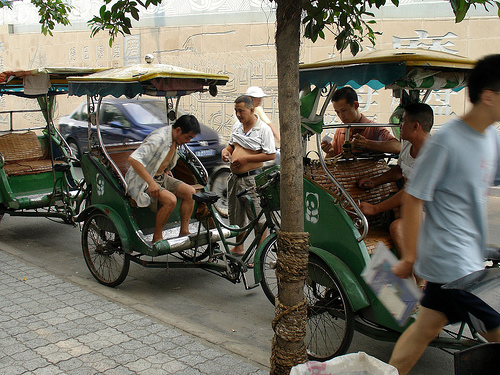
Pedicabs like this one above are found throughout the world.
Photo by drs2biz from Flickr.


To celebrate World Town Planning Day, the Ontario Planners Institute called on planners, towns and cities to “start planning ahead for a future where the car is a thing of the past.” Although it’s difficult to imagine a post-car city, we only have to look back to recent history to realize that cities are fluid, transforming over time, often based on the dominant form of transport. Because most of our cities emerged during the age of the automobile, it should come as no surprise that most of our cities have been shaped for and by the car. But this wont always be the case. The rising cost of oil and the environmental and human cost of congestion and air pollution is turning the logic of car-dominated cities on its head. As we explore options for a post-car future, it’s instructive to turn to the developing world, where cars still haven’t flooded the streets, and examine one of the most ubiquitous and green-friendly forms of transportation: the pedicab.

In our automobile driven cities, the pedicab occupies the bottom rung of the transportation ladder, frowned upon by both rich and poor alike. Where buses are seen as undisciplined nuisances with which cars must begrudgingly share the road, the pedicab is viewed as a backwards mutant not even deserving of the asphalt. Even pollution spewing autorickshaws and tuktuks are preferred to the pedicab. Some even refer to pedicabs as “road roaches” because they scamper and scatter in and out of traffic like cockroaches in the light. But as far as green cred goes, all other modes of transport pale in comparison to these human powered vehicles. Pedicabs generate no emissions and produce no waste, unlike cars and buses, with their heavy metals from used batteries that leech into the soil.

As far as low barriers to entry, the pedicab business is one the Bottom of the Pyramid folks at Nextbillion would love. You could literally buy hundreds of pedicabs for the price of one bus. Plus all building materials can be sourced locally, so there’s no need to import spark plugs or oil filters or engines. What’s more, there’s no need to buy oil that supports oppressive petrocracies. And the technology is so simple that self-repair is the rule rather than the exception. Bike infrastructure can help power local economies, as it has in Portland, Oregon, where an entire industry revolving around bicycling has emerged.

Pedicabs are unsafe only when they mix with other vehicles, affording little protection to the driver and the riders. And perhaps that’s the design challenge that our cities and city planners could solve. It is clear that our streets were not designed for pedicabs which must vie for a slice of the road with fast moving buses, trucks and SUVs. But what if cities built a city-wide green network anchored on shared roads for bikes, pedicabs, and pedestrians? Cities could set apart secondary and tertiary roads and designate them as green ways. They could redesign the road right-of-way to be friendlier to pedestrians, bikes and pedicabs. We could create a modified version of the Woonerf street to build alternative transport infrastructure that’s friendly to pedicabs.

The most bike friendly cities in the world are leading the way, engineering their streets to encourage biking. But these western cities are building bike infrastructure only for single riders. Perhaps the global south can lead the way with public transport built on human-powered service. The pedicab is the perfect place to start!

(Cross posted from: The City Fix)

11.24.2007

readability

readability


Is that why I only have a dozen readers?

HAHAHAHA.

(Watch out when you do the readability link. They throw in an ad into the code.)

11.22.2007

19.20.21


Eugene sent me a link to this project.


The mission of 19.20.21 is a multi-year, multimedia initiative to collect, organize and package information on population's effect regarding urban and business planning and its impact on consumers around the world. This 5+ year initiative will deliver results via 5 channels: online, television, print, exhibits and seminars. This project will include 10 worldwide partners and appropriate affiliates.

Here's to hoping that Metro Manila gets into the final 19.

Quick Links

Notable posts on the metro