6.15.2006

a strategic approach to historic preservation

Avenue Theatre before it was demolished. Image from Carlos Celdran's Blog.

I know the wrecking ball has taken down the Avenue theatre, despite the heroic efforts of Carlos Celdran, Ivan Henares and the rest of the blogosphere along with the work of the Heritage Conservation Society and the NCCA. The nearby Galaxy theatre and a few more historic structures are also in danger of being demolished.

As forensic as this post may be, I'd like to contribute some notes on how to take a more strategic approach to historic preservation:


1. It's about economics


The Avenue theatre was reputedly demolished to make way for a parking lot. The owners apparently think that parking fees will give them better returns than whatever was in the existing building.

Apart from being historical artifacts, buildings are utilitarian objects -they were built to be used or to be lived in. Keeping the building in use, keeping it economically productive will insure its preservation more than any regulation or historic designation.

So the building owner's pro-forma is one of the most powerful tools the historic preservationist needs to understand.

Good regulations are built on incentives that keep the building owners pro-forma healthy -i.e., the owner should earn more by maintaining the building than letting it rust or turning it into a parking lot.

Historic Tax Credits -that allow the owner/new developer to offset the cost of maintenance or redevelopment within the first year of the pro-forma (i.e. -even before the building takes in tenants) have been effective in many locales.

Some non-profits and cities even do pro-bono work to help the building owner find development partners (i.e.-new tenants) conditioned of course on redevelopment and preservation rules.

(See my previous post on the role of rent control in historic preservation.)


2. It's about reuse


Many historic buildings become obsolete because the use they were built for has become obsolete. So old warehouse buildings lose their usefulness when the business they used to house has failed or the industry they used to served has lost out to new technology.

In many older downtowns, the old storefronts and theatres lose out their audiences to newer malls with larger capacities, better airconditioning, stage technology or even parking.

The trick is to find an appropriate historic reuse. Incentives for conversions also help, such as expedited building inspections or tax waivers.


3. It's about the district


Historic preservation works best when it considers the district as a whole -not that the whole district needs to be declared a historic site* but that the role of the historic sites -particularly when it comes to reuse -is considered in the context of the economics and demographics of the district.

Successful preservation efforts must consider residents and neighbors. Is there a demand for housing that will justify a conversion into lofts or apartments? Is there need for business incubator space? A school? A civic facility?

For many theatres retrofitted for stage performance, the question is whether there is enough retail in the area to provide a critical mass of possible attendees or viewers. (Apart of course from having a theatre-group that can actually draw an audience). -Whatever it be, the re-use of the historic building must serve the needs of the locals and the local clientele. Preserving buildings as tourists sites (very tempting for many cities) is rarely effective. At best it dolls up the historic building -preserving the facade while letting the rest of the space go to waste. It also removes the building from the life of the community -treating it as a trinket rather than a part of the social fabric.

In the US, one of the most potent weapons of the National Trust for Historic Preservation is its Main Streets program that encourages conservation in the context of reviving old town centers and business districts.

*- (Some cities/states have taken to the historic preservation of whole districts. This has been successful in high demand markets -if it is coupled with sensible redevelopment processes. In many places, the designation of whole districts has tended to stunt the market and continued, rather than reversed decay.)


4. It's about local government


All historic preservation must be tackled at the local level. National recognition or designation programs rarely produce anything more than a historic plaque on the site and maybe a mention on the national historic register. (This approach is more "monumentalism" -emphasizing preservation at the expense of revitalization.)

Historic preservationists have gotten the most traction when they get local government involved in actively encouraging preservation and reuse.

The logic behind this is that the legal authority for construction and demolition permits rests with the local government. So too with zoning and land use.

Enlightened national governments can provide the right policy environment -and economic incentives (Q: Why not give the same tax breaks we give to IT centers to businesses that locate and reuse historic buildings?) but ultimately, the local government has to buy in -and factor historic conservation into their land use and economic development plans.


5. It's about politics


If it's about local governments -then it's about local politics. Unless the historic preservationists are prepared to mount a serious electoral challenge, polemics about the incumbent mayor or city council do more harm to the cause.

Given that our mayors are allowed 3 consecutive terms -and can run again for another 3 terms after a one term hiatus (the "sabbatical" term often taken by the mayor's own patsy), incumbent mayors in the Philippines can realistically hold sway over the city for 30 years or more. Long enough to see real changes -and long enough to sit in opposition to historic preservation until no historic buildings are left.

Historic preservationists can make better headway if they can find a seat at the mayor's power table. In many cities, this is best done by finding allies in business who also double as financial supporters of the mayor. (c.f.- Carlos Slim's role in the redevelopment of Mexico city's historic core.) The mayor and the city council will listen to a businessperson (or businesspersons) with enough investment clout who can speak about preserving heritage while directing resources into the economic development of the other parts of the city.

Historic preservationists then need 3 legs to their campaign if they are to wage a strategic and successful effort: Education (getting people to value heritage), Economics (making preservation and reuse profitable) and Politics (finding a seat on the table). Media is a useful tool, and so are the courts but resorting to sound byte battles will probably save a building or two - while ceding the rest of the war to preserve the historic fabric of the city.


(For further reading, check out the works of Dr. Ismail Serageldin on the role of historic sites and culture in urban development.)

6.14.2006

understanding urbanization

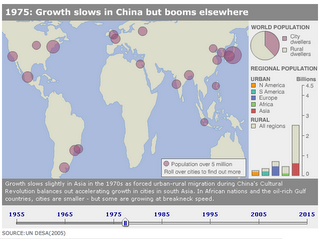
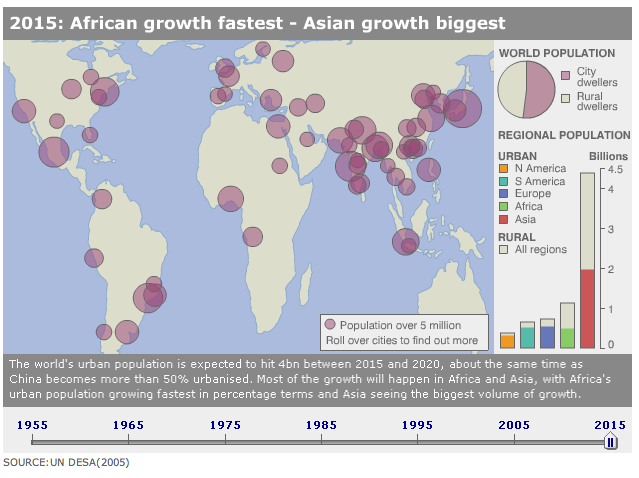
BBC's interactive map showing state of urbanization by 2015.

BBC has an interactive feature showing the rapid urbanization that the world has experienced over the last 50 years -and what it will experience in the next decade. By 2015, more than 50% of the world will be living in cities. (See the accompanying article here.)

It is this context of rapid urbanization we must understand to better cope with the issues that face Metro Manila. Understanding how that rapid growth affects our urban conditions - housing, services, schools, water, sewer and the environment - will lead us beyond just griping about the sorry state of our cities to sensible policy, regulations and market-based approaches to improving the quality of life in our cities.

Metro Manila's own rapid growth began in the late 70's when we officially hit megacity status and crossed the 5M population mark. Within 3 decades we doubled that population, essentially adding close to 180,000 people each year to the metropolis.

To have sensibly coped with that influx, we needed to build over 3,300 new housing units every month for the last 30 years. (That's building more than 1 house a day -for over 10,000 days.) Coping with that growth meant our public transportation system needed to accomodate at least 90,000 new passengers each year -requiring 1,500 new buses each year. It is no wonder then that we face such daunting issues now.

And we are set to add another 3 million more to Metro Manila by the middle of the next decade.

The good news is, we are not alone in this problem. There is a wellspring of innovation that we can harvest from the experience of other megacities - from Mexico, to Sao Paolo, to Cairo, to Jakarta. We need to get ahead of the curve -ahead of the growth, by looking at what has worked and what has failed in other cities. Perhaps we can even contribute some of our own innovations to the global discussion.

(I wonder if our cities are sending representatives to the 3rd World Urban Forum next week?)

I hope to explore some of those solutions in this blog.

6.13.2006

on a clear day

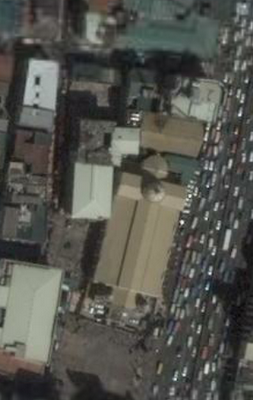
Detail from Google Earth showing CCP and Roxas Blvd.

Good news! The latest update of Google Earth shows higher resolution satellite imagery for Metro Manila. So far it's a single orthoquadrant that is centered around the port area -and large parts of the scan are obscured by low lying clouds but it does promise better images in the future.

The image above shows the reclaimed area in very good detail. Check out the major traffic jam along the boulevard. Here's one of Quiapo Church.

Also, vectors for the primary highways are also available.

6.09.2006

on the waterfront

Map showing inundated sections of Metro Manila if the sea level rises by 10M.


What will the metropolis look like if global climate change models are correct? How much land will we lose? The image above takes the extreme case of a 10M rise in sea levels. (This for a higher contrast version

You can keep this image in mind as you watch Al's film (which I hope will open in Metro Manila soon).

Alex Tingle has developed a googlemap app that shows global sea water rise. You can dial up the sea level from 1m to 20m.

If the models are correct, then Tondo and Binondo will survive as islands. The rest of Manila, large parts of Paranaque, all of Pasay and San Juan will be reclaimed by the Bay.

(On a personal note: it is s00o difficult to get back to the habit of posting - but hopefully, this one will get the juices flowing again.)

4.25.2006

Jane Jacobs


Sad news

TORONTO (Reuters) - Jane Jacobs, the social activist and renowned urban development critic, died Tuesday at age 89.

Jacobs, an American-born Canadian, is best known for her book "The Death and Life of Great American Cities," which, since its publication in 1961, has become a standard text on urban issue.

....

"Jane Jacobs will be remembered as one of the great urban thinkers of our time," Toronto Mayor David Miller said in a statement. "Her contributions and insights have forever changed the way North American cities are developed."


4.24.2006

a conversation with vic
(on rent control)


(Abandoned house in Detroit MI, Photo by Dylan Degraff)


I've been missing-in-action for over a month. Work tends to get in the way of blogging. I do owe Vic of NYC a long response - but it'll have to come in installments.

Anonymous said...
(Vic from NYC)

Hello Urbano, thank you for the response. I fully understand and appreciate your points but let me just make some clarfications of my own.

First let me just say that we both share in the belief that Manila needs to reform its low income housing policies. However, we may disagree in the particulars. I fully acknowledge that an overwhelming amount of economists share your views on rent control, but why are an overwhelming amount of tenant associations and renter organizations disagree with you and these economists. Is it a mere coincidence that landlords and giant real estate companies vehemently oppose rent control?Would National Low Income Coalition (NLIC), a group you worked with, agree on your stance to eradicate rent control? You mention the National Multi Housing Council's (NMHC) dissaproval of rent control, but are they a fair source for an opinion on the matter since they represent landlords?


on the National Low Income Housing Coalition - you're right. They do not have a stand on removing rent control. BUT they don't have a stand for spreading or maintaining it either. In fact, they are pretty much silent on the matter, which is probably the safe out between respecting some of the constituents, and respecting the research.

Between tenant associations -who have no small stake on the matter; landlords, who also have a stake in the matter; and disinterested economists (from academic research and governmental policy) -whom shall we believe? You could accuse the economists of having been bought by the landlords -if they were all from western economies. But when the chief economists of Finland and Vietnam tell you rent control is a problem, what can you conclude?

For every "study" that is anti-rent control, there is an equal and opposite version. But, what is unequivocal is who really benifits from eradicating rent control. Yes, there maybe iscolated cases such as Carly Simon. However, that is not an accurate picture to view the merits of rent control. The "Carly Simon" cases are propaganda tactics that landlords use to promote their cause. As a learned man as yourself, one must know there are always certain people that find loopholes for personal benifit. Much like Bush Sr. running Willie Horton ads to make voters believe Dukakis was soft on crime.

I'll have to disagree with you completely on that. You're using the "play the controversy" card that the anti-climate change and the anti-evolutionist love to use. The number of studies and the results simply do not correspond one to one "he said, she said" debate. The studies overwhelmingly point to negative effects of rent control (either as hard -price ceiling, or soft -tenancy protection models).

And yes, the studies ARE unequivocal on who benefits from removing rent control. It's the general population. The studies are too numerous to list (try researching with JSTOR or Lexis-Nexis, or even Google-Scholar), but here's a sample abstract from Basu and Emerson in The Economic Journal (October 2000):

"We consider a rent control regime where rent increases on, and eviction of, a sitting tenant are forbidden. When apartments become vacant landlords may negotiate new rents. If inflation exists, landlords prefer to rent to short-staying tenants. Since departure-date-contingent contracts are forbidden and landlords cannot tell whether tenants are short-stayers, an adverse selection problem arises, with a Pareto inefficient equilibrium. When tenant types are determined endogenously, multiple equilibria can arise where one equilibrium is Pareto dominated. Abolition of the rent control regime, cannot only shift the equilibrium out of this inferior outcome, but also result in across-the-board lowering of rents." (emphasis mine)

From Vic:

The true benificiaries of rent control is not the rich as you claim but the poor and NOT even the middle class. As a matter of fact according to the 1993 Federal Housing Survey, the median income of stabilized tenants in NYC was only $19,000. Of 200,000 tenants under rent control that pay below $400 rent, 80% make under $25,000. One third of these people (about 70,000 housholds) pay up to half their wages on rent. I bet all these people would disagree with your statement that "rent control benifits only a small number of existing tenants."


In 2000, 43.5% of the 2,216,749 renter occupied units in NYC metro area were renting for under $500. That's a little less that 964,300 households paying below $500. The 70K households you cited represent just over 7.26% of the total demand. Of the total number of renter households, 35.4% -or 784,726 households, were paying over 35% of their income to rent. Again, the 70K you quote represents little less than 9% of the total number of households paying more than 35% of their income on rent.

Again, in 2000, 14.6% of NY PMSA's households were earning below the poverty line. That's 308,190 families -or 4 times the number of households you quote. (All figures from 2004 American Community Survey - census.gov)


I was not comparing NYC's state of gentrification with that of Manila's real estate situation. I was merely pointing out how gentrification has relocated the poor in NYC as will eradicating rent control in Manila. The shanty towns and dillapidated buildings you speak of is a regulatory problem not the cause of rent control. As a matter of fact, In “Scapegoating Rent Control: Masking the Causes of Homelessness,” the authors point out that 3 out of the top 4 cities in the US with the most severe homeless problems do not even have rent control laws. Detroit and St. Louis, which never had rent controls, have suffered massive abandonment. But, in Santa Monica and Berkeley, where both have rent control policies, abandonment and homelessness is not a problem. You see we used the same example cities but used different studies to prove opposite points.

Again, you have to look at the urban land dynamics between the two cities - per sq. meter costs in NYC has more than tripled over the last decade, making redevelopment attractive to developers. No such pressures exist in Manila. Shanty towns are not a regulatory problem (otherwise we would have solved it by throwing inspectors at the problem) it is a demand and supply response.

As to the four cities you cite, the argument is non-sequitur. Detroit and St. Louis have severe homelessness problems because their economies are sliding into failure. Detroit, which built its economy on the US auto industry, lost over 76,000 people between the 1990 and 2000 census -and continues to lose people, and has fallen from the 5th most populated city in the US to the 10th in just 2 decades. The population in St. Louis, also a rust-belt city, shrank by 48,000 in the 90s. Clearly you can't compare them to Santa Monica and Berkeley where population is growing. Santa Monica is also part of the Los Angeles metropolitan area - and Berkeley, part of San Francisco-Oakland.

more, next time.

3.26.2006

transport and development


Image credit: Salt Lake City TOD and Multi-modal hub by the IBI Group.

This article came out a month ago (Feb. 24, 06) in BusinessWorld's online edition. I've only included segments of the article -and all emphasis (italics) is mine:

Northrail woos Ayala for railway project


The North Luzon Railways Corp. (Northrail) has invited the Ayala group to look into the possibility of putting up malls that would serve as train terminals for the railways system in a bid to reduce government's cost for the project.

In an interview, Northrail President Jose Cortes, Jr. told BusinessWorld the company had pitched the idea to the Ayala group in a letter.

"We have conveyed it in writing and we're just waiting for them to reply. The letter was to inform them of our interest to join whatever activities they have along the way. If they set up a mall, we'll be willing to put the rail station in the same area to give them the market," Mr. Cortes said.

Northrail, which will initially run from Caloocan to Malolos, Bulacan, will have six stations for the first phase -- Caloocan, Valenzuela, Marilao, Bocaue, Guiguinto and Malolos.

Malls that will serve as terminals for the train system could benefit from the 164,743 passengers that Northrail will transport daily once it starts operations. Northrail said the number of passengers it will transport will later increase to 363,193 daily.

Mr. Cortes said Northrail is giving Ayala the option to choose which terminals it would want to put a mall in. "It would depend on what properties they have," he said.

Ayala Land, Inc. spokesman Jan Bengzon said the company is not as yet in the position to say if it is interested in the proposal. "All I can say is we're looking at it, as I'm sure other developers are," he said.

...The SM Group, meanwhile, has already signified interest in putting up malls in some areas that are designated for Northrail terminals.

"They are just waiting for the terms of reference," Mr. Cortes said.

Among others, the SM group would like to know if the Northrail stations would pass through its existing malls in the north. SM has malls in Valenzuela and Marilao, and is putting up a mall in Clark, which Northrail could later use as a terminal once the project is extended all the way to the Clark Special Economic Zone.

Mr. Cortes added mayors of the towns that Northrail will be passing through are also talking with the Gokongweis and other mall owners for the possibility of putting up malls that would serve as train stations.

Northrail is asking mall owners to build malls that would serve as terminals for the railways system to lower its costs. Mr. Cortes earlier said that if Northrail builds the terminals itself, it will only be able to allocate P5 million per station.
Well congratulations to Northrail for at least being creative about financing and seeing the potentials of the rail stations.

BUT the rail stations could be so much more.

First of all, how strategic is it to put the stations where the malls are? They should site the stations based on access and density (i.e. -how will people get to the stations, what towns should it serve) -and then invite the malls to locate.

We already made the mistake of locating MRT stations near malls rather than the logical pedestrian and multi-modal junctions. Let's not make that mistake with Northrail.

Transport access will decide development -i.e. build the trains and the malls will definitely follow.

Second, instead of just malls, they should create (say it with me folks): TRANSIT ORIENTED DEVELOPMENT, i.e-not just malls, please, but also housing. and offices.

Think of it, you could live in a station in Marilao -and take the train in to get to Fort Boni or the Makati CBD. Or you could build call centers on top of commercial centers (which we are already doing) on top of the train station. Add medium rise housing within 4/5 of a kilometer (about a 5 minute walking distance) and you have the beginnings of a transit village. Creating opportunities within a radius of .8Km will yield about 2M sq.m. of developable land. At a comfortable 20 dwelling units per acre - each station could provide more than 10,000 units of housing. At an optimal 50du/acre -stations could generate 25,000 housing units. (Not to mention at least 100,000 extra-riders and commercial customers from each station.)

And with office and commercial in the mix -there will be lots of opportunities for cross-subsidies, allowing the developer to either 1) offer below market rates for the housing or 2) set aside a large percentage of the housing for low income families. (And an opportunity to provide rental housing -to help solve the housing backlog.)

I'm sure the pro-forma would show a healthy balance sheet. HUDCC should get involved in this. And the mayors shouldn't just be looking at malls - they should consider rezoning around the stations to make them ready for transit oriented development, and create TOD friendly urban plans that encourage walking to the station.

Third, use the stations to spur development in existing centers - locate them near our old communities to open up investment possibilities in these old towns and cities.

Fourth, the stations are opportunities for civic infrastructure - for buildings that inspire and tell a story about what we want our country to be. Don't let the malls decide what the stations will look like (unless SM's concrete boxes or the Gokongwei malls fill your heart with civic pride).

The northrail investment is going to be huge and could be hugely strategic if the managers can think outside the box of trains-as-a-solution-to-congestion (i.e.- traffic reduction) and begin to think of the lines and nodes as opportunities to reshape both the built fabric of the city and the dynamics of our urban economies.

(For more information about what transit oriented development is, visit the Center for Transit Oriented Development site. For more on the benefits of TOD and strategies for implementation, visit the Rail-volution 2005 conference site to download the speaker presentations.)

3.24.2006

working the street


"...our streets are being managed almost entirely for traffic flow, with neighborhoods and business districts buckling under increasing amounts of dangerous car and truck traffic. If we continue planning our streets for cars and traffic, we will get more cars and traffic; conversely, if we start planning our cities for people and places, we will get more people and places."

Quick, the above paragraph describes what city? Manila? L.A? Atlanta? -Wrong. It describes New York City. It's a quote from a campaign to re-imagine NYC streets. The New York City Streets Renaissance is a coalition campaigning for a redesign of NYC streets. They want to make the streets more livable -more oriented to the pedestrian.

Their goals:
  • Educate New Yorkers about potential transportation policy changes that will improve quality of life across New York City
  • Promote a rebalancing of this public space away from private vehicles and toward community needs
  • Demonstrate the widespread public support for reform on these issues
  • Tap the potential of New Yorkers to re-imagine their own streets
They also list down the characteristics of great streets:

Access & Linkages
  1. Easy to cross the street
  2. Sidewalks accommodate pedestrians and activity comfortably
  3. Multiple transportation options
Uses & Activities
  1. There are reasons to linger
  2. Ground floors are welcoming to passers-by
  3. Mix of resturants, stores and services
Comfort & Image
  1. Local and cultural identity is reflected
  2. Good seating, lighting, trees and other amenities
  3. Clear signage with local information
Sociability
  1. People are inclined to gather
  2. Sense of pride and ownership
  3. Presence of children and seniors
Anyone up to forming a similar organization for Metro Manila?

3.20.2006

further on rent control
(to vic, a fil-am in NYC)


Vic, a fil-am based in NYC, posted a long comment on my entry on rent control in the Philippines. He raises several points so I think his comment and my reply deserves a post of it's own.

Vic writes:

Hello, I'm Vic, a Fil/Am from New York City.I thought I'd just add some remarks. First, I own a few apartment buidings here in New York so I have some experience with rent control. I read your post with some mixed feelings. As a business man whose main objective is to ultimately make money, I HATE rent control. It definitely hinders my ability to turn a profit and selling a property with tenants under rent control is a deal breaker. But, as a person who comes from a modest backround, whose mother was a nurse and had to work two jobs to support the family and pay the rent, I can relate to those living under rent control.

There are facets to the rent control issue that you have left out. Here in NYC, for the last decade or so, gentrification of entire neighborhoods have taken place to the effect that middle income families have fled manhattan. A one bedroom apartment in a average neighborhood goes for about $2000 a month. If you are rich that is no problem but what if you are not? A family that is not rich must move further away from the city or the source of work, further putting a strain on the family income.

I also took some economics classes in college and back then I may have agreed on some of your points on looking to the market for solutions. However, I know now from experience that you cannot use the market economy as a guide line for setting public policy. We don't live in a vacuum, there are too many forces that manipulate supply and demand. One strategy for large companies here is to hold large numbers of apartments vacant. These apartments are held for some time until rents and values go up and up. You see the demand is always the same but they manipulate the supply and they make a ton of money by doing so.

Your ideas sound very much like "trickle down economics" or better known here in America as "Voodoo Economics" coined by George Bush Sr. It did not work here for the 12 years employed by Reagan and Bush and I do not think it will work there in the Philippines. The hope that the rich or property owners would reinvest into the economy utimately improving it and its positive effects would somehow trickle down to the poor is just too much to ask for.All it did was make the rich even richer. Lets face it a slum lord will never change. I personally know slum lords here in New York and there in the Philippines. Their properties are dilapidated for a reason other than lack of capital. They are content with the low rents they get even if they can get more if they improved their properties. If given more capital, they would just turn more properties into slums.Here in New York, slum lords are fined heavily for having sub-standard housing. But also given tax breaks and other concessions for building low income housing. For example for every skyscraper condo without rent control Donald Trump builds here in NYC he also has to build some housing units for the poor.

Rent control is a public policy created to help the poor stay in urban places like manila and new york. Somehow, I feel that throwing the poor unprotected into the market economy not to mention an unstable and corrupt government is too harsh. You have not addressed an answer for creation of low income housing except by saying "when supply normalizes" people may be able to get affordable housing. Even if I concede your ideas that market solutions will somehow create lower income housing, when will that take place? For the meantime, where shall the poor live? Your ideas may change the physical landscape of manila for the better but ultimately, as gentrification dictates all you will be doing is forcing the poor to relocate to further distances in the outskirts of the city not unlike leper colonies of old. My family and countless others lived under rent control and we were able to stay in manhattan. There, the salaries were higher and consequently enabled my parents to put me in the best schools. Without having the fruits of living in the city I would not be the success I am today.

Thanks, Vic. I have a few clarifications, then on to my points:

Although the two are often interchanged, "trickle down economics" (or more aptly, "trickle down effect") is the term generally used for a totally laissez-faire market approach that refuses to provide safety nets or redistributive policies. The assumption is that any wealth created in the economy will eventually trickle down to its poorest members. (Which John Kenneth Galbraith derided as "horse and sparrow" economics. i.e. ""if you feed enough oats to the horse, some will pass through to feed the sparrows.")

"Vodoo economics" was a term used to describe supply-side economics popularized in the 70's by Robert Mundell, Arthur Laffer, and Jude Wanniski -and ultimately implemented by the Reagan and Bush I administrations -which has become the doctrine of the conservative right. Basically, supply-siders believed (contrary to Keynesian -demand side economics) that "supply creates its own demand" - so putting in a tax cut gives money back to people which increases supply which creates demand.

I advocate neither. I believe in social welfare and policies for wealth redistribution. I lean towards the successes of the northern european welfare states and socialist governments. (i.e. -Nokia, a global capitalist success, is from Finland -where they pay the highest corporate and personal income taxes in the Eurozone. BUT, because of social programs - the daughter of the president of Nokia and the daughter of a janitor from Nokia -go to the SAME schools.) I also have deep theological reasons for believing in redistributive policies -so I am definitely more Keynes than von Hayek.

I also work for a non-profit that advocates, among other things, affordable housing initiatives, so I am keenly aware of the effects of runaway real estate prices on the working poor and the middle class. I have also worked alongside the National Low Income Housing Coalition (NLIC) and with the National Multi Housing Council (NMHC) on the relationship between land use, density, zoning, and housing affordability. (Here's what the NMHC thinks about rent control. -The report is called "The High Cost of Rent Control." It's a short but really good read.)

As to your points, you are comparing apples to oranges. I cannot think of any place in Manila that is actually gentrifying. NYC's problem with gentrification is driven by the shortage of land (in Manhattan) and the increasing wealth of the city. It is also driven by homeowners and condo-conversions. Rent control benefits a small number of existing tenants - but denies affordable units to new lower income entrants. A 450 sq.ft. (41 sq.m.) studio in the Village rents out (to a new tenant) for about $1,300. Low income families, with service jobs in Manhattan, are forced to long commutes and live in the outer boroughs and outside the city. (NYC would not be able to sustain this without the Metro.)

Meanwhile, long time tenants (under rent control) pay under $300 for 850 sq.ft. apartments. In 1997, Carly Simon (yes, the Carly Simon) was paying $3,000 a month for an 11 bedroom rent-controlled apartment in Upper West Side. The market rate for that unit (in 1997) would've been $15,000. Her neighbor (in the same building) was paying $900 for a 7 bedroom unit.

Gentrification is happening in American cities because the white, upper middle class (mostly gen-xers or baby boomers) are moving back into the cities -which they previously abandoned (the white flight of the 60s and the 70s). The demand for housing in NYC is a mix of middle and low income families with jobs in the city - but also from a large cohort of single, fresh college grads earning more than $50K a year in finance industry jobs.

In comparison, the middle class is a very small portion of Metro Manila's population. Over 100,000 migrants enter Metro Manila every year -looking for jobs and housing. There is a growing backlog of 2 million housing units mostly for the urban poor. And where do the poor live in Metro Manila - in shanty towns and squatter colonies which are a response to this housing backlog. (By the way, they still pay rent in to live in those shanties.)

You say, "Rent control is a public policy created to help the poor stay in urban places like manila and new york."

Here's what the NHMC had to say about it (and bear in mind the NHMC is an advocate of affordable housing):
"Rent control is most often justified as an anti-poverty strategy. Yet, there is strong evidence that higher income households -- not the poor -- are the principal beneficiaries of most rent control laws. For example, a study of rent control in New York City found that rent-controlled households with incomes greater than $75,000 received nearly twice the average subsidy of rent-controlled households with incomes below $10,000. Another study concluded that rent control had the greatest effect on rents in Manhattan, the borough with the highest average income. Similarly, a study of rent control in Berkeley and Santa Monica found that the beneficiaries of controls in those communities are "predominately white, well-educated, young professionally employed and affluent," and that rent control had substantially increased the disposable income of these tenants while "exacerbating" the problems of low-income families. And in Cambridge, Massachusetts, residents of rent-controlled housing had higher incomes and higher status occupations on average than other residents of the city, including homeowners."
Clearly rent control in NYC has benefitted you and your family -and allowed you to get to where you are today. Kudos to you for that. Policy decisions though cannot be based on individual success stories, we have to look at the long view and the greater good. Study after study has shown the failures of rent control - and like I said earlier, economists everywhere - regardless of political stripe, agree on this matter. (NYT columnist Paul Krugman, writes about rent control and says of it, "That great sacred cow-- Rent Control-- is a textbook case of Economic stupidity.")

I agree that removing rent control on its own is not going to solve the housing backlog -but it will encourage reinvestment. It will allow the segment of the market to provide decent rental housing for below $10,000. In the long run, it will provide the working poor housing choice that is better than the shanty towns they are forced to live-in now.

Government also needs to step up by reconsidering its housing program -which, since its inception, has focused on home ownership. (More on this in a succeeding post.) They should build more rental units. The money we have spent on failed low-cost housing and relocation programs would have been better spent providing direct financial assistance (ala Section 8 housing vouchers) to would be renters.

3.14.2006

living streets
dynamic cities


Serendipity? or confluence?

This one looks good. It's a conference staged by Ateneo's Cultural Heritage Studies Program and FEU's Center for Studies on the Urban Environment, sponsored by the Spanish Program for Cultural Cooperation and Instituto Cervantes.

March 16-17 (that's tomorrow!) at the FEU Campus.

"The Conference aims:

  1. To call attention to the Street as a a basic focus of concern in any project of urban revitalization;
  2. To articulate the complexity of issues surrounding street regeneration;
  3. To highlight the connection between built heritage and street regeneration; and
  4. To emphasize the catalytic role of urban universities in the regeneration of cities."
Good list of speakers. Click on the image for more info.

And if you want an instant replay: here's what I recently had to say about our streets:
  1. Streets not roads
  2. Measure for measure
  3. Streets as green infrastructure

Quick Links

Notable posts on the metro